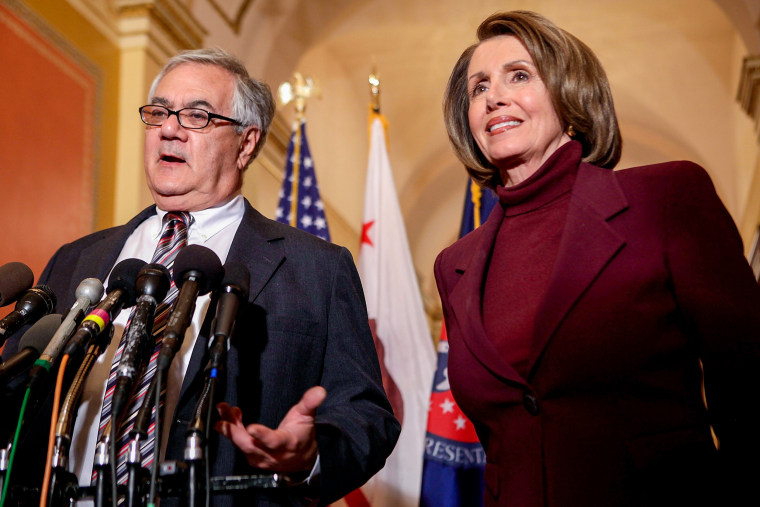
Barney Frank’s entry into politics began after he left Harvard. He took a position as chief of staff for Democratic Boston Mayor Kevin White from 1968 to 1971. This period was marked by significant racial unrest in the city. Later, Frank worked as a staff assistant in the office of Representative Michael F. Harrington, who represented Massachusetts’ 6th Congressional District.
In 1972, Frank began his electoral pursuits by winning a seat in the Massachusetts Legislature. He was re-elected three times, all while earning a J.D. from Harvard Law School. His next career step was an attempt to enter the U.S. House of Representatives. In 1980, he won a close race to represent Massachusetts’s 4th Congressional District with just under 52% of the vote. This narrow victory was not indicative of his future electoral performances, as he successfully secured re-election 15 times.
In 1987, during his fourth term, Frank became the first Congress member to voluntarily come out as gay, telling The Boston Globe, “If you ask the direct question: ‘Are you gay?’ the answer is yes. So what?” He added that hiding this aspect of his life would imply shame, which he did not feel, asserting that his private life was irrelevant to his job.
“I don’t think my sex life is relevant to my job, but on the other hand, I don’t want to leave the impression that I’m embarrassed about my life,” Frank told the Globe.
In 1989, Frank faced controversy over a relationship with a male sex worker, Steve Gobie, who was employed by Frank as a personal aide. Frank admitted to paying Gobie for sex but ended the employment after discovering Gobie operated a prostitution service from Frank’s apartment. As a result, the House reprimanded Frank in 1990 for using his influence to address Gobie’s parking tickets. Despite this, Frank maintained strong support from voters, winning re-election with 66% of the vote.
Throughout his tenure, Frank supported liberal causes such as abortion rights, environmental protections, anti-discrimination laws, and LGBTQ equality. He was a vocal proponent for repealing the “don’t ask, don’t tell” policy in the military.
Frank’s most significant legislative achievement was the Dodd–Frank Wall Street Reform and Consumer Protection Act. Co-authored with Senator Chris Dodd, this legislation aimed to stabilize financial markets and protect consumers following the 2008 crisis. President Obama signed the bill into law on July 10, 2010.
However, the Dodd-Frank Act faced criticism from both sides. Progressives argued it was not strict enough on banks, while Republicans and some business interests viewed it as burdensome.
Frank also took heat for supporting Fannie Mae and Freddie Mac in providing mortgages to low-income buyers, which some critics blame for the housing crisis.
In 2010, Frank encountered a challenging race against Republican tea party candidate Sean Bielat. He won with around 54% of the vote and chose not to run again in 2012. Joe Kennedy III, a Democrat, succeeded him.
Frank married Jim Ready in 2012, lightheartedly noting in an interview that marriage added a positive glow to his life without changing his day-to-day existence.
In 2015, Frank released an autobiography detailing his political experiences, “Frank: A Life in Politics from the Great Society to Same-Sex Marriage.” On the day same-sex marriage was legalized in all states, Frank simply tweeted, “#lovewins.”
Frank is survived by his husband Jim Ready, sister Ann Lewis, and brother David Frank.
Leave a Reply