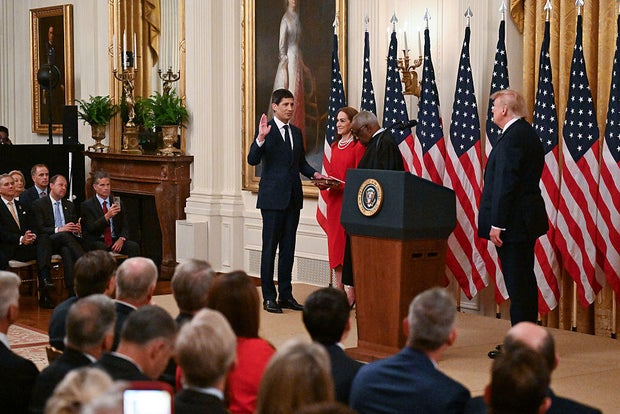
Kevin Warsh officially became the chairman of the Federal Reserve, succeeding Jerome Powell, after a swearing-in ceremony at the White House. Warsh assumed the role with the commitment to promote both price stability and maximum employment.
In his speech, Warsh emphasized the importance of approaching these aims with wisdom and clarity. He stated that when pursued effectively, they could lead to lower inflation, stronger economic growth, and higher real take-home pay. Additionally, Warsh spoke of America’s prosperity and security on the global stage.
“I’ve accepted a high and solemn responsibility,” Warsh declared. “I will lead a reform-oriented Federal Reserve, learning from past successes and mistakes, escaping static frameworks and models, and upholding clear standards of integrity and performance.”
President Trump, who introduced Warsh in the East Room, emphasized that he desires Warsh to act independently and perform excellently. The swearing-in was conducted by Justice Clarence Thomas, with Warsh taking the oath on a Bible held by his wife.
Trump expressed confidence in Warsh, stating that he would be regarded as one of the great chairmen of the Federal Reserve. He acknowledged Warsh’s unique abilities and widespread respect. The president has been vocal about his wish for rapid interest rate cuts to foster economic growth, but his remarks also suggested a balance between fighting inflation and encouraging economic progress.
Warsh has pledged to maintain the Fed’s independence regarding monetary policy. He has assured lawmakers that he will not allow the president’s requests to predetermine interest rates. Nevertheless, Warsh indicated openness to collaborating with the Trump administration on other issues, hinting at a possible “accord” between the Fed and the Treasury Department.
The direction Warsh will take concerning interest rate cuts remains uncertain. Decisions on monetary policy are made by a 12-member committee, and Warsh must convince them that reductions in rates are logical.
The economy presents a complex situation: inflation is above the Fed’s target amidst conflicts like the Iran war, while employment figures remain strong. The committee is divided, with some members favoring rate stability while others anticipate an increase if persistent inflation continues.
Financial markets also predict steady interest rates. Investors, monitored by CME Group’s FedWatch, foresee stable rates for upcoming meetings and a significant chance of increased rates by year-end.
Jerome Powell plans to stay on the Fed’s Board of Governors and contribute to decision-making until he believes the Justice Department investigation is conclusively resolved. Warsh, having had a hawkish approach previously, now advocates for lower rates, citing artificial intelligence as a factor to reduce inflation and enhance productivity.
Randall Kroszner, who worked with Warsh at the Fed, shared insights on his strategic thinking and consensus-building traits. He believes Warsh will remain resistant to short-term political pressures.
Kroszner, now a professor at the University of Chicago, stated, “Kevin is a long-run strategic thinker… You need to build consensus around things to be effective.”
This report includes contributions from Kathryn Watson.
Leave a Reply