Since the election of Barack Obama twice in the past, Iowa’s political landscape has shifted significantly, moving towards conservative inclinations. However, recent economic hardships and growing discontent with Trump-era policies have driven the state to reconsider its leadership choices.
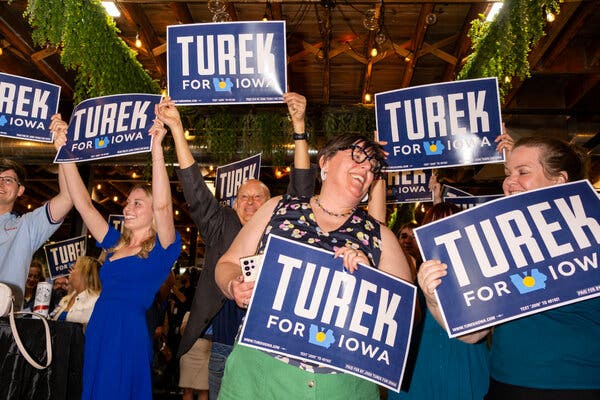
The Democratic nomination for the U.S. Senate in Iowa was secured by Josh Turek, a former Paralympian. His supporters gathered in Des Moines on election night, hopeful for a new direction. Confidence among Democrats is bolstered by the fact that Iowa, once a battleground during Obama’s successful campaigns, shows potential for political change due to current challenges.
There has been a significant absence of Democratic leadership in Iowa’s governorship since 2006. The last Democrat to hold a Senate seat was Tom Harkin, who retired in 2014, with current Republican control over all four of the state’s House seats. The combination of economic struggles, adverse consequences from Trump’s policies, and dissatisfaction with current state leaders revives the possibility for Democrats to reestablish influence in the state.
During the recent Democratic primary, voters selected Josh Turek, a moderate candidate, to run for Senate. Rob Sand, the sole Democrat in statewide office, was chosen to pursue the position of governor, aiming to succeed the retiring Kim Reynolds.
On the Republican side, internal divisions surfaced, as Trump’s endorsement of Representative Randy Feenstra was rejected. The nomination for governor was won by Zach Lahn, a businessman and farmer, following a contentious primary battle. These internal conflicts highlight the complexities within the state GOP.
Despite Iowa’s traditional conservative stance, marked by voting for Trump in three presidential elections and implementing policies on education, abortion, and transgender rights, there is an undeniable desire for change. The state’s economic downturn over the last two years has been exacerbated by Trump’s tariffs, increasing costs for agricultural essentials like tractors and fertilizers. The trade war critically affected Iowa’s soybean market due to strained relations with China. Additionally, tariffs on steel and aluminum have adversely impacted local manufacturers, compounding economic woes.
As Iowa grapples with these issues, the state emerges as a significant focus for future political shifts. Voters increasingly express their demand for change, motivating Democrats to challenge longstanding Republican dominance.
Leave a Reply