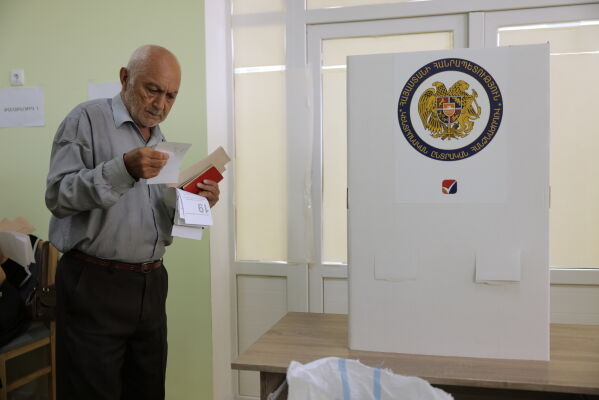
In a significant general election, Armenian Prime Minister Nikol Pashinyan declared victory with preliminary results showing his party, Civil Contract, leading with 49.82% of the vote. The election acts as a litmus test for Russia’s influence in Armenia, as Moscow’s presence looms large in the region.
Pashinyan seeks to align Armenia more closely with the West, with the European Union identified as a key partner. During the election, European observers noted that while the process was well-run, there were concerns over Russia’s potential interference. Pashinyan’s main opponent, Samvel Karapetyan, head of the Strong Armenia bloc, was the runner-up with 23.28% of the votes. Karapetyan’s arrest and the alleged politically motivated charges against him typify the tense political climate.
Armenian authorities issued arrest warrants for six members of the Strong Armenia party on allegations of vote-buying, adding to the electoral controversy. Though full results won’t be available until the following Sunday, initial counts indicate Pashinyan’s party can secure a majority in the National Assembly, allowing them to govern predominantly without coalition dependence.
Geopolitical Repercussions
The election holds broader geopolitical consequences. Russia exerts substantial control over Armenia’s energy and infrastructure, an influence reinforced by recent bans on Armenian imports, which the European Commission describes as ‘economic coercion.’ Moscow warns of economic repercussions should Armenia drift toward the EU.
Russia’s hold on Armenia is metaphorically underlined by Russian President Vladimir Putin’s stark remarks comparing Armenia’s situation to Ukraine, raising stakes for Pashinyan’s administration. Despite warnings, Pashinyan committed to ratifying a new peace deal with Azerbaijan, part of a broader vision to transform Armenia into a global crossroads.
Observers and International Reactions
International observers, including the Organization for Security and Cooperation in Europe, acknowledged the election’s integrity, noting genuine voter choice amidst heavy Russian influence and internal confrontations. Despite criticisms, Pashinyan’s government receives a significant mandate for their chosen trajectory.
Following the election, the EU extended congratulations to Pashinyan. European Commission President Ursula von der Leyen emphasized the deepening partnership between the EU and Armenia, heralding extended economic cooperation. Meanwhile, Russia’s Foreign Ministry criticized the socio-political pressures on the opposition and took note of Armenia’s internal divisions. Moscow indicated a willingness to work with Pashinyan’s administration, despite applying political pressure.
Leave a Reply