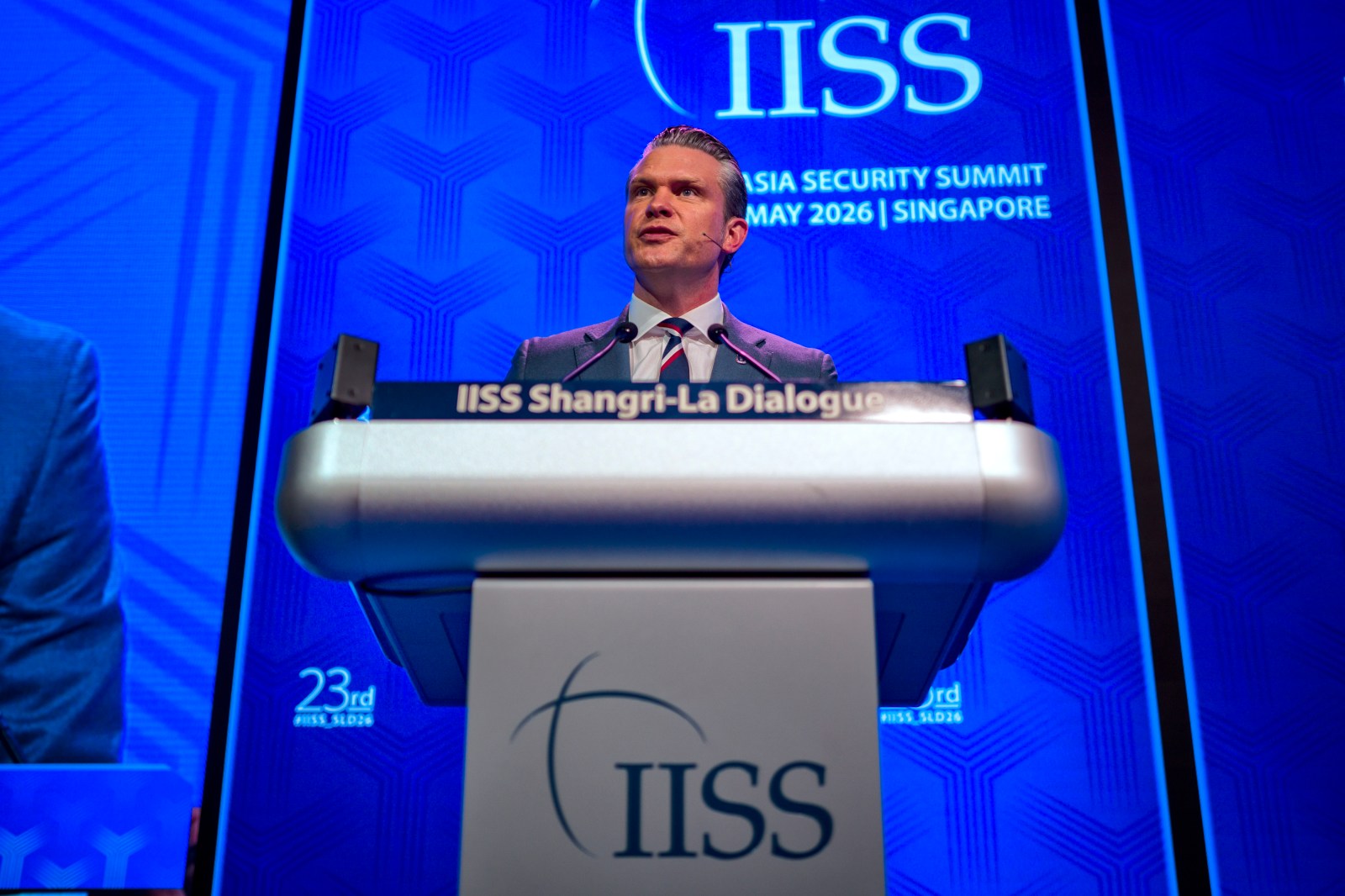
U.S. Secretary of Defense Pete Hegseth delivered a standard speech at the Shangri-La Dialogue, a key national security conference in East Asia, on May 30. While he mentioned the defense of the ‘First Island Chain,’ he did not directly address Taiwan. Taiwan remains a critical topic in the Indo-Pacific region.
In discussions with reporters after his speech, Hegseth noted, ‘We respect their ambitions,’ referring to China. This statement drew criticism because China’s ambitions include territorial expansion and control over international waters and airspace.
Hegseth’s remarks echoed President Donald Trump’s comments on Taiwan made during interviews with Fox News and other reporters. After a summit with China’s President Xi Jinping in Beijing, Trump’s references to Taiwan as a ‘good negotiating chip’ raised concerns about American credibility and regional stability.
Following the summit, China intensified military activities near Taiwan and Scarborough Shoal. The latter is a South China Sea feature claimed by China, despite protests from the Philippines.
American presidents have struggled to address China effectively, leading to regional worries about Chinese aggression. Japanese Defense Minister Shinjiro Koizumi took a bold step by publicly questioning Hegseth about the U.S. commitment to the region during the conference.
According to Lance Gatling of Nexial Research, Koizumi’s actions indicated a new approach by Japan’s conservative national security faction. This approach highlights Japan’s willingness to stand with Asian partners in obtaining clear commitments from the U.S.
Japan represents a positive trend in the region, working closely with the U.S. and other allies. Examples include the Japan-U.S.-Australia collaboration on weapons production, the AUKUS submarine partnership, and the Quad alliance involving Australia, Japan, the U.S., and India. New informal groups like JAROKUS and JAROPUS also show regional unity.
Furthermore, the Pentagon has engaged Indonesia as a new security partner. The U.S.-Indonesia defense pact aims to keep maritime routes like the Strait of Malacca open, deterring China’s expansionist actions.
James Fanell of the Geneva Centre for Security Policy points out Indonesia’s strategic importance, given the heavy maritime traffic through the Malacca Strait. He emphasizes that the U.S. offers a more reliable partnership than China, which seeks to claim Indonesian waters.
Taiwan is not formally part of regional alliances, yet its security is seen as essential by many nations. Last year, Japanese Prime Minister Sanae Takaichi warned that a Chinese attack on Taiwan would pose a vital threat under Japan’s 2015 security law, indicating Japan’s possible military response.
China reacted strongly to Takaichi’s statement, but she maintained her position, strengthening her political standing. Her example shows that smaller countries can push back against China’s influence.
Hegseth gave a reassuring response in Singapore, but there is a need for clear and strong words from President Trump. The region remains tense, expecting firm assurances from the U.S.
Gordon G. Chang, author of Plan Red: China’s Project to Destroy America and The Coming Collapse of China, emphasizes these points. Follow him on X at @GordonGChang.
Leave a Reply