Rachel Levasseur spent seven years searching for a treatment effective against her complex form of obsessive-compulsive disorder (OCD). This OCD manifests as an ongoing belief that she poses a threat to others. During this time, she attempted suicide multiple times.
Last year marked a turning point when Levasseur’s parents contacted Sheppard Pratt, a psychiatric hospital in Maryland. The hospital features a self-pay, residential treatment program named The Retreat. This program offers patients a personalized care team, including psychiatrists, therapists, and other providers.
After spending a year at the program, Levasseur, 24, showed noticeable improvement. She had not attempted suicide during her stay and had grown more social, showing willingness to engage in social activities like dinner and concerts.
However, her insurance provider, CareFirst BlueCross BlueShield, has only covered a small portion of her treatment costs. Her stay was prematurely ended in March as her parents could not continue to pay the nearly $3,000 daily fee.
“It’s just confusing how insurance can’t recognize that I am getting better finally,” Levasseur expressed. “They’re just focused on the money instead of my life.”
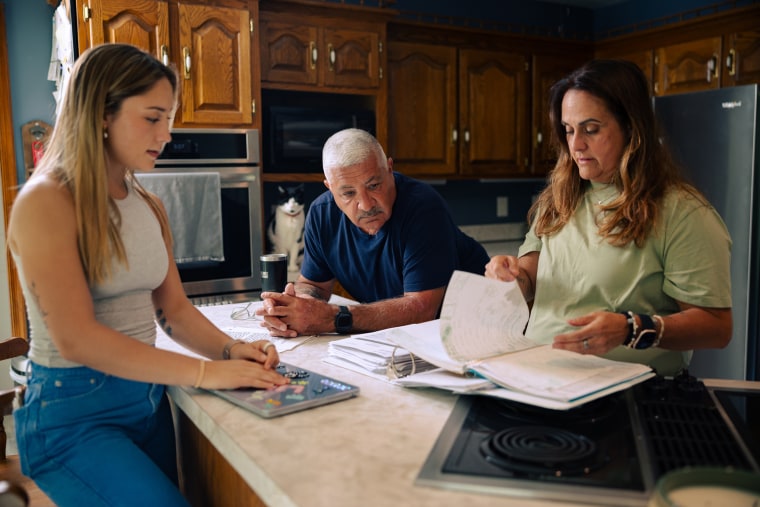
Ellie Levasseur assists her parents in addressing insurance claim issues regarding her sister’s treatment.
Levasseur’s parents, Larry and Kandy, state they owe roughly $1.3 million to the hospital despite taking out a second mortgage and using Larry’s retirement savings to cover the initial part of her treatment costs. NBC News could not independently verify this financial claim, which the Levasseurs received over the phone. CareFirst declined to comment on Levasseur’s case, and Sama Abduljawad from Sheppard Pratt cited privacy laws in not discussing The Retreat.
The Levasseurs point to Rachel’s journey as indicative of the struggle to access excellent mental health care covered by insurance, especially for complex cases. Over a third of psychologists polled by the American Psychological Association last year don’t accept insurance. Reasons include inadequate reimbursements and services denied by insurance.
The Levasseurs report Rachel’s condition is deteriorating outside of The Retreat. She is now in the hospital’s in-network inpatient unit, yet re-entry into The Retreat remains barred due to unresolved financial obligations.
Rachel’s OCD stems from childhood, marked by an intense fear of germs and illness. She frequently believes she has contracted a deadly infection, potentially transmitting it to others, which triggers suicidal thoughts. Compounding her OCD is autism spectrum disorder, making irrational thinking harder to counter.
Prior to entering The Retreat, Larry often monitored Rachel constantly, despite being a heavy sleeper, while Kandy frequently checked on her during the night.
“I truly believe that if Rachel wouldn’t have gone to The Retreat this last year, she would not be alive today,” stated Kandy.
The Levasseurs were aware the specialized program was out-of-network, but say CareFirst representatives suggested they might cover costs given Rachel’s lack of progress elsewhere over seven years.
In cases with no in-network providers available, CareFirst sometimes creates a single case agreement. This agreement permits application of in-network benefits to an out-of-network provider. Larry mentioned that multiple representatives implied if they could demonstrate exclusive care at The Retreat, the costs might be covered.
Ellie, Larry, and Kandy show tattoos symbolizing support for Rachel after her suicide attempts.
The Levasseurs wrote to CareFirst in early 2025, requesting reconsideration of funding for the program. At the time, CareFirst contributed $521 of the $3,300 daily treatment cost.
CareFirst rejected changing its contribution, pushing the Levasseurs to appeal to the Maryland Insurance Administration, then the Maryland Department of Budget and Management’s Employee Benefits Division.
In April, the Benefits Division informed the Levasseurs they had exhausted their options, stating the hospital “has not been willing to enter into a single case agreement.”
Sheppard Pratt’s Vice President, Bryan Mroz, later emailed in May that they “would be willing to enter into a single case agreement to address the current outstanding balance.”
The Employee Benefits Division reported communication between the Levasseurs and a substitute in-network facility, adding the state doesn’t negotiate with providers and isn’t part of Levasseur’s care team. However, the Levasseurs claim no contact occurred and request comparable in-network options from their insurance company yielded no results.
Rachel’s childhood bedroom serves as a testament to her hard work overcoming mental health obstacles. Her bathroom contains motivational collages, including one stating, “I’m so proud of you for still being alive, despite it all.”
From her bed hangs a newspaper saying, “The World is Not Better Without You.” Alongside is the suicide crisis lifeline number.
Larry and Kandy view addressing Rachel’s autism as pivotal to effective treatment. Dialectical behavior therapy, a common remedy for suicidal ideation, proved ineffective for Rachel.
The specialized program employed radically open dialectical behavior therapy, emphasizing vulnerable emotions and escaping rigid thinking. The approach, paired with a sensitive care team, contributed to her progress.
“When I got to The Retreat, it was different, because no one was giving up on me,” Rachel said. “It just felt like much more of a place where people were very focused on me getting better and I had a lot more of individualized support.”
Her treatment plan from last year noted, “It is possible she is finally in the appropriate setting she needs to be able to make sustainable progress.”
The Levasseurs argue that the long-term financial outcome for CareFirst might be beneficial. They claim The Retreat’s temporary coverage could reduce long-term costs as Rachel achieves recovery, diminishing her ongoing treatment needs.
“If they would just cover The Retreat for a time period enough for me to get better, then it would actually probably end up costing less, because then I could stop being in treatment,” Rachel shared.
If you or someone you know is experiencing a crisis, contact 988 or visit 988lifeline.org to connect to the 988 Suicide & Crisis Lifeline, or check SpeakingOfSuicide.com/resources.
Leave a Reply