Following the recent Los Angeles mayoral primary election, social media has been flooded with unsupported conspiracy theories about why Spencer Pratt, a reality TV personality, didn’t succeed in the race. One claim suggested that Pratt received zero votes during an update on election night. This was swiftly debunked by the U.S. attorney’s office. Now, a new story circulates, alleging that ballots from homeless individuals fraudulently affected Pratt’s loss.
Many spreading this narrative offer little or no evidence, relying instead on misinformation. A TikTok user, laneedsspencerpratt, shared videos where three identified Skid Row residents claimed they were paid a few dollars to vote for Mayor Karen Bass. Bass advanced to the runoff with Councilmember Nithya Raman after coming in first. As more votes were counted, Pratt, who initially led Raman, slipped to third place.
L.A. County election officials responded to these videos on X, asserting that there’s no proof that the woman voted for Bass for $5. Furthermore, the woman is registered to vote in Inglewood, a different city neighboring Los Angeles. Alex Stack, a Bass campaign spokesman, stated that the notion of paying for votes is “absurd” and aligned with the LA County Registrar’s denial of such actions.
Reporters from the Times visited the filming location of the TikTok videos, but couldn’t locate the individuals interviewed. Experts suggest that even isolated incidents wouldn’t alter the election’s outcome. Christopher R. Hallenbrook, an associate professor of political science at Cal State Dominguez Hills, emphasized that with over 750,000 votes, a few questionable votes weren’t enough to impact the results.
Rick Hasen, a professor and director of the Safeguarding Democracy Project at UCLA, stated that such cases warrant investigation. However, the idea that they affected the election’s outcome is far-fetched. He highlighted the impracticality and risk of paying large numbers of voters for such a purpose.
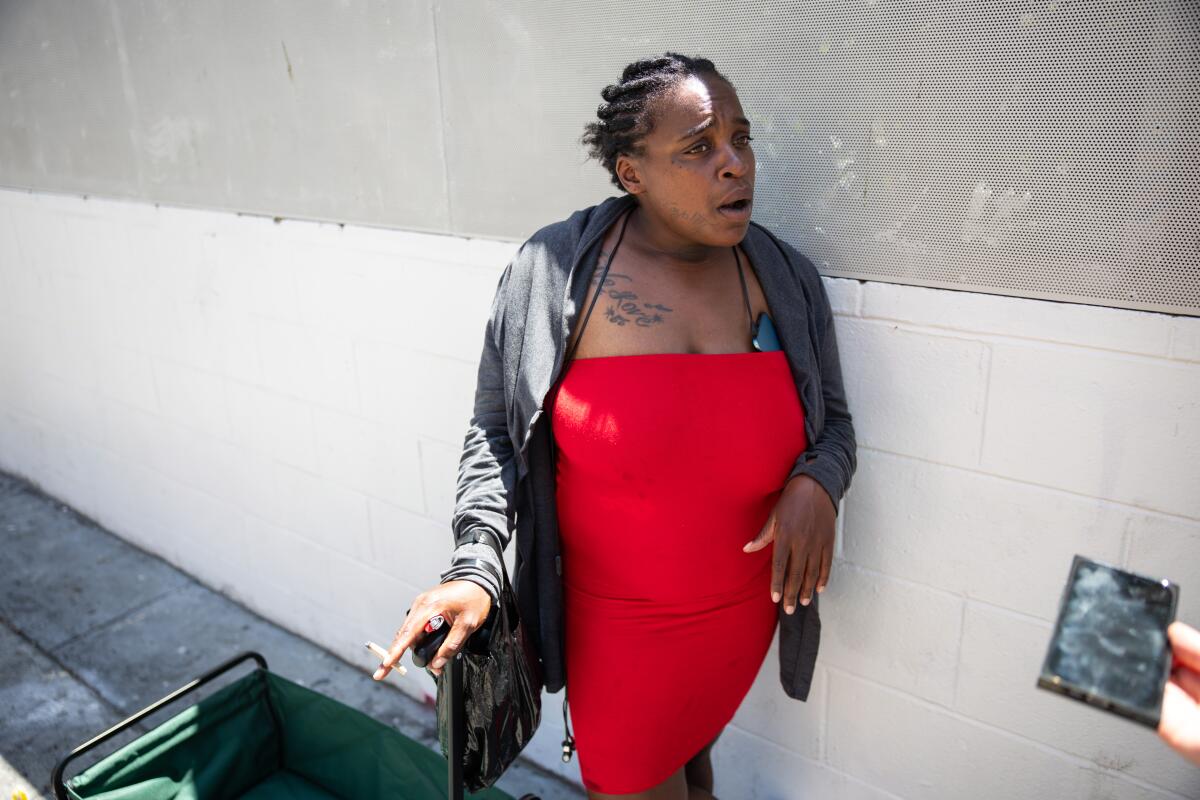
The simplest explanation for Pratt’s third-place finish, according to Hasen, is the limited number of Republicans in diversely Democratic Los Angeles. The Times interviewed 20 Skid Row residents about the election. None reported being offered money for votes, with many indicating they didn’t vote at all.
“They wouldn’t approach someone like me, I’d think they’re crazy,” said Kimberly, a Skid Row resident, reacting to the circulating stories.
Michele Brewster, a resident interviewed by the Times, stated that she witnessed neither candidates nor campaign efforts on Skid Row. Some interviewees mentioned seeing workers gather ballot petition signatures, offering cash incentives.
In May, the U.S. Justice Department announced that a Marina del Rey woman admitted to illegally paying Skid Row residents to register to vote for petition signatures. This was due to her earnings being tied to the number of signatures she collected. For those without an address, she allegedly used her former address to aid registration, raising concerns about mail-in ballots going to incorrect locations.
According to the L.A. County Registrar-Recorder/County Clerk, voter records are verified against U.S. Postal Service data. Incorrect matches render voters inactive, disallowing voting until corrected.
Benny Johnson, a conservative media personality, falsely claimed there was a scheme to withhold ballots for the chosen candidate’s benefit. His assertions about homeless individuals after preliminary map results also proved inaccurate as data was still incomplete. Spencer Pratt hinted that the homeless vote influenced the race outcome without presenting credible evidence.
The California Post reported that thousands registered at homeless shelters, prompting an investigation led by Bill Essayli of the U.S. attorney’s office. A spokesperson declined comment on this ongoing scrutiny.
Mike Sanchez, a county recorder’s office spokesman, advised against comparing shelter bed counts with voter registration, explaining that registration isn’t tied to a current residence. Unhoused voters receive mail through service providers or P.O. Boxes, maintaining voting rights despite housing status.
Rick Hasen emphasized the importance of outreach to register homeless individuals as voters as a positive development for democracy.
Times journalist Sandhya Kambhampati contributed to this report.
Leave a Reply