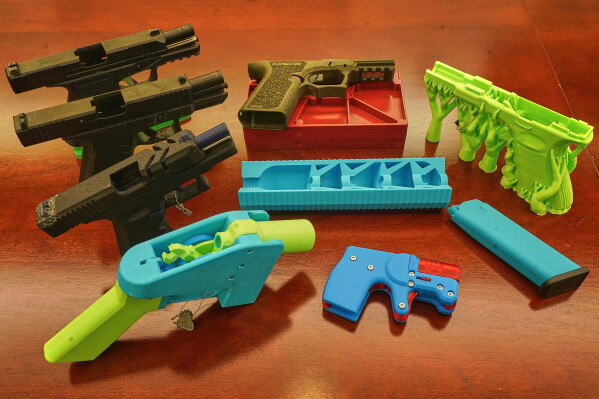
A groundbreaking law in New York mandates that 3D printers sold for home and business use include technology to block the creation of firearms. This measure, currently also being considered in California, seeks to prevent the production of untraceable ‘ghost guns’ commonly involved in criminal activities. Concerns remain regarding the efficacy of the technology and its implications for privacy and rights.
Efforts to Regulate 3D Printed Firearms
A third of U.S. states have already enacted laws to control homemade firearms lacking serial numbers, which bypass background checks. The distinctive approach of the new law targets the equipment used for manufacturing these weapons instead of the individuals creating them. By focusing on 3D printers, the initiative might set new industry standards and serve as a model for other states with rigorous gun regulations.
Rising Use of 3D Printed Guns in Crimes
Three-dimensional printing technology has proliferated over the last two decades. The number of 3D printers surged from 30,000 in 2012 to over 3 million today. The industry’s value rose from approximately $2 billion to $26 billion annually, according to Bill Decker, executive chairman of the Association of 3D Printing. While some high-end printers remain costly, many are now affordable, sometimes priced at only a few hundred dollars. These devices can produce toys, prosthetic limbs, airplane parts, and notably, components for firearms from digital designs accessible online.
The trend of privately made firearms, or ‘ghost guns,’ affected law enforcement as these weapons are difficult to trace. The U.S. Department of Justice reported a rise in the recovery of such firearms in crimes, from 1,600 in 2017 to nearly 27,500 in 2023. Notably, a case in New York involved a 3D-printed gun in the murder of UnitedHealthcare’s CEO in 2024.
Implementing Gun-Part Blocking Technology in 3D Printers
The New York law now requires experts to develop standards for detecting firearm blueprints through algorithms. This technology would examine designs submitted for 3D printing, compare them with a digital library of gun parts, and reject those that match. The implementation isn’t scheduled until 2029 in New York, contingent on feasibility assessments.
This approach resembles smartphone apps identifying flora by images, explained Solomon Diamond of Dartmouth College. Potentially, geometric analysis could assess shapes, dimensions, and structural features to filter firearm-related designs. Julian Chultarsky, from Physna, reassures that geometric search technology is capable and ready for this challenge.
Challenges and Concerns
Despite support from the Association of 3D Printing, skepticism remains. Bill Decker noted that determined individuals might still find ways to create guns, either by altering designs or moving operations. Rory Mir, from the Electronic Frontier Foundation, raised warnings about overly aggressive blocking technology misidentifying non-weapon items, causing privacy concerns for original designs reviewed by cloud-based AI.
Constitutional Concerns with Firearm Production
Safety advocates contend that 3D printing offers an illicit avenue for acquiring firearms, especially for individuals barred from legal purchases. Already, eleven states prohibit 3D-printed guns, and six more insist on serial numbers, reported Everytown for Gun Safety. Blocking 3D printing could enforce these prohibitions more strictly.
Mixed perspectives emerge, as handmade firearms have long been a cultural facet in America. John Commerford, from the NRA Institute for Legislative Action, criticized the new measures, arguing that they restrict law-abiding citizens while private firearm production remains a tradition since the nation’s founding.
Leave a Reply