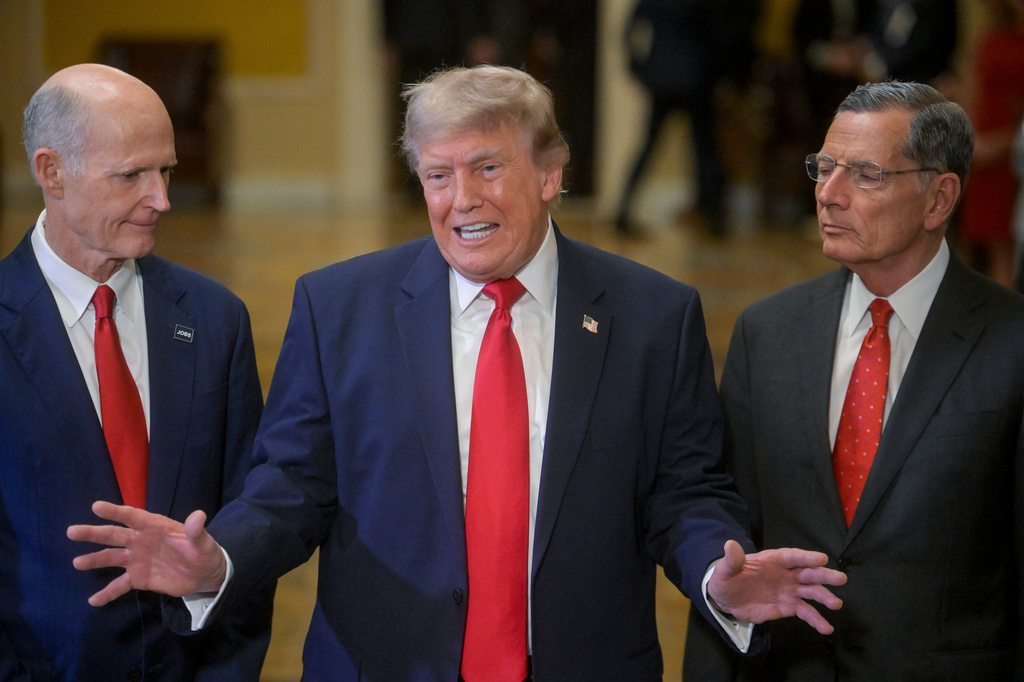
President Donald Trump recently found himself at the center of controversy after a heated exchange during a Senate Republican Conference lunch. The president criticized four GOP senators who supported a House resolution to limit future U.S. military actions in Iran. The resolution passed with a vote of 50-48, and Trump challenged its supporters, including Sens. Collins, Cassidy, Murkowski, and Paul.
Sen. Bill Cassidy, upset after losing his primary to a Trump-backed rival, confronted Trump. He questioned the president’s motivations and criticized the extended duration of U.S. military involvement in Iran, initially intended as a short-term mission. Cassidy’s outburst led to a loud dispute with Trump during the lunch.
The Trump administration argues that the war powers resolution contradicts the Supreme Court’s ruling in Immigration and Naturalization Service v. Chadha. This 1983 decision deemed any legislative measure required both houses’ approval and the president’s signature, striking down a one-house veto practice.
However, Congress has been cautious to revise similar laws, including the 1973 War Powers Resolution. The Supreme Court has traditionally avoided settling inter-branch disputes over foreign policy, labeling them as political questions beyond the court’s jurisdiction.
Following the tense meeting, Sen. Tim Kaine proposed a new joint resolution demanding the president’s approval to prevent further military action in Iran. Yet, this resolution failed to move forward when Cassidy and Paul changed their voting positions, resulting in a 47-50 vote.
Simultaneously, the Senate faced pressure from Trump to pass immediate election law changes under the SAVE America Act. He promised to consider a bipartisan housing bill if the election changes passed. Tensions led to an early adjournment without securing enough votes for the election changes.
The president’s tactic of withholding nominations and legislation until Congress addresses his priorities has disrupted Senate schedules. His actions have been compared to the 1941 film “The Man Who Came to Dinner,” highlighting the challenges Congress faces with his demands.
Don Wolfensberger, a former congressional staff veteran, reflects on these events. He emphasizes the complexities in congressional operations and the impact of Trump’s interventions. He is known for his works on congressional dynamics and legislative procedures.
Leave a Reply