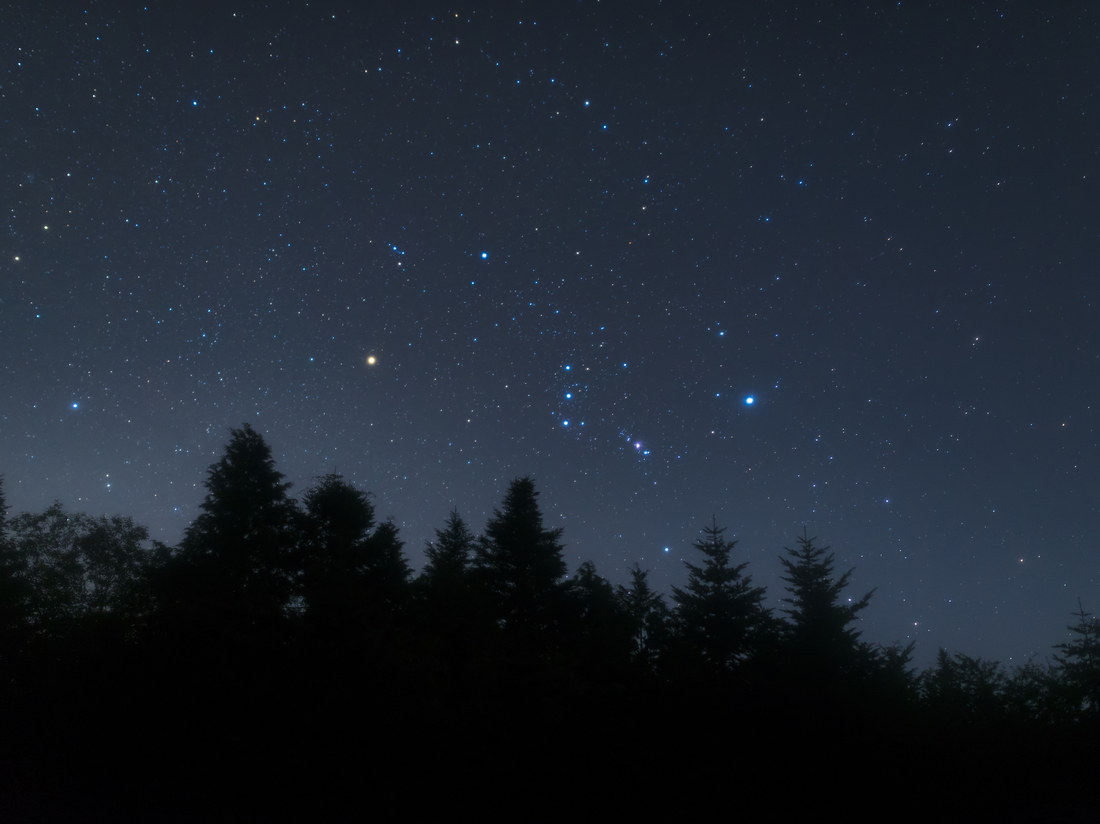
As night falls during winter in the northern hemisphere, a glance toward the eastern horizon reveals the constellation of Orion. In Greek mythology, Orion is a mythic hunter. One legend recounts his banishment to the sky for his boastfulness about his hunting prowess. Forever, he and his two dogs pursue Taurus the bull and the Pleiades sisters, never to catch them. Another tale describes Artemis mistakenly killing Orion with an arrow and setting his image among the stars.
Recognizing Orion in the sky is easy. Look for the three aligned stars that form the hunter’s belt. Astrophysicist Sarafina El-Badry Nance is particularly intrigued by Betelgeuse, a red supergiant forming Orion’s left shoulder. This star nears the end of its life and is approaching a supernova phase. But what journey did Betelgeuse, like any other star, take to reach this point?
The Birth of a Star
Stars originate within dust clouds dispersed across galaxies. El-Badry Nance explains that gravity pulls these regions of gas and dust together. The increasing density and pressure lead to their collapse, forming a protostar, an early stage in a star’s life.
As time passes, protostars commence the fusion of hydrogen into helium at their cores. This process releases energy, preventing the star from collapsing on itself. The energy radiates as light, visible to us as starlight or, in the case of our sun, sunlight. Stars spend most of their existence in the middle stage of their life cycle. For instance, the sun is a stable, middle-aged star with about five billion more years of hydrogen fusion ahead.
The Demise of a Star
When a star exhausts its hydrogen fuel, its core collapses, marking the beginning of its end. The outer layers expand and cool, transforming the star into a bloated form. Betelgeuse exemplifies such a life stage. Its massive size foreshadows a dramatic end as it eventually explodes in a supernova.
While the exact timing of Betelgeuse’s explosion remains unknown, it will be visibly spectacular from Earth. As we ponder the lives and deaths of stars, El-Badry Nance emphasizes the lessons they offer. She notes, “First and foremost: Everything changes. Right? There’s nothing static in the universe. Even though it might feel that way because those timescales are so much longer than our own.” This process reflects our journeys through turbulence and beauty.
If you have an interest in the night sky, reach out via email at [email protected]. Tune into Short Wave on Spotify, Apple Podcasts, and Google Podcasts for more insights. Today’s episode was produced by Rachel Carlson, edited by Rebecca Ramirez. Brit Hanson verified the facts, and Ko Takasugi-Czernowin handled audio engineering.
Leave a Reply