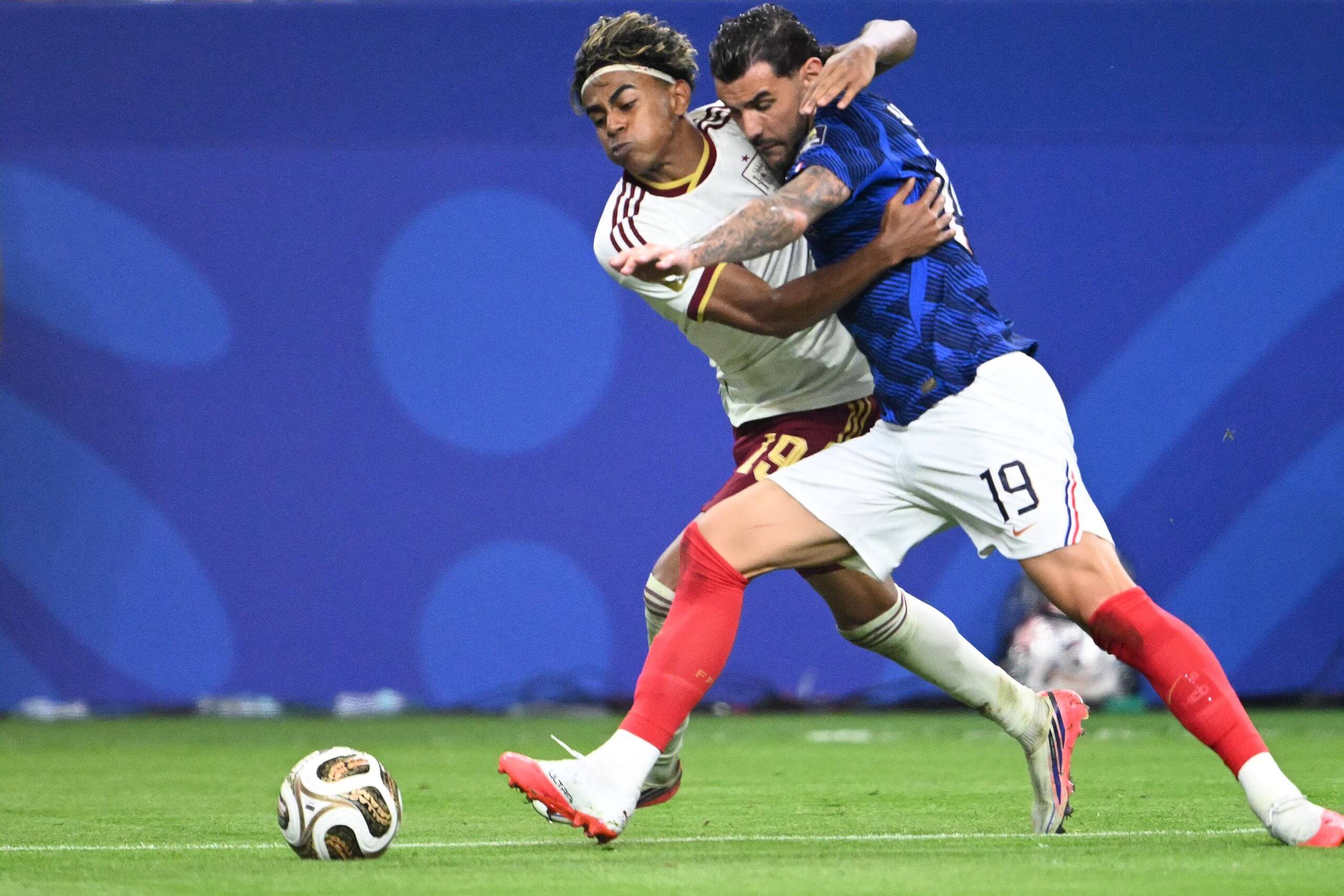
By the end of the match, Kylian Mbappe, a standout performer in the tournament, showed evident frustration. He had already received a booking for a challenge on the Spanish goalkeeper Unai Simon and then failed to capitalize on a free-kick opportunity.
In the World Cup semi-final, Real Madrid’s Mbappe, renowned as the second highest World Cup goalscorer of all time, did not deliver. Ousmane Dembele, Paris Saint-Germain’s Ballon d’Or winner, also failed to make an impact. Likewise, Bayern Munich’s Michael Olise, known for orchestrating goals throughout the season, did not shine. When France relied on their key players Desire Doue from PSG and Rayan Cherki from Manchester City, they found no success either.
Post-match, the performance of French coach Didier Deschamps and his star-studded squad will undoubtedly face scrutiny. Rayan Cherki acknowledged that France “lost against ourselves.”
This result was neither accidental nor due to defensive tactics. Spain did not rely on saves from goalkeeper Unai Simon, nor did they employ defensive measures to frustrate France. Spain enjoyed more possession, executed more passes, and matched the opponent in shots.
A realistic French evaluation must acknowledge the brilliance of the Spanish team, which delivered one of the most exceptional collective performances in World Cup history.
Many observers, including many analysts, believed France was the most impressive side during the group stages and early knockout rounds. Yet, within the Spanish camp, a strong determination prevailed. Lamine Yamal, one of Spain’s young stars, just celebrated his 19th birthday, maintained throughout the week that the French should be concerned instead of the Spanish.
Yamal demonstrated practicality when he spent his birthday engaging in training, attending a press conference, and engaging in personal time away from football activities.
“There are much harder things in life than a football match,” Yamal said. “It’s a game, I know what I’m capable of and I’m not worried about anything.”
The Spanish team’s confidence was backed by results. Spain won the UEFA Nations League in 2023, reached the finals in 2025, and clinched the Euros in between. During this stretch, they defeated top teams like Italy, England, Germany, Norway, Portugal, Belgium, and France, not once but thrice. They maintained a 37-match unbeaten streak, the longest in men’s international history, according to Opta’s statistics, which exclude a penalty shootout loss against Portugal in the Nations League in 2025. Deschamps could hardly claim ignorance about Spain’s capabilities.
France’s approach to the tournament seemed unchanged from previous matches, which may have led them to underestimating Spain. Spain had a distinct strategy aimed at countering French strengths while exploiting weaknesses. Although Yamal was not at his sharpest, his presence significantly influenced the game.
Spain identified Lucas Digne as France’s vulnerable spot. Yamal’s anticipation forced a foul from Digne, earning Spain a penalty that shaped the match dynamics. Exhausted, Digne was replaced by Theo Hernandez.
By age 20, Yamal will have experienced a European Championship final — a victory for Spain against England in 2024 — and now approaches a World Cup final scheduled for Sunday at MetLife Stadium.
Spain excelled in individual matchups across the field. Michael Olise, usually influential, was neutralized by the disciplined positioning of Rodri and Fabian Ruiz. With Olise subdued, Dembele and Mbappe struggled to receive effective service. France’s midfield appeared understaffed, hampering play development and defensive efforts. Adrien Rabiot, a dependable member of Deschamps’ team, committed two late-game challenges in the first half, earning a booking and narrowly escaping a second, which led to his exclusion in the second half.
Spain’s coach Luis de la Fuente astutely leveraged the matchup imbalance. He exploited the French formation by employing Spain’s midfield prowess. Rodri, once a Ballon d’Or winner, had regained form after recovering from a severe knee injury. He excelled at the base of Spain’s midfield, suppressing French attacks and facilitating play. De la Fuente praised Rodri as Spain’s backbone.
“I said a long time ago that questioning him was insulting intelligence,” De la Fuente stated. “Time showed us right. He’s an ideal player for this football idea that we have.”
Spain exhibited discipline, organization, and commitment, excelling in various game facets. According to De la Fuente, Spanish players succeed in interpreting defensive phases, a trait honed through coaching at youth levels.
Though Spain boasts exceptional players, they hadn’t captivated global audiences throughout the month. Apart from Yamal, few were celebrated as icons or preferred for merchandise marketing.
Spain struggled at times but consistently rose to challenges. Late goals were required against Portugal in the round of 16 and Belgium in the quarter-final. Initially perceived as a sign of vulnerability, these late-stage victories demonstrated Spain’s resilience and refusal to concede.
De la Fuente emphasized the significance of selecting suitable companions during the extended World Cup journey, remarking on the exemplary attitude within the camp both on and off the pitch.
Spain’s semi-final performance showcased unmatched cohesion. France struggled, failing to register a shot on target until the 82nd minute. Some players outshone their club performance. Pedro Porro, who had struggled at Tottenham, was celebrated in Dallas for an outstanding display, earning man-of-the-match recognition and sealing Spain’s second goal. Aymeric Laporte, solid in defense, recently returned to Athletic Bilbao after a stint in Saudi Arabia. Pau Cubarsi, at age 19, confirmed his status as a promising central defender, exhibiting skill against Mbappe. Dani Olmo contributed guile and finesse, aiding Spain’s second goal with an exceptional flick.
Spain reminded the audience that tournaments might favor the most robust defense over a potent attack, and it’s coherence over fleeting brilliance that prevails.
“This team interprets to perfection every single game,” De la Fuente conveyed. “That’s the key. When we play like a team, we’re unbeatable.”
In 2010, Spain won their only World Cup, conceding only two goals. In the 2012 Euros, they conceded just once. In the current World Cup, Spain allowed only one goal, this time against Belgium.
As the final moments passed, cameras captured Spanish legends: Iker Casillas, Carles Puyol, Sergio Ramos, and Xavi in the stands, witnessing Spain solidify their legacy of both style and substance.
Leave a Reply