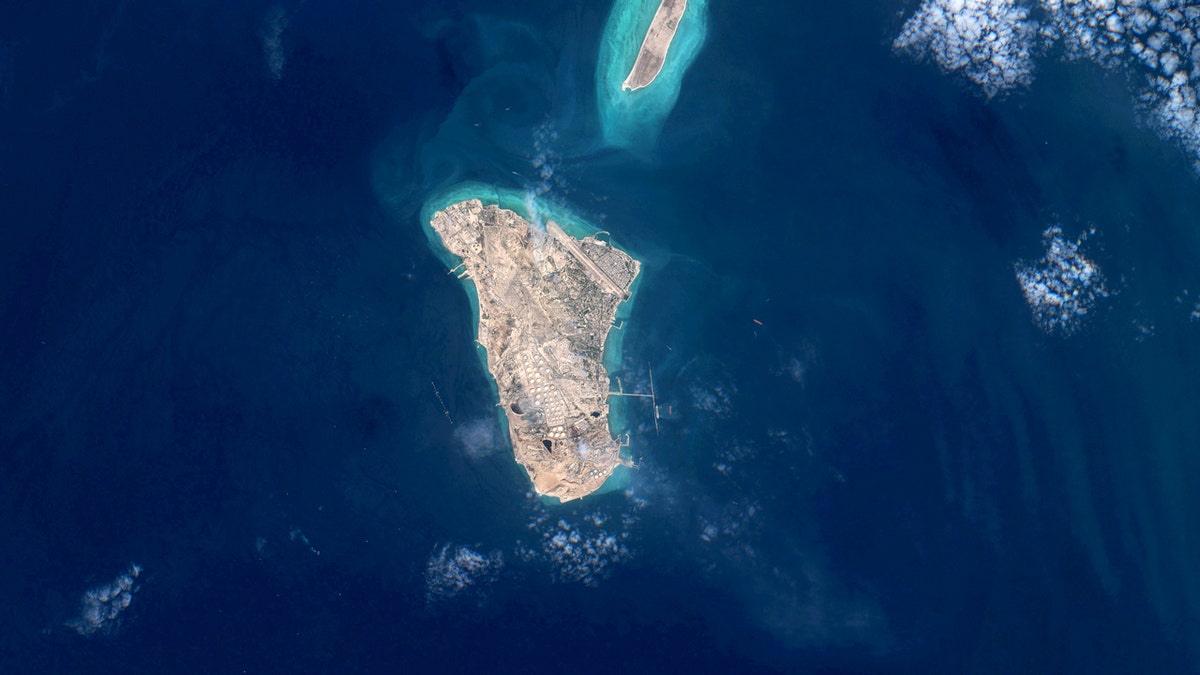
Hundreds of U.S. Marines would land as helicopters roar above, while Navy warships and fighter jets secure air and sea dominance. Commanders would warn Iranian forces to surrender or face being overrun. This scenario depicts the early moments of a possible U.S. mission to seize Iran’s Kharg Island. The island is key to Iran, handling nearly 90% of its crude oil exports. It stands central in Washington’s economic pressure on Tehran.
This potential operation gained attention when President Donald Trump was asked about seizing Kharg Island. Trump declined to rule it out, mentioning that U.S. strikes had spared the island’s oil facilities to protect a part of the global economy.
There are many ways to approach this,said Vice Adm. (Ret.) Robert Harward. He explained that a Marine Expeditionary Unit could conduct an amphibious assault, with U.S. naval and air forces controlling the area. Iranian defenders would have a chance to surrender before intense combat.
The aim would be to take the island and keep the oil infrastructure intact for a future government in Iran. Harward highlighted the importance of minimizing risk to both U.S. forces and the local population while preserving facilities for a government that supports its people instead of promoting the Islamic Revolution.
Trump echoed Harward’s view, stressing the importance of safeguarding Kharg’s oil facilities.
The island’s location, just 16 miles from Iran’s Gulf coast, keeps it within reach of Iranian missiles and drones. Military experts note that while U.S. forces could capture the island quickly, defending it would mean a larger military commitment, elevating the risk of direct conflict with Iran.
Kharg’s strategic importance is longstanding. British forces once occupied it to pressure Persia. Iran later selected it as a deep-water oil terminal. The island, developed in the late 1950s, became the main outlet for Iranian crude.
Nicholas Carl from the American Enterprise Institute noted Iran’s long investment in denial capabilities to keep away U.S. forces. These include anti-ship cruise missiles, drones, naval mines, and fast attack craft.
Harward, involved with the Jewish Institute for National Security of America’s Iran Policy Project, acknowledged the threat of missiles and drones from Iran’s mainland. The primary concern is their launch with U.S. forces present on the island.
He pointed out the attack’s consequence, stating that if Iran strikes Kharg, they risk damaging their own economic lifeline.
This situation underscores the challenge of tactical versus strategic success. Taking an island is one challenge; defending it against sustained assaults from nearby Iran is another.
Harward suggested Washington has options beyond an amphibious assault. Reinforcing the U.S.-led blockade presents one such option. Additional economic measures could target land routes and air traffic, which could pressure Iran without deploying troops.
Strategists question Kharg’s military value, arguing that capturing smaller islands near the Strait of Hormuz could pose significant strategic difficulties for Tehran.
Harward emphasized the broader issue of stability in the region. Long-term stability, he argued, requires a government in Iran focused on its people and not the Islamic Revolution.
Military planners agree on one point: taking Iran’s economic lifeline could happen swiftly, but holding it and managing the regional response would be complicated and prolonged.
Leave a Reply