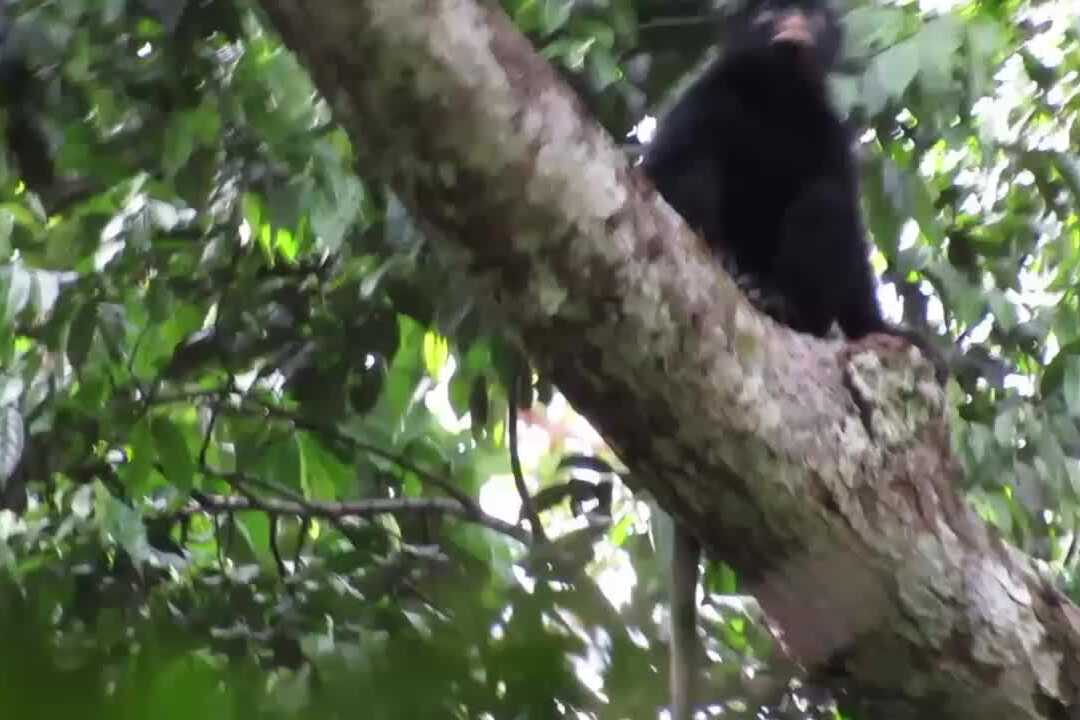
A notable discovery emerged from the remote forests of the Democratic Republic of Congo, unveiling a new species of monkey called Colobus congoensis. Locally known as Likweli, this primate is marked by its deep, resonant calls akin to other Colobus species.
Despite being initially captured in a blurry photograph from nearly two decades ago, this species has now been identified as the fifth new African monkey recognized in the last 75 years. The photograph, taken in 2008 by researchers from the Lukuru Wildlife Research Foundation, showed the monkey in the treetops of a forest area, now part of Lomami National Park. Due to the unclear image, it did not garner much attention at the time.
A breakthrough came a decade later when a field team captured clearer images of a medium-sized monkey with distinct shaggy black hair and an orange patch around its nose and mouth. These photographs, shared with Junior D. Amboko, a Ph.D. student at Florida Atlantic University, and John Hart, the scientific director of the Lukuru Wildlife Research Foundation, indicated that it was a previously unknown species in that region.
To investigate further, the scientists established a project, partially funded by the National Geographic Society, to locate and study the new primate. From 2018 to 2022, they conducted extensive surveys across Lomami National Park and neighboring areas, observing treetops, recording monkey calls at dawn, and interacting with residents from 52 nearby villages.
Villagers from eight areas recognized the distinct orange-mouthed monkey, particularly among the Balanga ethnic group, who referred to it as Likweli. The research concluded that the Likweli monkey inhabits a limited region in northeastern Congo, within a forest roughly half the size of Rhode Island. This restricted habitat explains its obscurity, even among local inhabitants. Additionally, the monkeys exhibit a tendency to be reticent, which further contributed to their limited recognition.
Leave a Reply