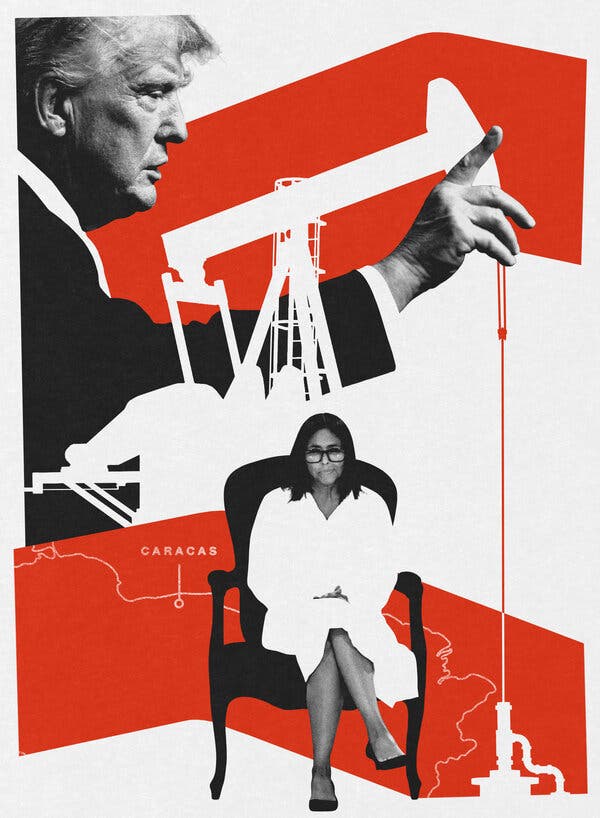
Since the U.S. Special Forces captured President Nicolás Maduro of Venezuela in January, a continual influx of American officials and oil executives has been seen in Caracas. Their mission mirrors the actions of colonial administrators and businesspeople from past generations, exercising influence over another nation.
As highlighted by The Times, Secretary of State Marco Rubio plays a pivotal role in guiding Venezuela’s Acting President, Delcy Rodríguez. He engages with her through text messages, overseeing her government’s access to oil revenues. Rodríguez brings potential hires to Rubio’s attention, and he recommends which Maduro loyalists should be removed from power. With Rubio’s assistance, Rodríguez has allowed U.S. companies entry into Venezuela. The Trump administration cautions that discussions of democratic elections must be deferred until there’s stabilization in Venezuela’s energy sector and economic recovery.
This relationship, marked by imbalance, has led some observers to use outdated yet evocative terms. Venezuela has been labeled as President Trump’s “puppet regime,” “colony,” and an American protectorate or client state. Economist Carlos Mendoza Potellá, a former advisor to the Venezuelan central bank, argues that Venezuela has given up its national sovereignty. “We are not a nation anymore,” he states. “We are a territory with administrators from abroad making decisions. Who decides? Emperor Trump, with his proconsul Marco Rubio.”
Despite these descriptors, Venezuela’s situation remains unique. Legally, it maintains its government, defined territory, stable population, and capacity to engage with other countries. These are the prerequisites for statehood detailed in the 1933 Montevideo Convention. There’s no established U.S. military presence though around 900 American troops assist with earthquake recovery efforts.
However, the autonomy of the Rodríguez administration is questionable. “This is not an occupied nation,” notes Javier Corrales, political scientist at Amherst College, “but it is a nation that has essentially surrendered a lot of its economic assets to the United States.” The question emerges: Is Venezuela a sovereign nation, a U.S. territory, or something in between?
The U.S. involvement in Venezuela symbolizes modern imperial dynamics, wherein formal occupations are seen as unnecessary, cumbersome, costly, and illegal for powerful states. Wars in Iraq and Afghanistan showcased that “the costs of occupation have soared,” according to Tom Long, an international relations professor at the University of Warwick. Consequently, major nations have devised methods to exert control over other states without overtly laying claim to them.
Sovereignty, once viewed as an indivisible asset, is now perceived as a “bundle of rights” that can be divided, delegated, acquired, captured, and transferred. Many small states entrust governance elements to foreign powers and international organizations. A British firm handled customs operations in Angola and Mozambique. Australia temporarily managed policing in the Solomon Islands. Numerous states have requested U.N. or I.M.F. supervision over security, taxation, and electoral processes due to weak domestic governance. China’s Belt and Road Initiative extends Beijing’s influence over several countries. Joining the European Union led European nations to sacrifice some national sovereignty elements.
Leave a Reply