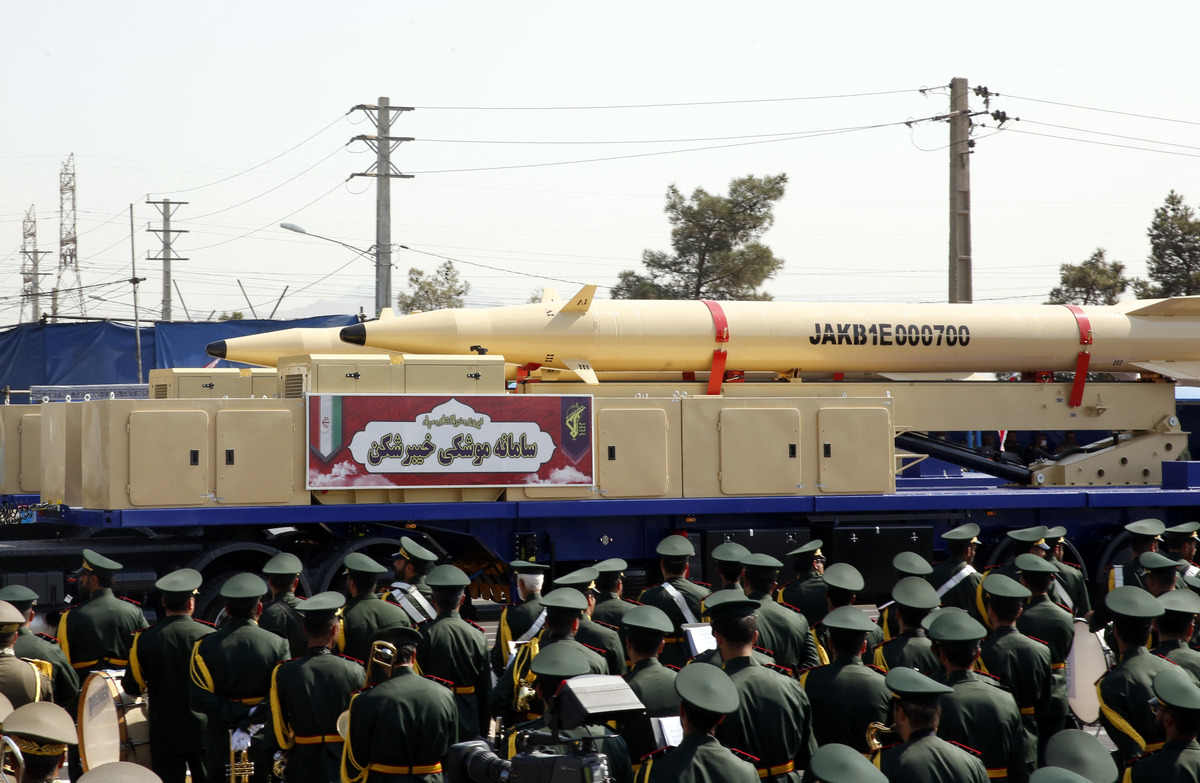
Iran has modified its military tactics by employing Kheibar Shekan ballistic missiles to target U.S. bases throughout the Middle East. This change includes altering flight paths, speeds, and mid-air maneuvers to bypass American air defenses. These details were shared by unnamed U.S. officials with The Wall Street Journal in an article published on Saturday.
Since the beginning of July, Tehran has initiated waves of missile attacks on American installations in at least five Middle Eastern countries. These events have challenged a fragile ceasefire established in June. As a result, consecutive nights of operations occurred before the area experienced a temporary lull.
President Donald Trump stated on Friday that negotiations with Iran are ongoing, while keeping military action as a possible option. The U.S. paused its strikes on Iran for a second consecutive day on Sunday. Simultaneously, Iran’s army spokesperson announced on state TV that it had also paused its attacks.
Tehran’s recent escalation followed a strike on Muwaffaq Salti Air Base in Jordan, resulting in the death of three U.S. servicemen: 1st Lieutenant Tyler James Feehan, Private Isabella Gonzales, and Sergeant Angel Rampersad. In Iraq, Sergeant Michael Emmanuel Swinton was killed by a drone at Erbil Air Base. These incidents bring the total number of U.S. personnel killed in the conflict to 18. Recently, Iran targeted U.S. facilities in Kuwait, Bahrain, and Qatar.
Overview of the Kheibar Shekan
First introduced in 2022, the intermediate-range ballistic missile boasts an estimated range of about 900 miles. This range allows it to reach the entire Middle East, parts of Russia, India, and NATO member Turkey.
The missile’s solid-fuel design, fired from mobile ground launchers, offers significant advantages. It reduces preparation and launch times, limiting opportunities for opposing forces to attack launch sites. The missile is named after the Battle of Khaybar, where Prophet Muhammad’s forces conquered the fortified oasis of Khaybar, held at that time by Arabian Jews.
Weighing less than previous models to enhance travel distance, the Kheibar Shekan is part of Iran’s solid-fueled arsenal, including the short-range Zolfaghar and the medium-range Fattah-1. State media claims Fattah-1 is a hypersonic weapon capable of speeds exceeding five times the speed of sound.
Why the Missile Draws Attention
The evolution of Iran’s tactical strategy includes integrating Kheibar Shekan missiles with jet-powered drones. These adaptations underscore concerns about defense capabilities.
Tehran has not published official cost figures for the missiles. However, assessments suggest they are substantially cheaper than the interceptors used by the U.S. and allies, which range from several million to $15 million each. Defense analysts highlight sustainability challenges posed by continually expending expensive interceptors against less costly missiles.
Nicole Grajewski, an expert on Iranian strategy at Sciences Po in Paris, noted, “The Iranians kind of figured out that the Kheibar Shekans are advantageous due to their cost-effectiveness, flexible launch options, and efficiency.”
Meanwhile, Ukrainian President Volodymyr Zelensky asserted on Saturday that Russia utilized satellites for reconnaissance on U.S. bases in the Gulf and shared intelligence with Iran. “There is a clear correlation between Russia’s satellite imagery of these sites and Iranian strikes,” Zelensky stated, pointing out Russian satellites’ observation of airbases in Bahrain, Jordan, and Kuwait between July 19 and July 20.
Challenges in Intercepting the Missiles
While U.S. and allied forces have successfully intercepted most Kheibar Shekan missiles since the conflict’s onset on February 28, there have been failures. Fabian Hinz, an independent missile expert, explained that Iran has identified effective maneuvers to overcome missile defenses through experience.
Ballistic missiles pose interception difficulties due to unpredictable trajectories, coupled with high and rapid travel. The Kheibar Shekan’s reentry vehicle, carrying the warhead back into the atmosphere, maneuvers to evade air defenses.
Success may arise from overwhelming defense systems with sheer volume rather than precision or advanced technology. “The Iranians use simple missiles to distract the radar,” stated Qasid Mahmoud, retired lieutenant general and former deputy chief of staff for the Jordanian military.
“They then fire superior missiles, altering their final target within the last 30 or 40 kilometers,” making interception challenging, he added.
Leave a Reply