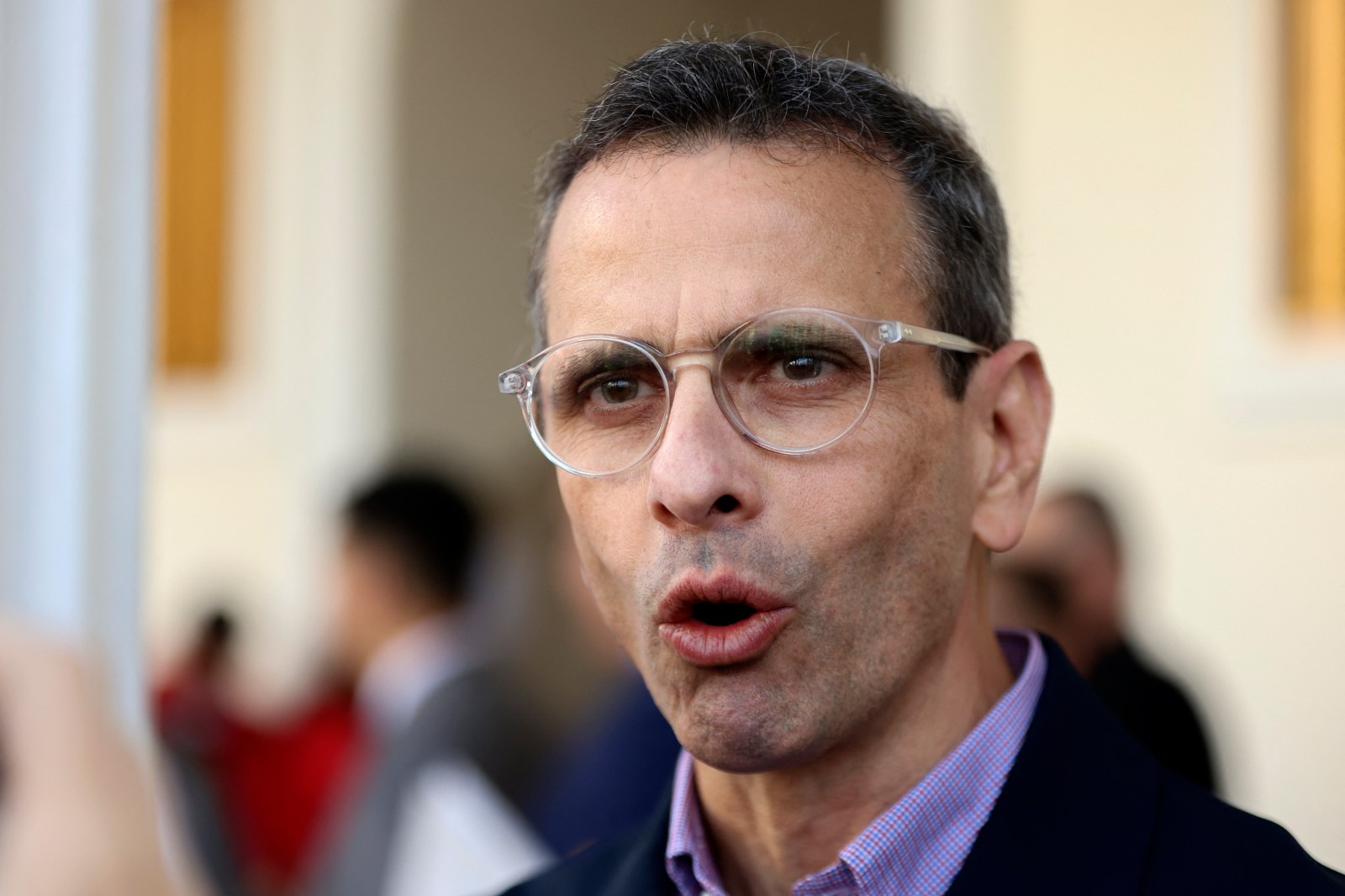
Henrique Capriles, a prominent Venezuelan opposition leader, has approached the political dynamics between Venezuela and the United States with a discerning eye. Having contested the presidency twice, Capriles closely analyzes Washington’s actions during the transition period led by the interim government.
Throughout the transition engineered by the United States, Capriles noted the disparity between President Trump’s public statements and subsequent presidential actions. He expressed skepticism in accepting Trump’s words as definitive. Capriles commented, “I don’t take them as some kind of definitive sentence, because we’ve seen many statements from President Trump, and three days later it’s something else.”
The stark contrast in rhetoric was evident following the January 3 operation which led to President Nicolas Maduro’s capture. Initially, Trump threatened severe consequences for interim Venezuelan President Delcy Rodríguez if she failed to comply, a tone that later shifted to praise, highlighting her performance and the relationship benefits of Venezuelan crude supplying American refineries.
A Gamble That Paid Off
Operation Absolute Resolve involved the U.S. Special Forces capturing Maduro and his wife from a compound in Caracas, concluding months of military pressure framed as an anti-narcotics campaign. “Venezuelans give President Trump credit for taking out Maduro. The truth is, with elections we couldn’t get rid of Maduro,” Capriles noted. Trump’s initiative changed the game.
Maduro was extradited to New York, and he, along with his wife Cilia Flores, pleaded not guilty to charges including narco-terrorism conspiracy. The trial is scheduled for June 1, 2027.
Capriles believes that if Maduro had respected the 2024 election results where Edmundo González triumphed, such drastic intervention might have been avoided. According to Capriles, allowing González to assume the presidency would have fostered different international relations.
The Sovereignty Question
The U.S. involvement raised inquiries regarding Venezuelan sovereignty. Criticisms emerged from various corners including Colombian President Gustavo Petro, highlighting the regional implications and potential humanitarian crises.
A New York Times investigation revealed Marco Rubio’s considerable influence in Venezuela, describing him as the “viceroy” who even weighed in on personnel decisions. However, Capriles refutes claims of surrendering sovereignty, seeing it as a temporary situation Venezuela needs to navigate carefully.
The Economic Angle
The transitional arrangement has yielded significant U.S. revenue from Venezuelan oil sales, estimated at over $13 billion. Yet, merely $300 million has been publicly documented reaching Venezuela. Capriles acknowledged the arrangement’s economic facets but argued the broader scope is crucial, advocating for democratic values and fair elections.
Capriles asserted, “It’s true that the United States has economic interests. But I believe there is, or should be, awareness in Washington that democracy is very important in Venezuela, that voting is part of democracy.”
The Three-Phase Plan
Rubio’s three-phase strategy—stabilization, recovery, and transition—forms the framework for Venezuela’s political progress. Despite opposition rifts and discontent over the planned talks, Capriles emphasized the necessity of including various opposition voices, asserting Machado’s importance in productive dialogue.
An Earthquake Complicates Recovery
Natural disasters have tested the transition’s resilience. Two massive earthquakes in June, causing more than 5,000 fatalities, hit Venezuela during its economic stabilization efforts. The devastation introduced further uncertainty regarding reconstruction timelines.
Capriles remarked, “There was a great economic expectation, and then came this disaster, these two earthquakes.” As emergency funds remain insufficient, the recovery costs seem daunting for a plummeting economy.
Looking Forward
Despite challenges, Capriles perceives a shift in social dynamics post-earthquake, reducing political polarization. Accountability alongside establishing firm institutions will serve as the bedrock for averting past mistakes.
Capriles concluded, “Justice is not revenge. If Venezuela has a strong and independent judicial system, then whoever thinks the plan is simply to change the color of the shirt and do the same thing Chavismo did will run into that justice, will run into strong institutions.”
Contact Newsweek editors on this story: Jason Lemon and Sam Wilson.
Leave a Reply