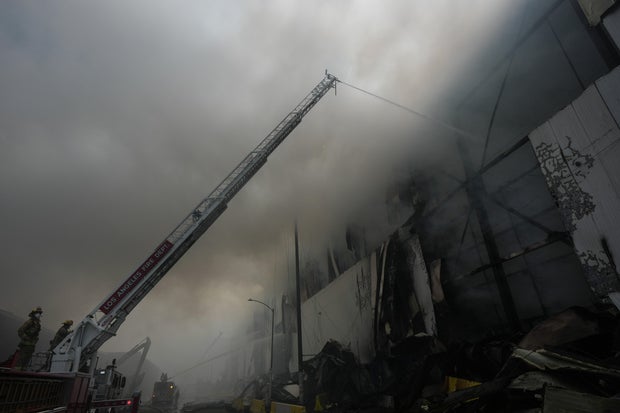
The massive fire at a food warehouse in Los Angeles in June was not an isolated incident. CBS News found that it was one of many fires at facilities run by Lineage, one of the largest cold storage companies globally. Over the past decade, federal records indicate at least 63 fires at Lineage properties. The company acknowledges 34 of these incidents, including a prolonged fire in Finley, Washington.
The June 17 warehouse fire in Boyle Heights heightened scrutiny on Lineage’s safety practices. Residents report continued problems with odors, pests, and possible exposure to pollutants. One resident expressed frustration, stating that leadership at all levels has failed the community.
The Boyle Heights facility, owned by Chill Build LLC, was operated by Lineage. Both entities face lawsuits from residents alleging negligence. The lawsuits also name contractors and solar companies involved in the warehouse’s operations. Chill Build spent millions on fire response efforts, but asserts that maintenance and recovery are Lineage’s responsibility.
A statement from Lineage indicates their commitment to ongoing odor and pest control efforts, with expectations for improvements as cleanup progresses.
Authorities have yet to determine the exact cause of the fire. Lineage believes it began on the roof while Altus Power, the owner of a solar array, had contractors working there. Altus Power has pledged cooperation with investigative authorities.
Dr. Jill Johnston, an environmental health expert at the University of California, Irvine, described the incident as a major industrial disaster. She notes the added burden of air toxins and health impacts on urban communities. The fire destroyed approximately 85 million pounds of food, compounding the disaster’s environmental and public health impacts.
Lineage operates over 500 temperature-controlled warehouses worldwide. It promotes safety as a core company value, yet has a history of safety concerns. A separate CBS News investigation found that since 2016, Lineage facilities have experienced numerous fires involving buildings, vehicles, or trash.
Community members in other affected areas, like Finley, have taken legal action over pollution and health impacts. Records show Lineage faced over $4.5 million in penalties for workplace safety and environmental violations since 2014. A significant incident occurred in 2020 when an ammonia leak in Statesville, North Carolina, resulted in a worker’s death.
Cold storage warehouses employ systems using anhydrous ammonia, a hazardous chemical. Johnston notes the risks of explosion and massive toxic releases in cold storage facilities. Lineage reportedly removed ammonia from the Boyle Heights warehouse early in the fire response.
Air quality data collected after the incident showed that while ammonia levels decreased, they initially spiked at levels higher than other neighborhoods, although still below dangerous thresholds set by authorities.
The Environmental Protection Agency has demanded Lineage provide details on compliance and hazardous chemical releases during the fire. Cold storage facilities, often close to urban centers, pose unique challenges due to their proximity to residential and commercial areas. In Boyle Heights, the warehouse’s location near homes and schools underscores the potential risks.
Throughout the cleanup, Lineage assures that it maintains environmental monitoring and shares data with communities and local regulators. The company emphasizes its support for the affected community and their commitment to safety performance, claiming it surpasses industry averages and works towards continuous improvement.
Leave a Reply