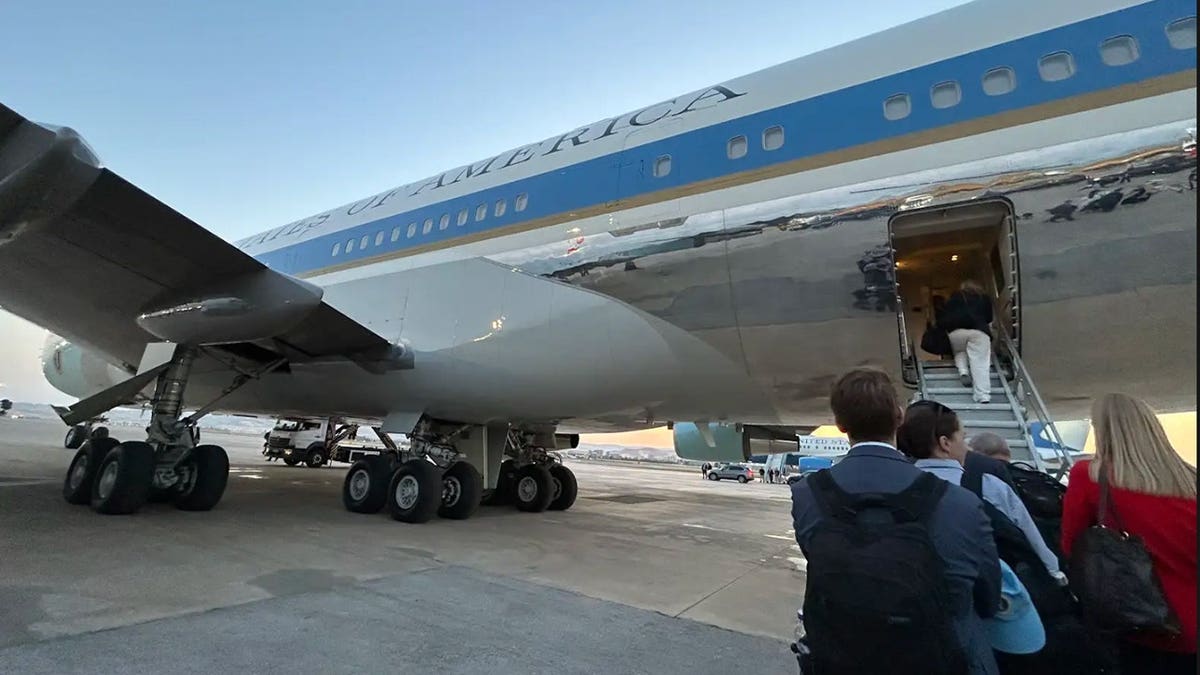
President Donald Trump’s discreet departure from Ankara, Turkey, highlighted sophisticated security measures. This form of decoy traveling on Air Force One has historical precedence. Trump’s December 26, 2018, surprise visit to U.S. troops in Iraq involved stealth tactics like a darkened Air Force One and concealed window shades with a unique military call sign. A British observer uncovered this operation, leading to more intricate plans in subsequent years.
The recent July 8 episode involved Trump leaving a NATO summit under a credible threat. To ensure presidential safety, Trump publicly boarded Air Force One, only to secretly switch to a catering truck leading to an Air Force C-32A. The larger aircraft took off with journalists, under the guise that Trump was onboard.
Trump clarified his compliance with Secret Service protocols, stating, “I just follow what they’d like to do.” This operation used an “AF1” call sign for deception, while Trump traveled under the label “RCH18” on the C-32A. Journalists adhered to specific instructions, reminiscent of Trump’s 2018 Iraq visit’s secrecy measures.
Prior to this, at the suggestion of intelligence indicating an Iranian threat, innovative strategies unfolded. Trump’s disclosure, “I have a threat all the time,” underscored the constant dangers facing his position. The procedures reinforced security for Trump during precarious travels.
This tactic aligns with Trump’s previous war-zone travels. On Christmas of 2018, Trump covertly flew to Al Asad Air Base in Iraq. Observers noted the aircraft’s identifiers and unusual call sign, sparking curiosity and tracking by dedicated enthusiasts. Despite this exposure, the mission maintained secrecy for presidential safety.
Later, during Thanksgiving in 2019, Trump visited Bagram Airfield in Afghanistan. This time, enhanced strategies prevented recognition and rerouted journalists discreetly. While a familiar jet remained in Florida as a deceptive decoy, Trump transitioned to another VC-25, flying to his destination unnoticed.
The Ankara operation surpassed prior strategies. Trump publicly boarded an apparent flight, discreetly switched planes, and orchestrated a decoy operation. The Washington Post notes that such tactics have previous precedents, like President Bill Clinton’s similar maneuver during a trip to Pakistan in 2000.
Controversy surrounds the July flight, as journalists were unaware of the switch. As the “decoy” plane traveled with prominent officials, the complexity of tactics continued evolving. The operation symbolizes an ongoing battle to ensure presidential safety while minimizing exposure.
Leave a Reply