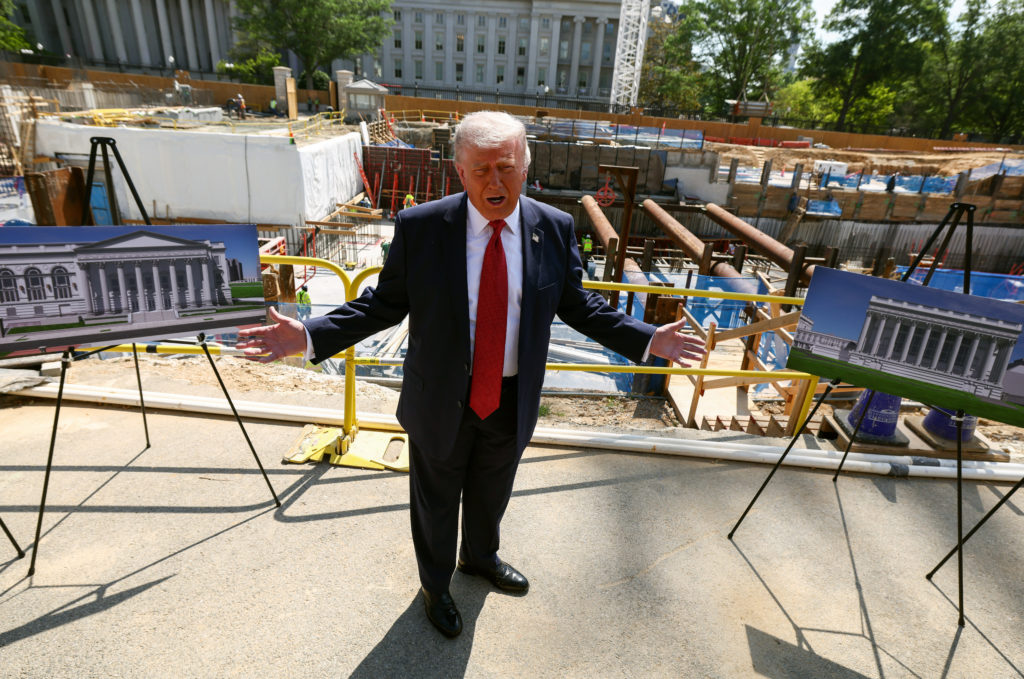
On a cool May evening, President Donald Trump addressed reporters at the under-construction Lincoln Memorial Reflecting Pool. He highlighted the new ‘American flag blue’ color and criticized former President Barack Obama’s renovation efforts. A journalist questioned Trump’s focus on construction during the Iran war. Trump responded, emphasizing his desire for a clean, beautiful, and safe country while criticizing the question.
The exchange underscored a recurring theme in Trump’s public appearances since March. While managing challenges like the ongoing Iran conflict and rising U.S. gasoline prices, Trump often focused on physically reshaping the White House and Washington, D.C. PolitiFact analyzed Trump’s speeches and public events from the first seven months of 2026, noting his frequent mentions of construction projects, including the White House ballroom and the Reflecting Pool.
These construction discussions comprised nearly 45,000 words since January and occurred at 84 events over 66 days—more than a quarter of his public engagements in that timeframe. Topics like the economy and immigration received less attention compared to construction, with the Iran War being the only topic mentioned more in 73 out of 84 events. Trump’s unprompted remarks often highlighted these projects as his primary focus.
In May, the focus on the Reflecting Pool intensified after Trump unfoundedly linked vandalism to damage. On August 6, a judge agreed to dismiss charges against Olympic canoeist David Hearn and others, citing contractor flaws as the cause.
The White House spokesperson linked Trump’s projects to beautifying America for its 250th Independence anniversary. According to Sam Martin, an associate professor at Boise State University, Trump’s focus reflects a belief in personal judgment over institutional processes.
Not all Americans appreciate Trump’s construction efforts. A July Washington Post/Ipsos poll showed that nearly 2 out of 3 Americans were dissatisfied or upset with Trump’s projects, with opinions largely divided along partisan lines.
Trump argued that past presidents have long desired a White House ballroom. He first discussed the idea in a 2011 conversation with David Axelrod, a senior Obama adviser, offering to construct it free of charge. He lamented the lack of a large event space for foreign dignitaries. By February 2025, demolition began on the White House’s East Wing for the new ballroom. The project, initially aimed at improving security, gained more emphasis after a shooting incident.
The ballroom, initially projected to cost $200 million, expanded to $400 million after Trump doubled its size. Trump claimed no taxpayer funds would be used, contradicting a Washington Post report.
University of Kansas professor Robert Rowland suggested Trump’s real estate background influences his emphasis on high-profile projects, as they may positively impact public perception. Martin echoed that Trump’s communication style emphasizes personality-driven leadership over collective decision-making.
A federal appeals court ruled on August 7 that Trump needed Congress’ approval to proceed with the ballroom construction. He announced plans to appeal the decision.
As the 250th anniversary approached, Trump turned to the Reflecting Pool’s disrepair. He often mentioned inconsistent repair costs from previous administrations. By June, Trump’s costs had risen significantly, despite lacking evidence for vandalism claims.
In August, Trump insisted that vandalism was responsible for the Reflecting Pool damage, despite the Justice Department attributing it to contractor error. Trump maintained he had evidence of tampering.
Throughout the year, Trump’s attention included other projects, such as the John F. Kennedy Center and White House improvements. He frequently connects these efforts to his real estate instincts and leadership style.
Though Trump is not the first president to prioritize historical preservation, as seen with Harry Truman and Jacqueline Kennedy, his rhetoric ties projects to his identity. According to Allison Prasch from the University of Wisconsin-Madison, Trump’s approach aims to shape the national narrative with lasting personal influence.
Leave a Reply