Russia has constructed at least 10 concealed locations capable of deploying long-range drones into NATO regions, according to a recent report. Alliance officials have cautioned that Moscow may initiate a limited assault on alliance territory soon.
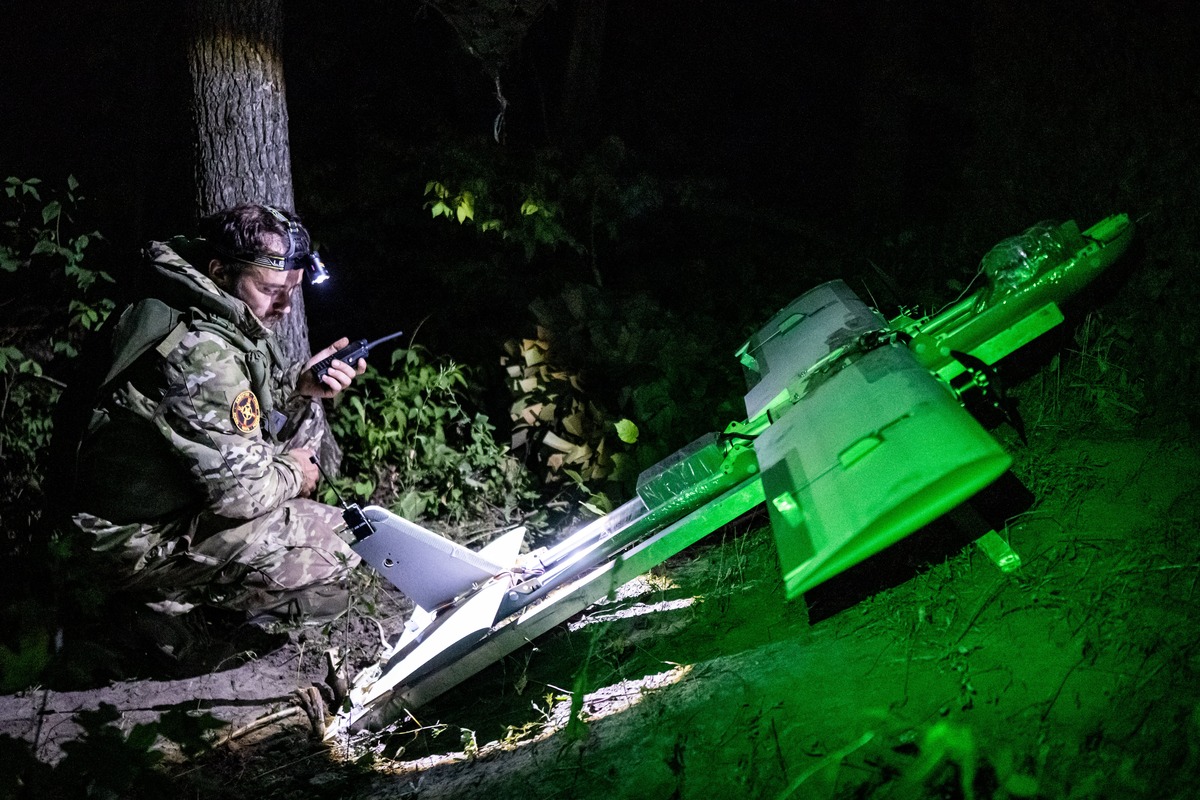
According to British newspaper The Telegraph, Russia has erected numerous new “launch rails” along the Russian border with Belarus and Ukraine. Troops can utilize these rails to elevate fixed-wing drones for missions or strikes. Analysts from intelligence firm DroneSec, who examined satellite images of these sites, report that at least 20 of these new rails could deploy Russia’s advanced long-range drones.
The majority of the 10 sites, often situated in isolated areas or integrated into military bases or airfields, have recently been employed to strike Kyiv, the capital of Ukraine, according to the source. Russia has consistently refuted allegations of planning to target NATO territory, dismissing them as “nonsense.” Newsweek has sent an email inquiry to the Russian Defense Ministry for comments.
Evolution of Drone Warfare
Drone warfare has evolved dramatically due to nearly four and a half years of intense conflict in Ukraine. Both Kyiv and Moscow are not only fighting for land but also competing in the drone arena—a race closely monitored by NATO nations.
Russia is known for deploying Iranian-designed Shahed drones against Ukraine, including the local version known as Geran-2. Ukrainian intelligence indicates that the Kremlin is hastening the development of jet-powered versions capable of striking more distant targets. Russian industry now produces approximately 3,000 enhanced Geran-4 and Geran-5 attack drones monthly.
Most of these advanced drones are manufactured at a facility in Yelabuga, within Russia’s Tatarstan region, which serves as a drone hub, according to Ukraine’s GUR military intelligence agency. Reports from Russian and Ukrainian outlets suggest that the Geran-5 has a range of about 1,000 kilometers, covering over 600 miles. If launched from areas near Ukraine or Belarus, it could reach NATO territory well beyond the alliance’s eastern boundary.
DroneSec CEO Mike Monnik noted in a statement, “This launch site expansion shows how Russia has expanded its ability to launch greater numbers of drones while at the same time using technology to make the types of drones used more difficult to intercept.”
Since Russia’s full-scale invasion of Ukraine began in February 2022, drones and missiles have frequently violated NATO airspace. These incursions often prompt fighter jets from border countries to scramble and occasionally shoot down unmanned vehicles crossing from the conflict. In September 2025, when over 20 drones entered Poland, NATO officials accused Russia of assessing the alliance’s response to an attack. Concerns grew when a Russian cruise missile landed in eastern Poland close to Ukraine’s border.
Russia’s Hybrid War Strategy
These violations are occurring at a challenging time for Europe, which questions the U.S.’s dedication to safeguarding the Continent. U.S. President Donald Trump and his administration have criticized Europe for its historically low defense spending and reliance on tens of thousands of U.S. troops stationed in Europe, as the Pentagon evaluates its military presence there.
Germany’s leading military officer, General Carsten Breuer, stated that Moscow uses drones to observe NATO air defenses’ reactions to these intrusions. “Hybrid attacks are taking place every day in NATO countries,” he shared with The Wall Street Journal.
Hybrid attacks encompass diverse activities excluding open combat, including cyberattacks, information warfare, acts of arson, or assaults on fragile infrastructure such as undersea cables. NATO asserts that Russia has engaged in hybrid warfare with the alliance for many years. However, a full-scale attack on NATO seems improbable. Alliance representatives argue that Russia might instead conduct a smaller, probing military operation against Baltic nations or Poland to gauge NATO’s reaction, or amplify its hybrid attacks.
The Kremlin could attempt to occupy a modest segment of NATO land or execute larger hybrid assaults on the alliance soon, reported the Journal recently, referencing U.S. intelligence analysis. Nevertheless, NATO countries are preparing responses if Russian tanks penetrate a Baltic state.
Contact Newsweek editors John Fitzpatrick and Shakeema Edwards for more on this story.
Leave a Reply