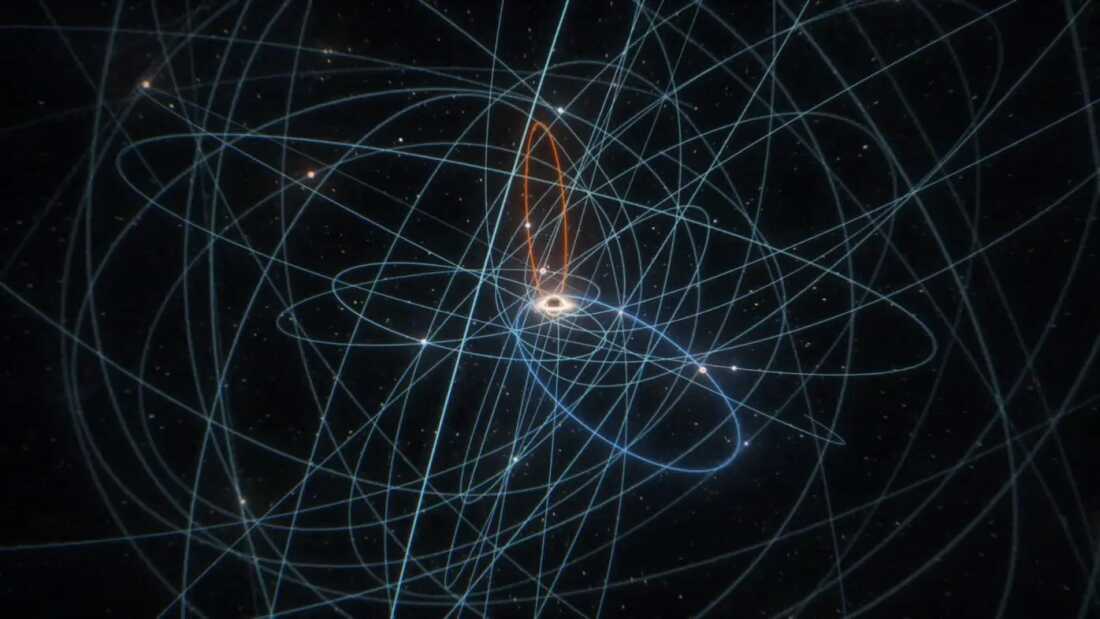
Image analysis reveals paths taken by stars orbiting the massive black hole located at the Milky Way’s center. Among them, the star S301 orbits closely to this black hole, moving at over 15,000 miles per second at its closest point. This revelation was made by researchers at the Max Planck Institute for Extraterrestrial Physics.
In 2002, scientists determined that the Milky Way’s central entity weighs four million times more than our Sun, identifying it as a supermassive black hole. Stefan Gillessen from the Max Planck Institute likened its appearance to films like ‘Interstellar,’ describing a dark silhouette bordered by a halo of light.
Black holes are hard to detect due to their immense gravitational pull preventing light from escaping. Despite this, ongoing research aims to uncover more about these celestial objects. In a recent publication in ‘Nature,’ Gillessen and colleagues shared their observations of the star S301. This star’s proximity to the black hole offers a new way to visualize gravitational effects on space and time.
The Milky Way’s Black Hole
Research efforts continue to unravel the mysteries of black holes and their impact on their surroundings. According to Gillessen, the Milky Way’s center is an optimal research location due to its proximity. Using the European Southern Observatory’s telescopes in Chile, researchers gathered infrared data, bypassing cosmic obstructions to capture images of the galaxy’s core.
Felix Mang, a researcher at the Max Planck Institute, noticed a faint star in the data moving at high velocity. Known as S301, this star demonstrated unique movement patterns.
A Star’s remarkable Journey
Mang tracked S301’s trajectory and found its orbit resembled a stretched ellipse, confirming elements of Einstein’s theory. The star reaches extreme speeds of over 15,000 miles per second as it makes a sharp turn around the black hole. This speed classifies S301 as the fastest observed star in the galaxy.
The star’s movements help illustrate gravitational potential. Researchers analyze these motions to study how gravity affects space and time near the black hole.
Further Insights
Erin Kara, an MIT astrophysicist, emphasized the significance of this research. The data paves the way for future black hole studies, including measuring our galaxy’s black hole’s rotational speed. This knowledge may uncover details about how the black hole and our galaxy were formed. According to Kara, black holes lie at the intersection of complex physics and fundamental galaxy formation.
Gillessen finds the idea of a star circling a black hole fascinating, even imagining life on an alien world near S301. Being able to see the black hole up close every nine years would be breathtaking, instilling awe at the universe’s intricacies.
Leave a Reply