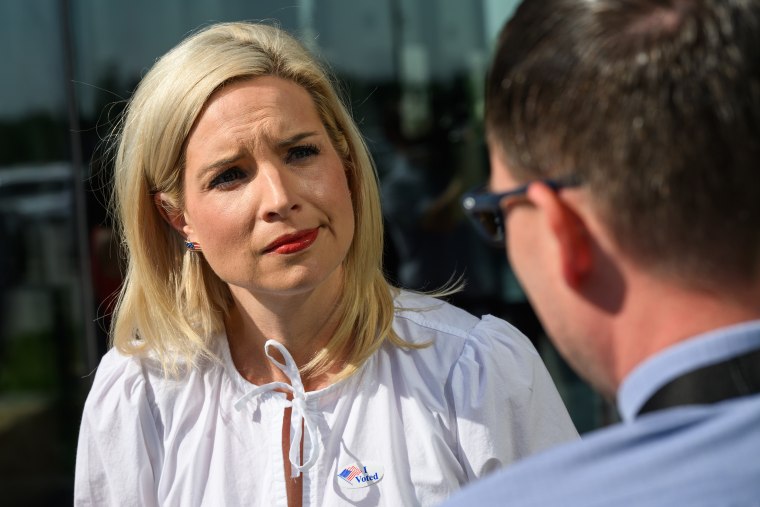
Concerns about the economy and high costs are influencing the decisions of undecided voters in Iowa and Georgia, pivotal states in the Senate elections approaching closer to Election Day. “Nothing has improved in terms of cost of living; food and gas prices are astronomical,” said Patty O., a 59-year-old Georgia Republican and Trump voter from 2024. “The cost of living is extremely high now.”
Patty was among a dozen voters in two Senate races who participated in recent focus groups held by Syracuse University with the research firms Engagious and Sago. NBC News observed the discussions, which included six independents, five Republicans, and one Democrat. Nine voted for Trump in 2024, while three supported then-Vice President Kamala Harris.
Most voters feel more anxious about the economy compared to when Trump retook office, with eight expressing that Trump has not focused enough on economic issues. According to polling, anxiety about Trump’s economic management prevails widely. Focus groups shed light on individual thoughts of a few people on key national questions. With less than three months until the midterm elections, these voters face decisions in Senate races, though some have already chosen governors.
Economic Anxiety
Among 12 undecided voters, eight expressed dissatisfaction with Trump’s economic performance in his second term, even though a majority had voted for him. Criticisms included his management of the economy. Jamie G., a 55-year-old Iowa independent, expressed his disillusionment. “He claimed he’d end conflicts on day one but engaged us in needless wars. His tariffs feel like a tax on Americans,” he commented.
Some voters approved of Trump due to his immigration policies, noted Tyler R., a 24-year-old Iowa Republican. Tyler appreciated the discipline in immigration policies and efforts to negotiate with Russia, despite concerns over increased tariff-related prices and involvement in Iranian conflict.
Drew G., a Georgia Republican, expressed mixed feelings. “Financially, investments and 401(k) are growing but Trump’s spontaneous comments can be frustrating.” Others, like Jennifer B., an Iowa independent, found stock market positives inadequate, stating, “I’m earning well through investments, but it’s for the future, not spending now.”
Lack of focus on economic improvement and unmet campaign promises frustrated Jennifer. “It’s familiar with politicians, but not fulfilling big promises is significant,” she emphasized.
Economic concerns encompass broad life areas for voters, such as healthcare, gas, and utilities. Sarah M., a 47-year-old Iowa voter, discussed struggles as a middle-class American. “High taxes nearly bankrupted us last year. Grocery affordability requires driving 45 minutes, compounding gas price issues,” she shared.
Georgia’s Patty had similar concerns. She stopped buying luxuries like orange juice and boutique gym memberships. “Utilities soared last summer, leaving fewer options to decrease costs,” Patty remarked.
Midterm Choices
Despite dissatisfaction with Trump and economic anxiety, half the group considered these factors when voting in midterms. Margaret Talev, director of the Institute for Democracy, Journalism, and Citizenship at Syracuse University, commented, “People showed disappointment in Trump’s costly policies but aren’t tactically using ballots to restrain the White House.” Democrats shouldn’t assume rising anti-Trump sentiment guarantees House or Senate victories, she added.
Disapproval of Trump might offer openings for certain candidates. Tyler, an Iowa Republican, while largely favorable on Trump, noted concerning prices and attracted to cross-party cooperation. He saw political division as a problem, saying, “I’d consider a Democratic Senate candidate more now due to Trump’s first two years than earlier.” Yet, recognition of Democratic nominee Josh Turek was limited.
Amongst Iowa panelists, four supported State Auditor Rob Sand for governor, viewing him as bipartisan. Concerns about Democrats’ perceived shift leftward existed, but Sand seemed willing to cooperate with Republicans.
Georgia voters wanted to learn more about Senate candidates Jon Ossoff and Mike Collins. Three voters preferred Republican Rick Jackson for governor, citing his success from foster care to a business empire. Others remained undecided between Jackson and Democratic nominee Keisha Lance Bottoms.
While the economy was central to votes, other issues like the war in Iran and data centers mattered to some, like Ron S., a 43-year-old Georgia independent. Environmental impact concerns from data centers and higher electricity costs were mentioned, though Patty viewed centers as job creators.
Alice N., a Georgia Republican leaning towards economically-focused candidates, stated, “I’m considering votes based on actions towards reducing living costs and making essentials affordable.”
Leave a Reply