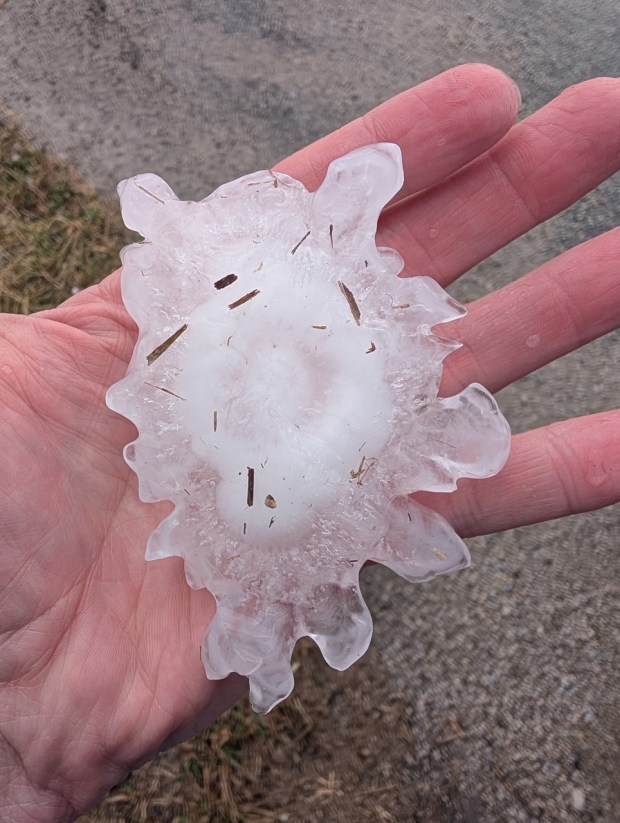
Imagine a large can of soup being thrown at you at 80 miles per hour. That’s the equivalent weight of the largest hailstone recorded in Illinois, according to Ian Giammanco, lead research meteorologist at the Insurance Institute for Business and Home Safety. This hailstone was discovered in a Kankakee backyard during severe storms in March.
Measuring 6.6 inches, the hailstone broke the previous 11-year record held by a 4.75-inch stone from Minooka. The National Oceanic and Atmospheric Administration announced the new record after a six-month confirmation process. Trent Ford, the Illinois state climatologist, led the committee evaluating the findings. Ford stated the announcement capped an intense year of weather across the state.
Victor Gensini, a meteorologist and professor of atmospheric science at Northern Illinois University, was also part of the committee. He noted a remarkable year for severe storms with high winds, damaging hail, and tornadoes. By June, Illinois recorded over 200 tornadoes, marking a new state record. Following recent storms, power outages continue in portions of northeast Illinois and northwest Indiana.
A study led by Gensini in 2024 highlighted the effects of climate change on hail frequency. Rising global temperatures will likely increase hail size, worsening property damage incidents. Days with severe hailstorms featuring larger stones are projected to rise in the Midwest, Ohio Valley, and Northeast.
Severe thunderstorms propel icy pellets into the upper atmosphere, where supercooled water forms hailstones. A warmer climate enhances these storms with more water vapor, creating stronger updrafts and larger hailstones.
Ford confirmed the plausibility of the March 10 storm producing the record-breaking hailstone, citing evidence of several stones that could have broken prior records. The storm led to many reports of significant hailstones in and around Kankakee and nearby areas.
Gensini recalled holding an almost 5-inch stone that day, larger than the former record-holder. He emphasized the irony of finding the largest hailstone near Kankakee, despite prior efforts to discover large stones elsewhere. Saving the hailstone in a freezer preserves what Gensini considers a “piece of history.”
Studying the supercell storm helped verify the record. Atmospheric interactions, like two hailstones combining in mid-air, can complicate understanding hail formation. On that March day, conditions were prime for forming large hailstones.
NOAA reported 126 severe hail sightings during the storm, with over 30 exceeding 3 inches. Hail larger than 2 inches can damage roads, dent cars, and harm crops. Ford explained that understanding hail formation can improve building practices and insurance rates.
The largest hailstone nationally measured 8 inches and fell in South Dakota in 2010. Giammanco’s team at the Insurance Institute for Business and Home Safety focuses on understanding the dynamics of hailstone formation.
While tornadoes receive significant attention due to their destructive capacity, hail is increasingly recognized for its damage potential. Annually, hail accounts for 60%-80% of damage from severe storms.
Insurance claims for hail damage have risen in recent years. A report from Verisk noted a jump in costs related to roof repair and replacement due to hail damage. Illinois ranked third in damage reports with $457 million claimed by State Farm customers in 2025.
Ford concluded that while the hailstone record holds posterity value, scientific observations from the storm will aid in future preparedness against severe hailstorms.
Leave a Reply