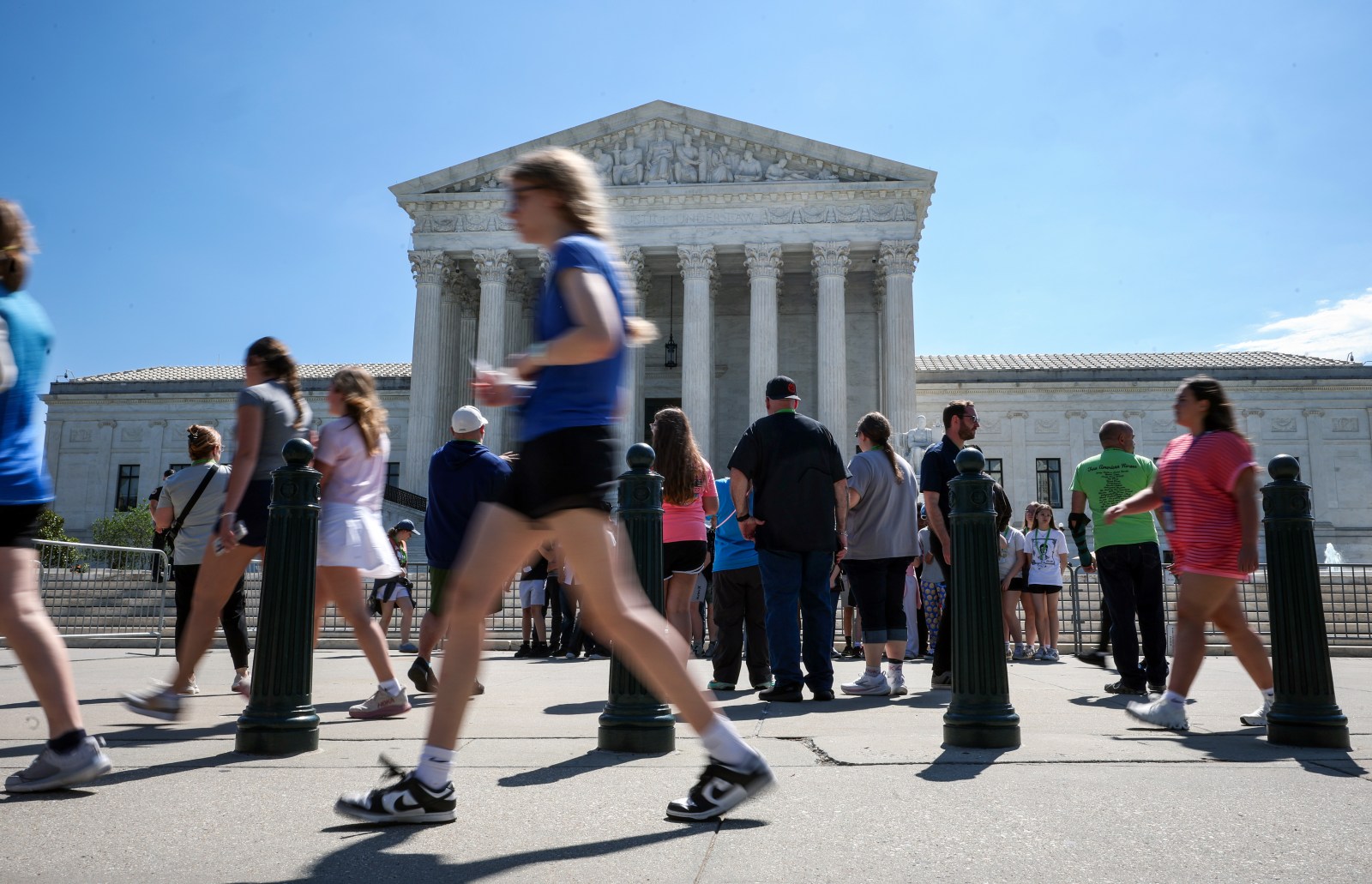
Supreme Court Decision Narrows Republican Opportunities
The U.S. Supreme Court’s recent ruling against a Republican-backed congressional map in Missouri has decreased the GOP’s chances of gaining an additional seat in the House of Representatives. The court’s refusal to approve the map on Thursday implies that the map is unlikely to be used in the upcoming November elections, and the state will probably default to using the 2022 map, as mandated by the Missouri Supreme Court.
This decision significantly affects the Republican strategy in the midterm redistricting push, posing a roadblock in one of the most promising opportunities for the GOP to increase its seats in the House, where they currently hold a slender majority.
The court’s ruling is a significant setback for President Donald Trump, who has supported mid-cycle redistricting in Republican-majority states to help preserve the party’s House majority. This approach is crucial as he faces declining approval ratings and voter concern over economic issues.
Missouri GOP’s Redistricting Efforts
The proposed congressional map by Missouri Republicans was intended to make the district represented by Democrat Emanuel Cleaver in the Kansas City area more competitive for Republicans, creating another GOP-leaning seat. Presently, Republicans occupy six out of eight congressional seats in the state, and the new map would have increased this to seven.
Under the map approved post-census in 2022, the 5th Congressional District covers solely the Kansas City region. The revised map, backed by Trump, would have significantly altered this district, moving parts of it into rural, Republican-favoring areas. The Associated Press estimated that about 59% of voters in this district would be new under the proposed boundaries.
While the new map was used in the August primary, its application for the November midterms was halted by the Missouri Supreme Court. The court stated that voter approval via referendum was required before implementation.
This legal issue escalated to the U.S. Supreme Court, which decided not to reinstate the GOP-backed map for November. This left the appellate court’s ruling in place as litigation continues.
Impact on Missouri Voters and the Broader Redistricting Battle
The Supreme Court’s decision means Missouri might face different U.S. House districts in the November election compared to the August primary. According to AP estimates, this could affect the candidate choices for over one million potential voters in Missouri, almost 25% of the electorate.
Though losing one congressional seat may seem minor, Missouri’s case is part of a larger national redistricting battle leading up to the 2026 midterms. With the current narrow balance in the House, gaining one Republican seat could make a significant impact.
Both parties have been redrawing congressional boundaries beyond the usual post-census period. Republican-led states such as Texas, Florida, North Carolina, and Missouri have attempted to create new maps favorable to the GOP, while Democrats have pursued similar efforts in states like California.
Courts have intervened in several states, reshaping the political landscape before the polls. Currently, Republicans lead in the national redistricting efforts. Nine Republican-led states successfully introduced new maps: Alabama, Florida, Louisiana, Missouri, North Carolina, Ohio, Tennessee, Texas, and Utah.
Conversely, only California successfully adopted a new map among Democratic-led states, aiming to gain five seats. New York and Maryland are considering new maps for 2028. The GOP’s redistricting could add 15 seats, whereas Democrats might gain six.
Redistricting has failed in Arkansas, Indiana, Kansas, Maryland, New York, South Carolina, Virginia, and Wisconsin.
Leave a Reply