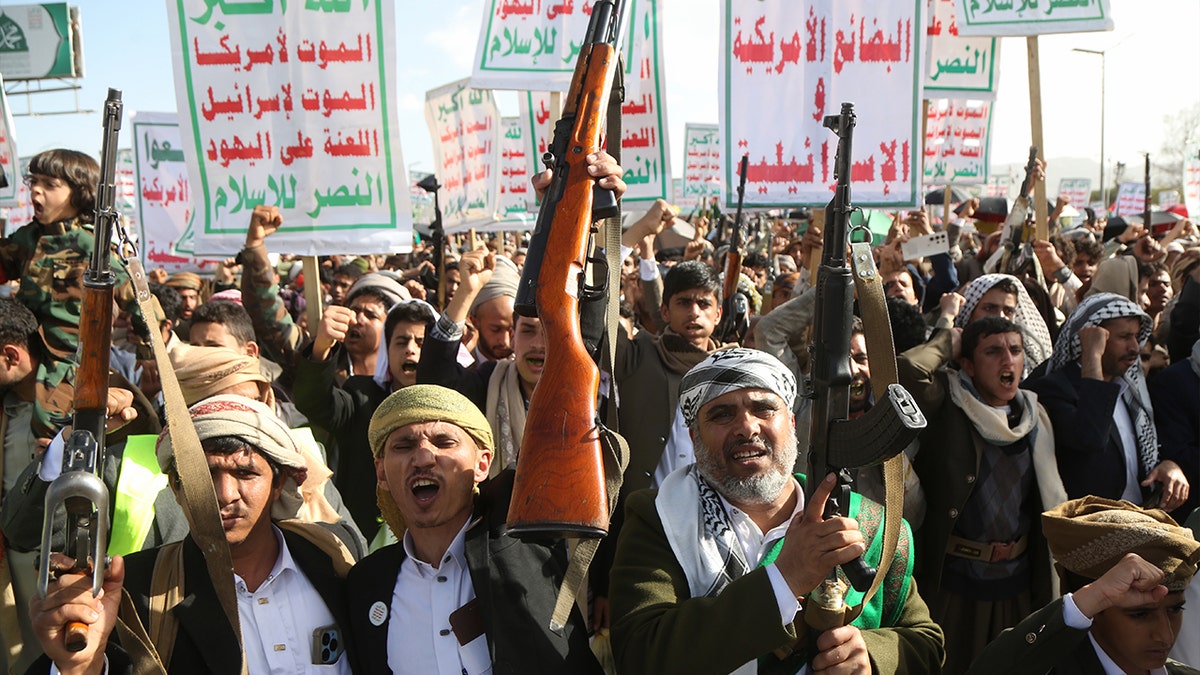
The Houthis have rapidly advanced toward a key shipping chokepoint, raising concerns about their financial network’s role in transforming the Iran-backed group from a Yemeni insurgency into a regional power. They have seized new territory along Yemen’s Red Sea coast, including the strategic port city of Mocha, and are moving toward the Bab el-Mandeb Strait, a critical waterway connecting the Red Sea to the Gulf of Aden.
For the U.S., this advance poses both a financial and military challenge. The Trump administration is working to cut off the financial support that sustains Iran and its proxies. However, the Houthis have established a complex network to evade sanctions while controlling ports, trade routes, and a large population, complicating efforts to disrupt their funding without harming civilians.
The Houthis have pledged to close the Bab el-Mandeb Strait through missile-drone attacks if Gulf nations join the U.S.-Israel conflict with Iran. Adam Rousselle, founder of Between the Lines Research, explains that the Houthis have a well-capitalized financial system extending beyond Yemen, involving Iranian oil, informal hawala networks, cryptocurrency exchanges, and international facilitators. Ports under Houthi control are vital for revenue, as they impose steep fees and tariffs on goods from rival ports.
Nadwa Al-Dawsari, a Yemen expert, highlights the importance of territory for the Houthis’ power, allowing them to recruit, generate revenue, manufacture weapons, and control smuggling routes. Their territorial gains only strengthen this economic base. Houthis’ finances are not merely a result of Iranian cash but are embedded in a broader Iranian commercial network.
The Houthis generate over $2 billion annually from oil and receive Iranian oil shipments via Iranian-affiliated companies. Treasury has documented their revenue from imposing taxes on petroleum imports. Miad Maleki of the Foundation for Defense of Democracies points out that despite their adaptation to sanctions, key financial connections remain vulnerable. Sa’id al-Jamal is noted as a central figure in the Houthis’ financial activities, operating a network that sells Iranian commodities and channels proceeds to the group.
China’s involvement, though primarily through private actors and not direct government action, complicates the situation. Rousselle notes Chinese-linked entities in Houthi supply chains and highlights the challenge of addressing decentralized illicit-finance networks. Maleki suggests focusing on where Houthi money intersects with the formal financial system as a possible strategy, even as the humanitarian crisis in Yemen adds layers to the dilemma.
Efforts to isolate Tehran economically face hurdles due to such complex networks. The need to maintain humanitarian goods while cutting off Houthi revenue requires careful consideration. Ultimately, the issue extends beyond Yemen, challenging regulatory controls worldwide.
Leave a Reply