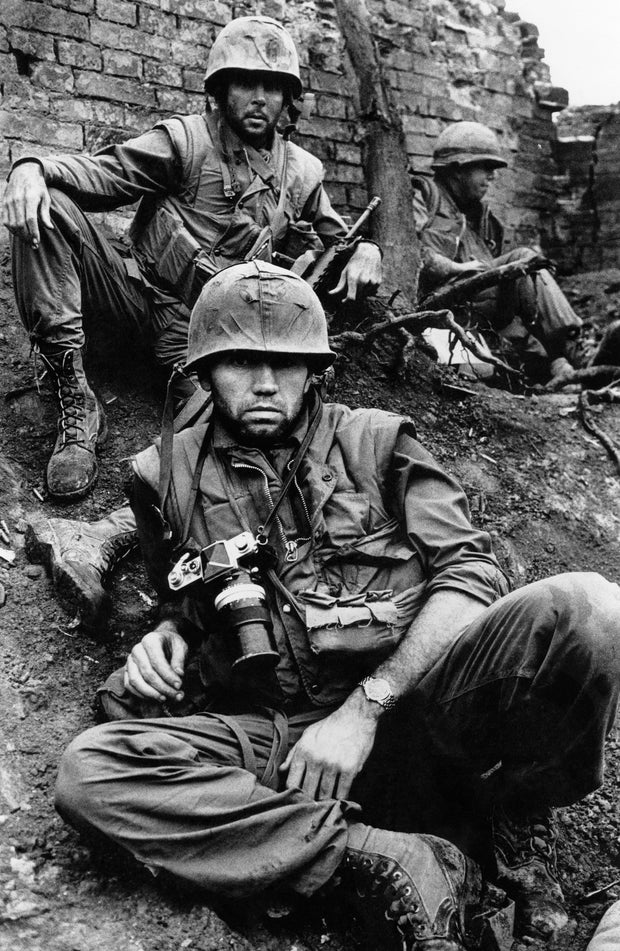
“I want my pictures to hurt you. I don’t want you having any free rides. I’m there to upset you and make you feel uncomfortable the way I feel when I go to bed at night. Otherwise, there’s no point in me going in the first place.” These are the words of the lauded British war photographer Sir Don McCullin. He shared this with CBS News before the release of what he intends to be his final book.
McCullin’s career spans over five decades, covering conflicts worldwide including Cyprus, Biafra, Israel, Lebanon, Afghanistan, and Northern Ireland. Now at age 90, McCullin is releasing a retrospective focusing on a conflict that shaped his profession and an era: Vietnam.
The book gathers thousands of images McCullin shot during numerous assignments in Vietnam in the 1960s and early 1970s. McCullin was captured in the walled city of Hue, South Vietnam, during the Tet Offensive. At that time, U.S. Marines were fighting to reclaim Hue from the North Vietnamese Army.
This collection of work features some of McCullin’s most iconic images alongside unreleased photographs. They portray the violence and pain endured by civilians and the fear and exhaustion faced by U.S. Marines with whom McCullin was embedded. The Battle of Hue in 1968, conducted during the Tet Offensive, stands central to the book.
“It was amazing any of us survived,” McCullin recounted to CBS News correspondent Charlie D’Agata from his home in southwest England’s hills. “I was told by a senior officer that there was going to be a 24-hour operation, and 11 days later, I was still there.”
It was in this aged city that McCullin snapped arguably his most famous photograph, crafting one of the Vietnam War’s defining images.
His renowned picture, “Shell-shocked US Marine,” is haunting in its simplicity. It shows a soldier, motionless, staring blankly, clutching his rifle. “I made five frames of this soldier sitting there, and not once did his eyelashes move. Each one is identical,” McCullin commented.
Despite its fame, McCullin feels uncomfortable with the photograph. “Frankly, I hate this picture, because people think it’s the only decent picture I’ve ever taken,” he said. “It’s just that you have to be careful when you make these pictures. If they turn into an iconic picture that’s bearable to look at, you haven’t done your job properly because it means people will accept it instead of turning away.”
The new book reveals how war photography can blur lines between observer and participant. McCullin photographed a severely wounded Marine pinned down by fire. He documented fellow Marines rescuing the casualty through a narrow alley.
McCullin intervened. “I said, ‘Bring him to me,’ and I put this Marine on my back, running him along the old medieval wall to safety,” he recalled. The experience during the Battle of Hue deeply affected McCullin. “To this day, I live that battle every night I go upstairs to sleep. Every night,” he stated to CBS News. “It never leaves me.”
He neither desires nor expects sympathy. The camera never offered him an excuse to detach from human suffering.
As McCullin’s extraordinary career draws to a close, “Vietnam” serves both as a historical document and a personal farewell. More than a collection of wartime photos, it affirms a lifetime devoted to witnessing suffering and a final reminder of his conviction that photography must challenge and disturb viewers.
All images featured are © Don McCullin and are included in the book “Vietnam,” published by GOST Books.
Leave a Reply