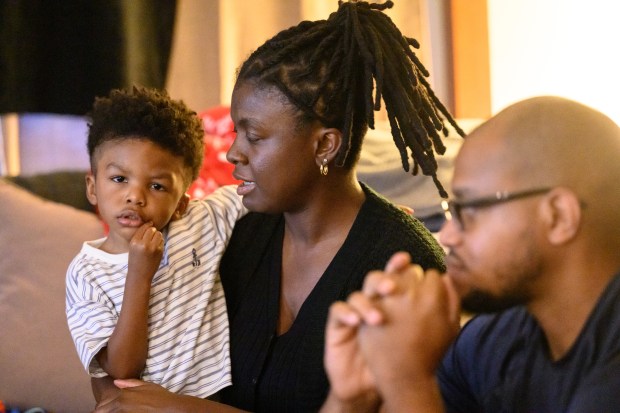
While playing in the living room, three-year-old Eliazer Glover fell and hurt his elbow. A kiss from his mother, Kal Glover, quickly resolved his tears. Despite the ease of this remedy, Eliazer’s sickle cell disease remains a significant part of his life. Kal, speaking to her husband Samuel at their Hammond home, emphasizes that Eliazer should not be defined by his condition.
“I don’t want the stigma of ‘you have sickle cell, you can’t do this,’” Kal explains. She knows people often prejudge, not recognizing Eliazer’s capabilities.
Kal and Samuel learned of Eliazer’s condition during his initial pediatric visit, just a week into his life. Though aware of the possibility, they had hoped he would only carry the sickle cell trait. The couple shares their experiences while Eliazer eats noodles at home, illustrating how daily life intertwines with managing his condition.
Understanding Sickle Cell Disease
The National Heart, Lung, and Blood Institute describes sickle cell disease as a genetic disorder affecting hemoglobin in red blood cells. Normally disc-shaped, red blood cells assume a sickle shape in this condition, hindering blood flow. Eliazer has Hemoglobin SC, a milder form.
The Glovers only learned of this family trait at their first pediatrician visit. Kal recounts their confusion, while Samuel recalls his cousin’s daughter’s similar battle. He describes frequent episodes and hospital visits that previously informed his understanding of the disease.
Upon receiving Eliazer’s diagnosis, Samuel was astonished. “I thought the test was wrong,” he admits. Dr. Laura Tyrrell, a pediatric hematologist, notes the prevalence of sickle cell among those with ancestry from malaria-prone regions, explaining its commonality in African American populations.
Managing and Living with Sickle Cell
Tyrrell highlights that the U.S. shows diverse racial groups with sickle cell traits, yet it predominantly affects African Americans. Pain from blocked blood flow often sends patients to emergency rooms, according to the CDC. Notably, body temperatures above 101 degrees require immediate medical attention. Extreme temperatures are also risky.
The Glovers diligently monitor Eliazer’s temperature, prioritizing his comfort. Kal explains their summer strategies to keep him indoors during scorching days. Daily care for Eliazer involves vaccinations and prescribed liquid penicillin, addressing his spleen’s underdevelopment to fend off infections.
Even at three, Eliazer is cooperative with his medication. Occasionally, he even reminds his parents of dosages. “He likes his medicine,” says Kal, remarking on her son’s unusual affinity.
The Challenges of Accessing Resources
Email correspondence with Tyrrell reveals that 1,049 Indiana babies carry the sickle cell trait, while 31 have the disease. Yet, despite high patient numbers in places like Lake County, the Glovers highlight resource scarcity. They initially drove to Indianapolis for tests, facing long travel times.
Sickle cell research lags behind other diseases, Tyrrell acknowledges, pointing to historical funding disparities. The Glovers believe that as a disease predominantly affecting Black Americans, sickle cell receives insufficient attention.
Fortunately, the Glovers now attend a clinic in Gary, reducing travel burdens. The center provides support networks and resources, creating a crucial community for families.
Ultimately, Kal and Samuel remain committed to ensuring that Eliazer thrives. “He’s special,” Kal asserts, grateful for his health and happiness. “You’d think he was a normal child,” adds Samuel, reflecting on Eliazer’s resilient spirit.
Leave a Reply