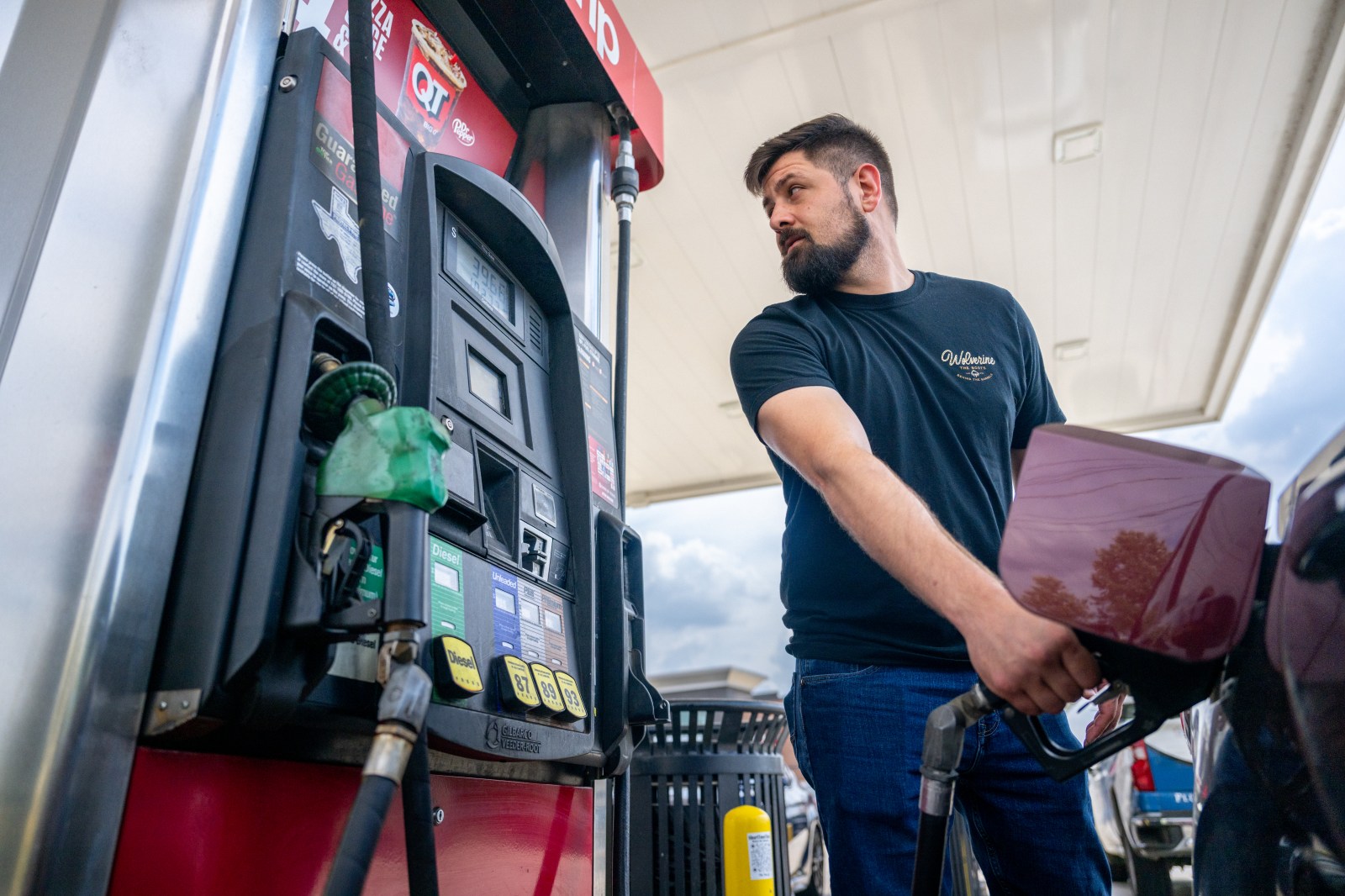
States are taking measures to alleviate the burden of high gasoline and diesel costs as President Donald Trump expressed confidence on Monday that fuel prices will decrease after the Iran war concludes. Trump assured reporters at the White House, “Iran will never have a nuclear weapon, and we’re going to win that war very soon; it’ll be over, and the gas prices will come tumbling down.” Despite this assurance, drivers across the nation are facing high costs at gas stations, with regular gas averaging $4.48 per gallon and diesel at $6.45, according to AAA.
California and Georgia have announced new actions to reduce costs, with California posting regular gas prices at $6.37 per gallon and diesel at $8.40. Governor Gavin Newsom suspended the state’s seasonal summer-blend gasoline requirement for the rest of the season, allowing the immediate use of the more affordable winter-blend gasoline. Previously, the summer blend, which is more environmentally friendly, was scheduled to continue until October 31. Newsom highlighted the impact on residents, stating, “Families are paying more to fill their cars, farmers more to grow our food, and truckers more to deliver it to market.”
Georgia Governor Brian Kemp declared a state of emergency, suspending the state’s motor-fuel tax for 30 days and removing the state’s 33.3-cent-per-gallon tax on gasoline and 37.3-cent tax on diesel. Kemp affirmed his commitment to providing relief, stating, “We’ve remained committed to helping [Georgians] and our small businesses fight through the tough times, and that’s why I’m taking this action today.” The order also removes commercial vehicle weight limits to help lower transportation costs that drive up prices for goods, including groceries.
Massachusetts Governor Maura Healey is seeking similar relief and plans to file legislation aimed at temporarily suspending the state’s gas tax for two months, pending legislative approval. Other states, including Texas, Alabama, Louisiana, and Nebraska, have temporarily relaxed rules concerning tax-exempt dyed diesel, typically reserved for off-road uses such as farming.
In South Dakota, hauling restrictions for farmers during harvest have been eased, allowing them to transport agricultural commodities at 10 percent above normal weight limits. Recent measures taken in Illinois, Indiana, Kentucky, and Utah have also helped manage fuel costs by reducing or freezing gas taxes.
AAA has projected that September could set a new record as prices remain volatile due to instability in the Strait of Hormuz and high crude oil costs. The Trump administration is considering a temporary ban on U.S. diesel exports to lower domestic costs. Trump indicated that both he and Secretary Scott Bessent are evaluating the feasibility of a partial or full restriction and expect a decision soon. The U.S., which supplies about 20 percent of global diesel demand, faces potential market disruptions if exports are restricted. Mark Williams from Boston University’s Questrom School of Business explained that although a surplus in U.S. diesel supply might briefly decrease domestic fuel costs, the long-term effects might include disruptions in refining economics, production reductions, and an increase in refined product costs.
Earlier this month, Trump predicted that fuel prices might drop following the November midterm elections, stating, “Right after the election, oil prices are going to be tumbling downward. They’re going to be tumbling down, and we’ll get them down. I think for gasoline, we’ll get them below $2 a gallon.”
Leave a Reply