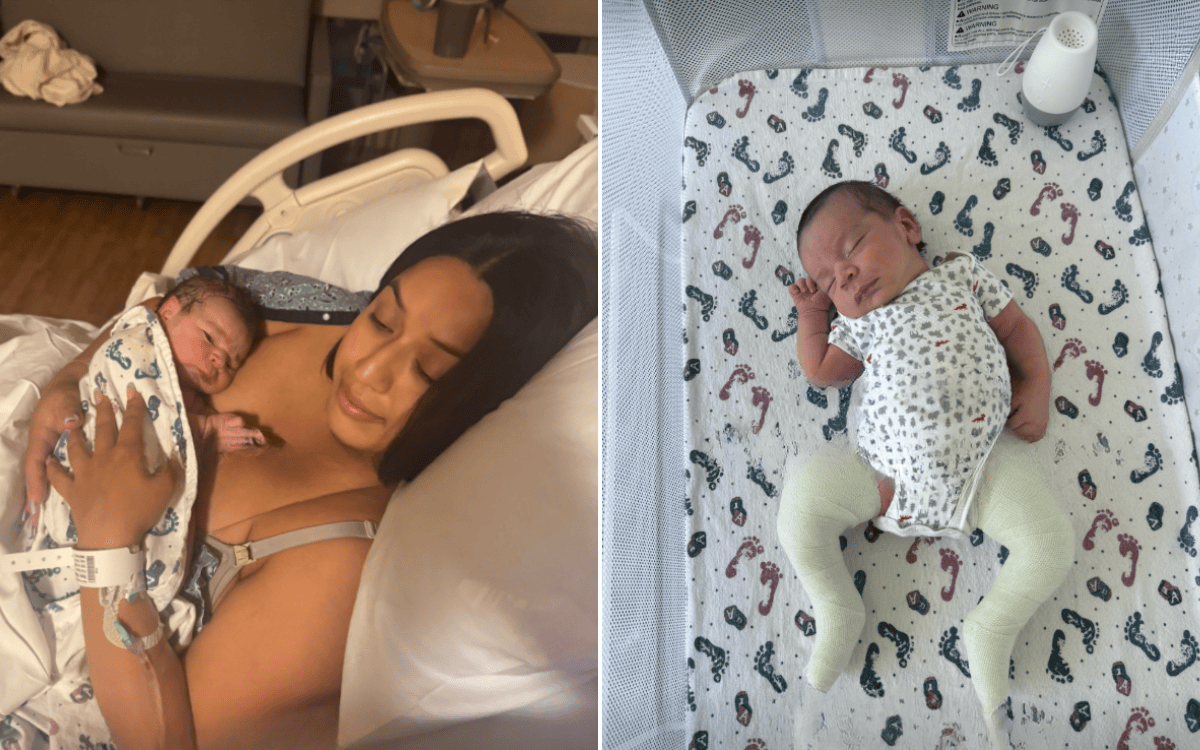
Michelle Reyes from Buena Park, California, welcomed her son, Tommy, into the world with both joy and unexpected concerns. Her third pregnancy was particularly challenging on her body. ‘My pregnancy with Tommy was really hard on my body. I asked for a chair at work because I was struggling to stand for long periods,’ she shared in an interview.
Despite the difficulties, all tests during pregnancy returned normal results. ‘All of my tests came back looking good,’ Reyes recalled. The expectation was a healthy baby boy. However, upon Tommy’s birth, Reyes noticed his feet were severely turned inward.
The medical staff initially reassured Reyes, attributing Tommy’s foot position to his position in the womb. Yet, a specialist’s examination and X-rays revealed a diagnosis of severe bilateral clubfoot, a condition affecting about one in every 1,000 babies in the U.S., with around half of cases involving both feet.
‘Hearing those words was a shock because we thought everything was fine,’ Reyes said. Coincidentally, she had recently seen a video about clubfoot but had not given it much thought at the time. Now facing the reality, she initially thought, ‘What did I do wrong?’ Her doctor explained that clubfoot’s cause often remains unknown, and parental actions are not to blame.
Six days after birth, Tommy began treatment with casts placed on both legs, extending from thighs to toes. Regular appointments occurred every two weeks, gradually realigning his feet. After five casts, he underwent an Achilles tenotomy. Once healed, Tommy transitioned to wearing special boots with a connecting bar for most of the day during his first six months.
Progress was steady, allowing a reduction in wear time to 14 hours daily, primarily during nighttime. The Ponseti method, which was employed, reports initial correction rates of 90 to 100 percent. According to a study in the Journal of Pediatric Orthopaedics, successful outcomes hover around 93 percent.
‘I’ve seen a significant improvement in his feet since birth,’ Reyes remarked. Despite the challenges, Tommy developed like any other baby, crawling, learning to walk, and swimming.
Reyes remains optimistic about Tommy’s future. She aims for her son’s experience to highlight that being born with clubfoot won’t restrict his potential. ‘I want him to know his story and remember everything he went through,’ Reyes stated.
Through their experience, Reyes hopes her family’s journey brings hope to those in similar situations. ‘I want other parents to know that it’s OK to be overwhelmed at first, but there is hope. Their baby can still grow up doing all the things they imagined,’ she added.
Leave a Reply