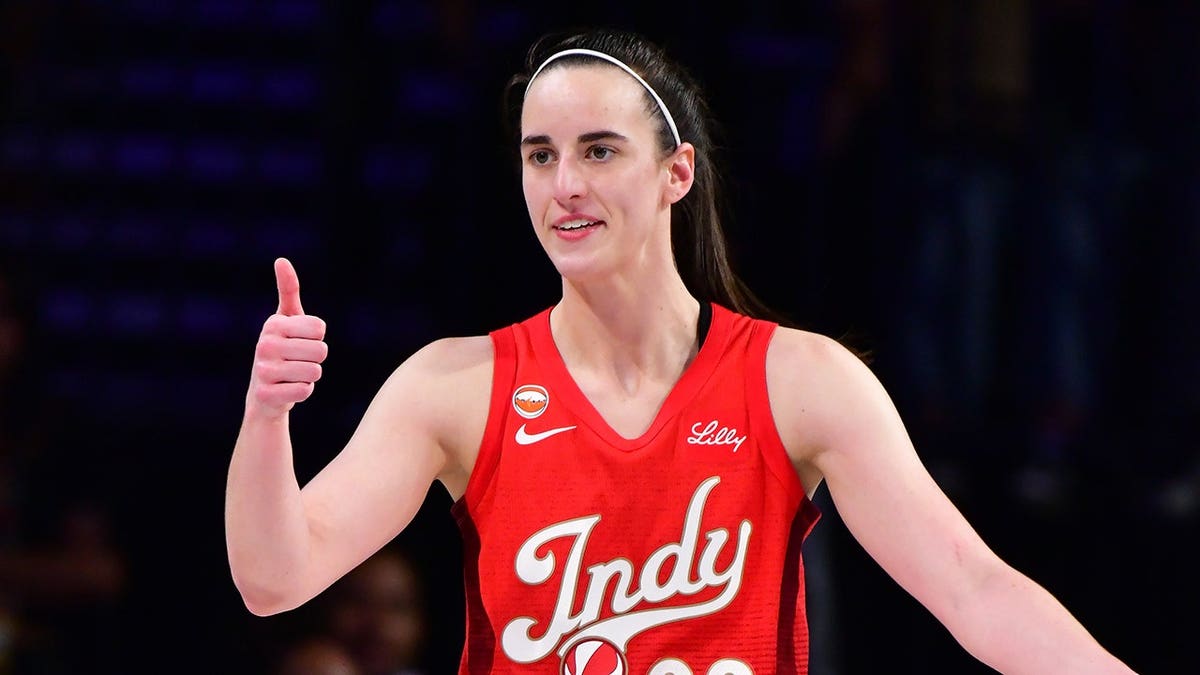
Riley Gaines and Louis Barker recently shared their experience attending an Indiana Fever game, where they highlighted the impressive performances of Caitlin Clark and Kelsey Mitchell. A notable shift in atmosphere was evident compared to Riley’s previous visit to a WNBA game in Minneapolis.
Data shows the Indiana Fever’s regular-season games on major networks averaged over twice the audience size of the WNBA semifinal openers on October 4. Affiliate links to sports betting sites may generate compensation for FOX News if you register or place bets. This article was independently created by a team separate from the FOX newsroom.
An OutKick review indicated that Indiana’s ten regular-season games televised on ABC, CBS, and NBC had an average viewership of about 2.32 million. In contrast, the two semifinal openers averaged approximately 1.16 million viewers.
Caitlin Clark significantly boosts WNBA All-Star ratings while a 3-point contest without her saw declining numbers.
Indiana’s regular-season games displayed an audience average nearly 100% larger than the semifinal games, highlighting Caitlin Clark’s significant impact on TV ratings. For instance, Game 1 between New York and Atlanta on ABC averaged 1.2 million viewers, while Las Vegas versus Golden State attracted 1.12 million on NBC and Peacock. Yet, Indiana’s first-round opener against Las Vegas on September 27 drew 2.11 million viewers, even airing opposite the NFL.
Overall, Indiana Fever’s games averaged 2.32 million viewers across four games on ABC, four on CBS, and two on NBC, including Peacock audiences. Notably, seven out of ten Fever games exceeded two million viewers, outperforming both semifinal openers.
For example, Indiana’s May 30 game against Portland, where Clark scored only six points, drew nearly 1.3 million viewers. That single regular-season game surpassed the viewership of either WNBA semifinal opener in October.
Clark’s presence continues to underscore her value to the WNBA. Compare this with New York’s regular-season matchups against Indiana on CBS, which each drew over 2.5 million viewers, while the Liberty-Dream semifinal opener managed only 1.2 million on ABC.
In comparison, Angel Reese from Atlanta proclaimed herself as a viewer draw in 2024. However, Dream’s playoff games aligned with other non-Clark games in terms of viewership, occasionally performing worse. Atlanta’s initial playoff victory had 1.2 million viewers on ESPN, compared to 1.4 million for the Dallas-Golden State game aired concurrently.
While WNBA semifinal numbers are commendable, Indiana Fever’s ratings remain dominant. Before Clark’s entry in 2024, the league had not seen a game with viewership over one million since 2008. This indicates significant progress. Media rights recently expanded over $3 billion, reflecting the league’s growing popularity.
Furthermore, the WNBA semifinal openers had 10% more viewers than last year’s. In fact, these games held second and third place for Game 1 audiences since 2016, with last year’s Fever-Aces game drawing 1.4 million without Clark due to injury.
Indiana’s ability to attract large audiences without relying solely on Clark is a positive sign. Even their 1.57 million viewership against Los Angeles without Clark on June 27 underscores this success. Indiana’s least-watched first-round game on Prime Video still surpassed all other non-Fever first-round games in viewership, even exceeding both semifinal openers on broadcast TV. The Fever’s audience base demonstrates widespread appeal, which the WNBA would benefit from fostering across more teams.
Leave a Reply