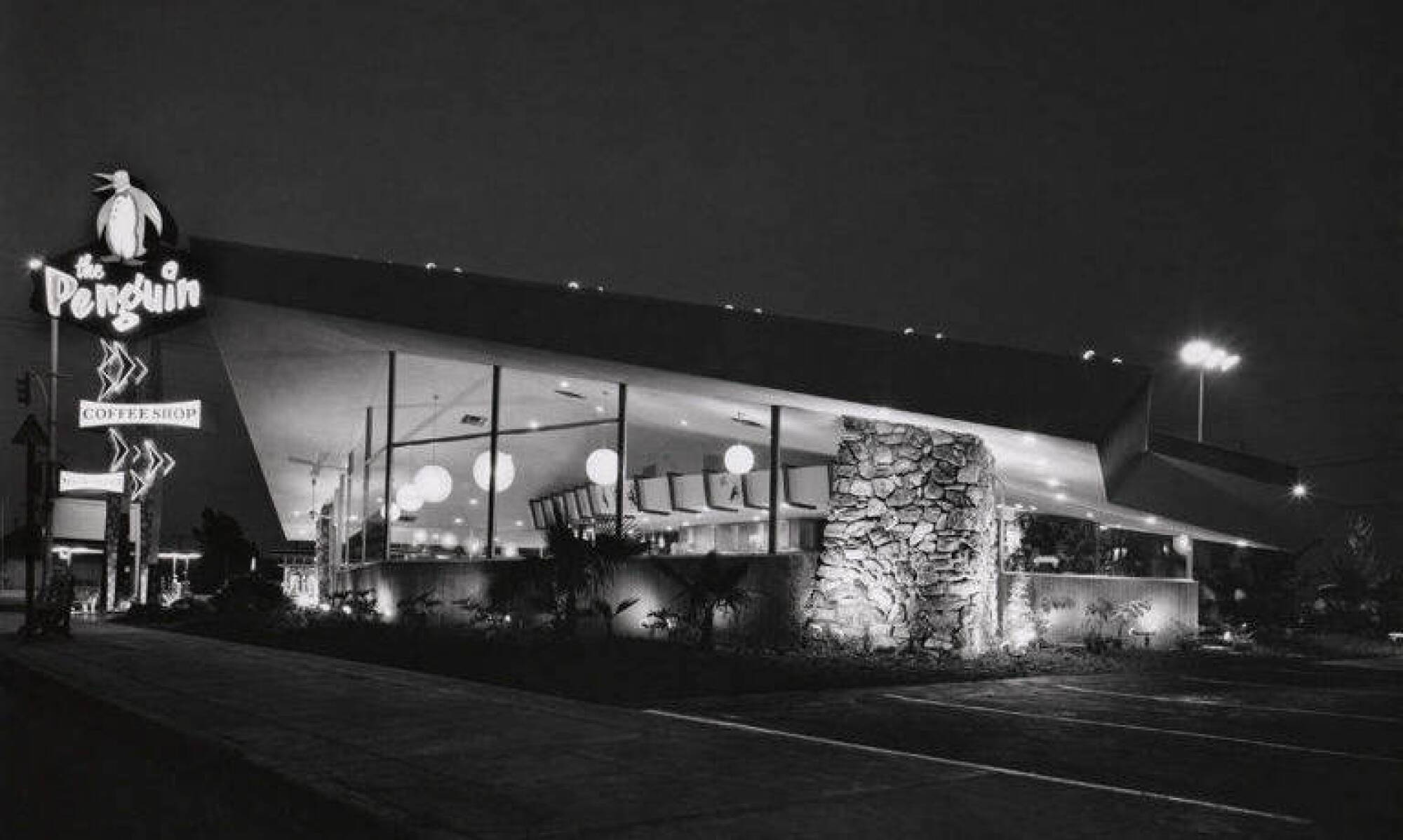
A building at the corner of Lincoln and Olympics boulevards in Santa Monica holds a unique place in history. It marks the end of the 2,400-mile Route 66 westward journey. Once known as the Penguin Coffee Shop, the site now houses Mel’s Drive-In. However, the building’s future is uncertain as its owners consider replacing it with an eight-story apartment complex. Local preservationists aim to secure historic status to protect it.
Preservation Efforts
A showdown looms on December 14 when the Santa Monica Landmarks Commission will review a proposal for landmark status, submitted by the Santa Monica Conservancy and the Los Angeles Conservancy. These advocates argue that the building, designed by Armet & Davis, epitomizes mid-century Googie architecture in Santa Monica.
Nina Fresco, Vice President of Santa Monica Conservancy, emphasized, “This isn’t about saving a modern restaurant. It’s about preserving important Googie architecture.”
Fresco advocates for combining historic preservation with housing development. Meanwhile, ValueRock Realty purchased the site in 2020 for $6.2 million and listed it in 2025 for $26 million. Upon learning of the sale, preservation groups quickly pushed for landmark designation to deter demolition. They raised $6,800 to cover application costs.
Potential Development Plans
ValueRock Realty submitted a preliminary application to replace the 1959 building with a new structure. This proposal includes 138 apartments, 123 parking spots, and retail space. Despite acknowledging the site’s historical value in prior statements, the application omits this recognition.
Fresco noted, “Under city law, buildings over 40 years old require a 75-day wait after a demolition permit request. So, we’re protected until the December hearing.” Landmark status could prevent demolition, but the owner might appeal to the City Council if the commission backs preservation.
Building’s Historical Significance
Mel’s Drive-In remains operational and attracts both locals and Route 66 travelers. While the building, designed by Armet & Davis, has undergone changes, renovations in 2016 aimed to restore its 1950s charm.
Architectural historians view the Googie style as a distinct mid-century modernist approach, characterized by bold designs and neon elements. Though not featured in significant architectural guidebooks, Mel’s received a $10,000 grant for Route 66 centennial signage from the National Trust for Historic Preservation.
Rhys Martin from the National Trust stated, “This site, like Route 66 itself, represents something greater than itself. It’s a connection to a journey through time and space that will be forever lost if this remarkable Googie structure is demolished.”
Options for Compromise
Fresco hopes for a development solution that retains the existing structure while introducing new housing, a model seen in other Santa Monica projects. For instance, 829 Broadway integrated a historic Quonset hut into a modern apartment development.
If the conservancies obtain landmark status, the owners could still develop the site but with considerate adjustments. Route 66’s original end point, determined in 1935, lies at Lincoln and Olympic boulevards, a testament to its historic significance in American culture.
By 1959, the Penguin Coffee Shop catered to Route 66 travelers, strategically positioned along evolving transportation routes. Its prominence reflects how popular culture has influenced Los Angeles’s urban landscape.
Leave a Reply