Significant Moments from October 18 in Chicago’s History
According to the Tribune archives, October 18 has seen its share of notable events in the Chicago area. Here’s a look back at some of these historical occurrences.
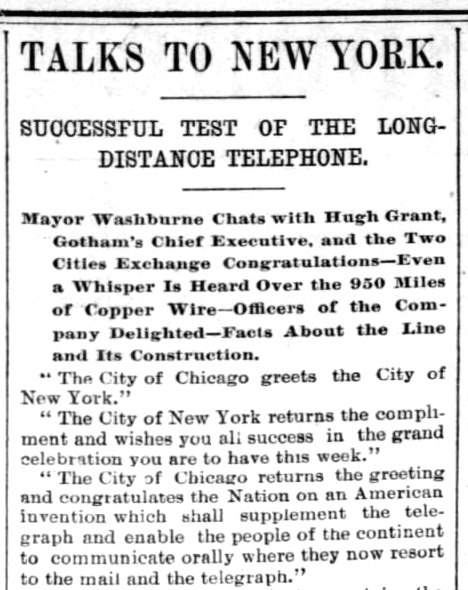
The First Telephone Call Between Chicago and New York in 1892
On October 18, 1892, the first telephone call was attempted between Chicago and New York. At the time, Chicago Mayor Hempstead Washburne managed to hear New York Mayor Hugh J. Grant, but Grant couldn’t hear Washburne. Nonetheless, a cornet solo was clearly audible. The Tribune reported that forty receivers in the circuit were all in use by the room’s crowd, which reduced the sound.
Weather Records in Chicago
- High temperature: 87 degrees in 1950
- Low temperature: 20 degrees in 1948
- Precipitation: 2.09 inches in 1985
- Snowfall: 0.7 inches in 1989
Duchess the Elephant’s Escape in 1892
Also in 1892, an elephant named Duchess escaped from Lincoln Park Zoo. Duchess, an 18-year-old female, got loose from her handler and caused a commotion. She broke the door of a saloon on North Avenue, smashed another window, and walked through a vacant lot’s fence before being captured and returned to her stall by noon.
Football’s Historic Game in 1924
The newly dedicated Memorial Stadium became the site of an iconic football match on October 18, 1924. Illinois met Michigan, and Harold “Red” Grange delivered a remarkable performance, scoring five touchdowns. The “Galloping Ghost” began the game by running 95 yards to score a touchdown, helping Illinois upset Michigan with a final score of 39-14.
Architect Ludwig Mies van der Rohe Arrives in 1938
In 1938, the prominent German architect Ludwig Mies van der Rohe arrived in Chicago. He took the helm of the architecture department at the Armour Institute of Technology, now known as the Illinois Institute of Technology.
The 1995 Eric Morse Case
Tragedy struck in 1995 when Jesse Rankins, 11, and Tykeece Johnson, 12, were found guilty of murdering five-year-old Eric Morse. They dropped him from the 14th floor of the Ida B. Wells public housing complex after he refused to steal candy. This case prompted Illinois to lower the minimum age for imprisonment from 13 to 10.
For more on Chicago’s past, subscribe to the Vintage Chicago Tribune newsletter or follow Chicagoland history on social media.
Leave a Reply