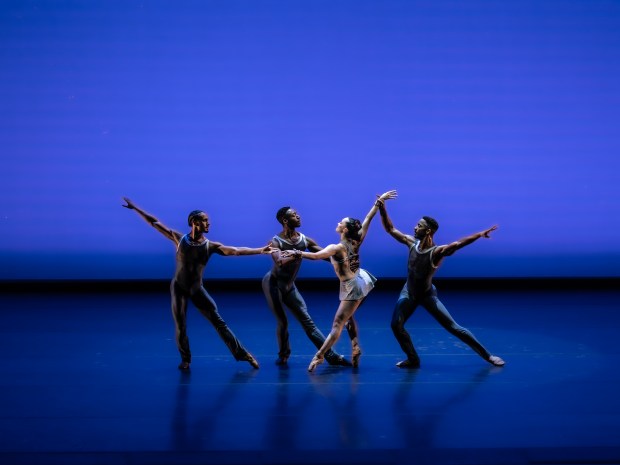
Robert Garland’s Return opened Dance Theatre of Harlem’s latest appearance in Chicago, coinciding with the company’s revival after a decade-long absence from the city. This neoclassical funk ballet, first created in 1999, uses music by James Brown and Aretha Franklin. Artistic Director Garland described the production as a personal testament, embodying all of his influences in a single piece. This sentiment captures the essence of Dance Theatre of Harlem, which graced the stage for a single performance at the Auditorium, marking the start of a season focused on North American dance.
Dance Theatre of Harlem was founded in 1969 by New York City Ballet principal dancer Arthur Mitchell during the civil rights movement. It began in Harlem, teaching ballet classes at a time when Black representation in ballet was sparse. Although there has been some progress, American ballet still struggles with full integration. Pioneers like George Balanchine envisioned a diverse ballet world, yet many companies show limited diversity today. Despite these challenges, Mitchell persevered, establishing the belief that ballet belongs to everyone. The company’s resilience is significant, having overcome an eight-year hiatus caused by financial troubles.
The company performed again in Chicago in 2014, revisiting Garland’s Return and other works. Two years later, they returned as a prominent voice in Black artistry, responding to social and political climates. This season’s performance drew a large audience, partly due to Garland’s artistic vision. Raised in Philadelphia, Garland merges classical ballet with funk-soul influences, captivating audiences with this unique blend.
In Return, dancers Carly Greene and Micah Bullard displayed remarkable versatility, transitioning between hip hop-inspired undulations and precise pirouettes. The mod-inspired costumes by Pamela Allen-Cummings, along with Roma Flowers’ dynamic lighting, enhanced the performance. This versatility extends to other works, such as Donizetti Variations, showcasing Dance Theatre of Harlem’s ability to master traditional ballet styles alongside contemporary expressions.
The Firebird, another highlight of the program, offers a timeless narrative. Choreographed by John Taras in 1982, this one-act ballet is based on a Russian fairy tale. Originally created by Michel Fokine in 1910 for Serge Diaghilev’s Ballets Russes, Taras’ version relocates the story to a Caribbean setting. With Geoffrey Holder’s scenic designs, it evokes a vivid tropical world. The tale involves a man, played by Derek Brockington, who receives a magical feather from the Firebird, portrayed by Alexandra Hutchinson, to help overcome the Prince of Evil, performed by Jhaelin McQuay.
The performance features elegant movements and a mesmerizing synthesis of narrative dance. Hutchinson’s portrayal of the Firebird blends elegance with sharp, birdlike gestures, embodying the character’s mystique. As the story concludes, the Firebird’s intervention secures a happy ending, with the piece resonating as one of Dance Theatre of Harlem’s signature works.
The Firebird, while carrying elements of the 1980s, transcends its era through timeless storytelling and choreography. Taras’ legacy as a ‘roving Balanchinian,’ as noted by The Guardian, spread the notion of plotless ballets globally. His Firebird remains faithful to Fokine’s vision, with the Dance Theatre of Harlem dancers elevating the experience. Altogether, the program provided a transformative evening of ballet.
Lauren Warnecke is a freelance critic.
Leave a Reply