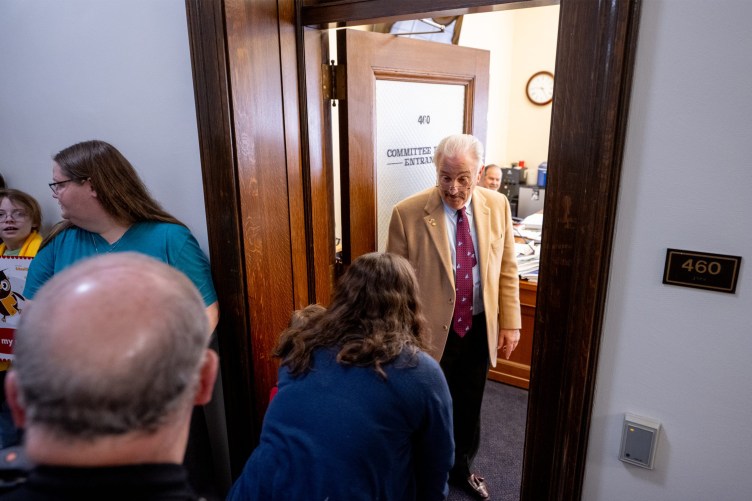
On a chilly February morning in West Virginia, children bundled in winter jackets gathered outside the House Finance Committee room. They held signs and their schoolwork, waiting with their parents. Inside, Delegate Vernon Criss considered the controversy surrounding a voucher program that redirected public funds to private education. Just days before, Criss suggested limiting payouts from this program. His proposal sparked daily visits from families and lobbyists who warned that the change would end the program entirely.
Criss initially supported the Hope Scholarship program, a first-of-its-kind educational savings account with no income requirements. Since its inception, similar programs have emerged in 12 other states. In its initial year, the program spent $9 million, but costs were projected to exceed $200 million annually by 2026. Criss was concerned this growth, alongside tax cuts, could jeopardize the state budget. He urged lawmakers to address fiscal reality seriously.
At a meeting in Charleston, when asked if the Hope Scholarship bill was on the agenda, Criss replied negatively. The parents and children then left in disappointment. Days later, lawmakers abandoned efforts to limit voucher spending, and Criss found his political future in jeopardy.
These elections are a warning to Republican leaders like Vernon Criss — if you oppose school freedom, expect to be held accountable.— David McIntosh, President of School Freedom Fund
The financial muscle behind the bill’s defeat and Criss’s targeting led to local and national ‘school choice’ advocates. When Republicans took over the West Virginia Legislature in 2015, voucher-style programs became a key agenda. Organizations like the Koch family network and billionaire Jeffrey Yass heavily funded campaigns to support private education funding.
The Hope Scholarship began with 2,300 students but grew to 26,000, exceeding the largest public school district’s enrollment. Political action committees, including ones linked to the Kochs and Yass, spent heavily to unseat lawmakers who opposed the program, including Criss. During the 2026 primaries, they helped defeat four Republican incumbents, notably Criss. His attempt to impose fiscal limits on the program coincided with severe funding issues for public schools. Since 2019, 70 schools closed, losing over 30,000 students. Meanwhile, political nonprofits continued advocating for voucher expansions.
Jason Huffman, director of Americans for Prosperity-West Virginia, played a significant role in shaping the Hope Scholarship. He sought to create a model open to all residents, regardless of income. Cardinal Institute, a conservative think tank, supported public funding for private schooling and received funds from Koch and Yass-related entities.
Families who backed the Hope Scholarship found allies in organizations like the Institute for Justice, which defends libertarian causes in court, and Cardinal Institute. They argued against public school advocates, leading to a legal battle won by the scholarship supporters. Attorney General Patrick Morrisey defended the program, boosting his gubernatorial prospects. The Club for Growth, supported by Yass, spent generously to aid Morrisey’s successful campaign.
By January 2025, as Morrisey took office, he vowed to expand the Hope Scholarship. The nonpartisan Rand Corporation reported on the state’s education crisis, with the program’s costs escalating. Criss proposed capping scholarship amounts to make the program sustainable, triggering opposition from voucher advocates.
Among these advocates was Katie Switzer, a vocal supporter of schooling alternatives. She criticized Criss’s plan, emphasizing its potential to limit families’ options. Leaders like Huffman portrayed the financial proposal as a threat to educational freedom.
Despite the political and community pressure, Criss stood by his plan, stating the need for sustainable budgeting. Yet, he failed to gather enough support to pass his measures. Campaigns against Criss focused on portraying him as a liberal outlier and accusing him of opposing conservative values. Americans for Prosperity and affiliated groups invested heavily against Criss, ultimately leading to his defeat by Charles Hartzog, a young gas station cashier.
Now, as Criss mounts a write-in campaign for his district, he reflects on the intense political forces at play and the implications for West Virginia’s education landscape.
Leave a Reply