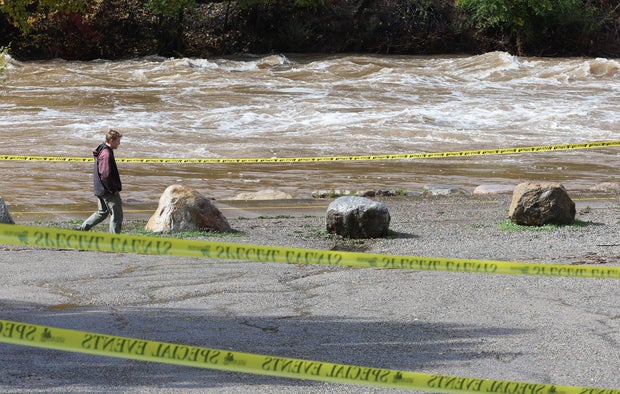
The Southwest U.S. faces a new wave of heavy showers and thunderstorms after recent rains led to evacuations and water rescues. The National Weather Service has issued a flood watch for the Four Corners region, which includes parts of Arizona, Colorado, New Mexico, and Utah. Local officials expect rivers to continue receding as the rains began last Wednesday.
Meteorologist Andrew Kozak from CBS News warns that repeated heavy rain and storms might flood roads, small streams, narrow canyons, and burn scars. The rain is predicted to move into the central and northern Plains on Sunday night and reach the Upper Midwest by Monday and Tuesday.
The Colorado Department of Transportation reported increased water flow levels in the San Juan River overnight. The San Juan River Bridge remains closed while video footage from CBS Colorado shows a house in Pagosa Springs submerged in floodwaters, with only a small piece of the roof and chimney visible. The Animas River also remained closed in Durango, Colorado as of Saturday, October 24, 2026.
Chris Mott, a Pagosa Springs resident, shared a video revealing rushing water through his neighborhood. “I’m sorry, buddy. I tried. I really tried. But this one was bigger than the last one,” Mott stated, highlighting the challenges faced by residents.
San Juan County in New Mexico experienced significant flooding, with about 4 feet of water affecting the home of Sheriff Shane Ferrari. While the situation appeared stable as of Sunday, residents, including Ferrari, are working on cleanup and damage repair.
The county spokesperson, Devin Neeley, mentioned there are no official damage numbers or evacuation statistics yet, with no reports of fatalities. Floodwaters have begun to recede but left behind mud and silt contaminated with sewage due to waste plant failures. Power outages persist in several areas, and electricity restoration may take several days.
Neeley described the area as a “pretty active disaster zone,” noting that recovery is ongoing. Recent tropical moisture from the Pacific has caused recurring heavy rain over two months, ending a period of drought but triggering destructive floods in places like the Grand Canyon and parts of New Mexico.
Leave a Reply