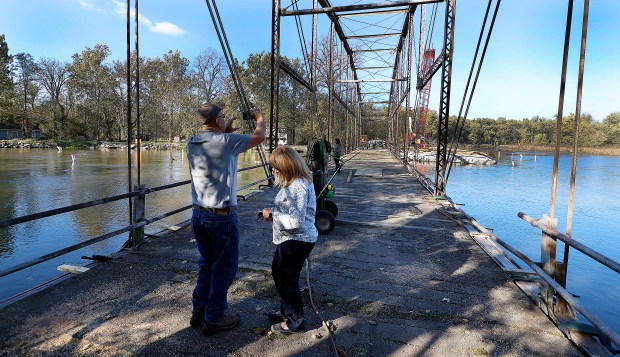
The State Line Bridge, a structure beset by snags and mosquito infestations since 1999, is set to be lifted off the Kankakee River by a massive crane. Subject to favorable weather conditions, this could occur as soon as next week.
During the opening ceremony dedicated to the bridge’s removal project, Craig Long and his companion, Jan Krizik, took photos for remembrance. The event, hosted by the Kankakee River Basin and Yellow River Basin Development Commission on October 28, 2026, was attended by members of the community.
Scott Pelath, the Executive Director of the commission, offered a succinct eulogy for the bridge, highlighting its aesthetic appeal and historical significance. Despite these attributes, the bridge has been closed to vehicular traffic since 1999. It stands two feet above the river, acting as an obstruction during floods and hampering the safe flow of floodwater.
The structure’s removal is essential for flood management, affecting residents in both Indiana and Illinois. Pelath noted that the bridge’s antiquated structure poses a risk of collapsing into Illinois during future floods, making its responsible dismantling a priority. Plans are in place to potentially reconstruct the bridge elsewhere for public use.
Once removed, the bridge components will be stored at the Lake County Highway Department. The $2.5 million project will also involve labeling each part for future assembly.
Removal Process
Project Manager Jordan Falls and Senior Superintendent Chris Creasbaum explained the logistics. A large crane, stationed 88 feet into the water on constructed stone piles, will detach the bridge from its supports. It will then move the 224-foot-long bridge to dry land, where it will be taken apart systematically.
This isn’t the bridge’s first relocation. Tony Ferraro, representative for northern Indiana, shared its history of being moved from Kankakee County in 1920. According to the Indiana Department of Natural Resources, the State Line Bridge is a Pennsylvania truss bridge, a rare and distinctive structure.
Historical Context
The bridge’s original construction dates back to around 1900, initially spanning the river south of what is now Illinois Highway 17. By 1920, it had relocated to its current position. Despite its lack of traffic, the bridge became a point of debris collection during floods.
The National Park Service noted the bridge’s unique engineering features, such as its light verticals and absence of certain structural elements. Communities expressed nostalgia, as shared by local anecdotes of fishing and gatherings on the bridge.
Environmental and Community Impact
The Kankakee River, a navigable waterway, exhibits diverse characteristics between Indiana and Illinois. Indiana’s portion underwent significant modifications a century ago, impacting natural flow and requiring eventual corrective measures.
State Representative Jim Pressel addressed past flooding issues, crediting the commission for recent improvements. Meanwhile, Toby Timmons, a nearby resident, highlighted the bridge’s transformation over time.
Efforts to ensure better water management and safety have been ongoing, explained by John McNamara and Rep. Mike Aylesworth. Their work reflects the increased focus on preserving natural environments and infrastructure.
The story and memories of the State Line Bridge resonate with local residents, enhancing community identity despite the necessity for progress.
It’s an emotional moment for many, marking the end of an era while ensuring future safety and environmental stewardship.
Leave a Reply