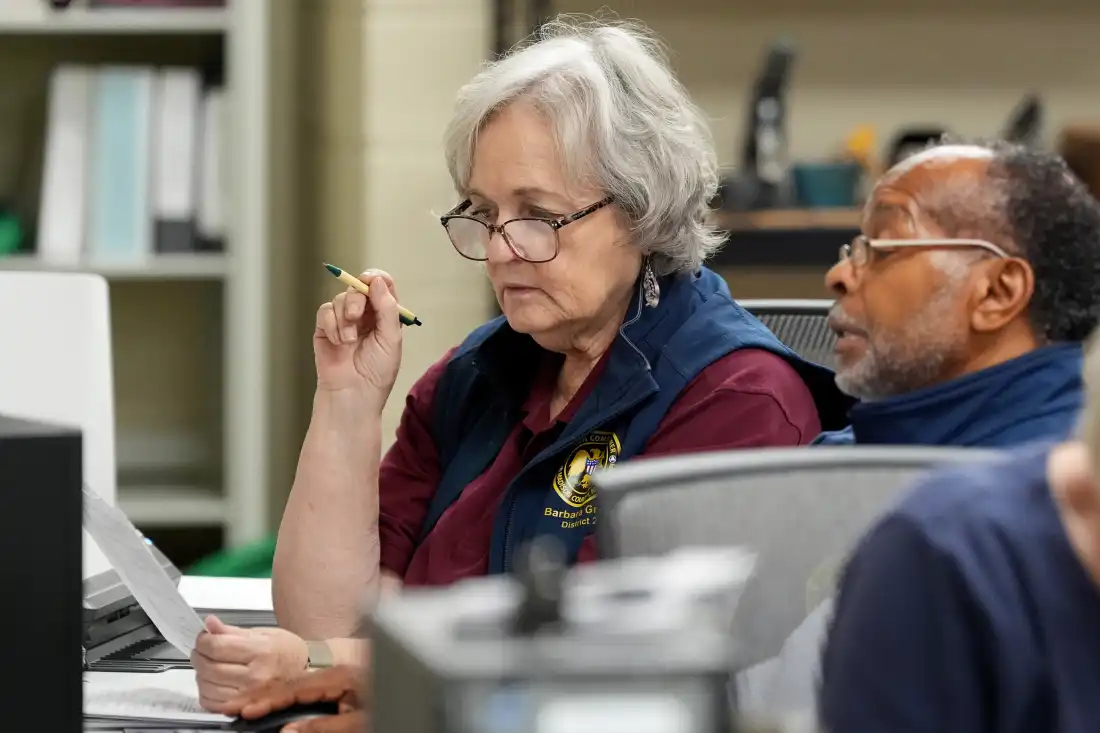
Two Madison County election commissioners are seen inspecting an affidavit ballot envelope in Canton, Miss. This activity highlights concerns in Mississippi’s election process, particularly in the context of the close U.S. Senate race. Every ballot counts, yet the total number of ballots left to process remains uncertain.
The contest between incumbent Republican Sen. Cindy Hyde-Smith and Democratic challenger Scott Colom draws attention to Mississippi’s election system. It is known for being both slow and decentralized. According to Michael Morse, a University of Pennsylvania law professor focused on voting, Mississippi’s administration of elections is not exemplary.
By midday Friday, the candidates were separated by fewer than 2,000 votes. However, detailed information on outstanding ballots is lacking. The Colom campaign reported awareness of over 15,000 provisional ballots pending verification. The state Republican Party estimated 20,000 outstanding ballots, including absentee votes, which may be counted if postmarked by Election Day and received by Nov. 10.
Mississippi’s Secretary of State Michael Watson highlighted that the counties manage their elections independently. Even his office does not have precise numbers on outstanding provisionals. As of Thursday, nearly 7,000 of these ballots had been processed, with about 80% accepted. Watson emphasized that individual counties serve as the best source for the latest information, but they are not required to report results to the state until the following week.
Morse expressed surprise at the lack of transparency in such an important race. He mentioned struggles in comprehending the process and called for basic information which is currently unavailable.
Mississippi reports a relatively high rate of provisional ballots, locally termed affidavit ballots. These are completed by voters whose eligibility is uncertain and are reviewed individually to decide if they will be counted. If the Colom campaign’s figures are correct, these affidavit ballots constitute approximately 1.5% of the total votes cast.
In the 2022 midterm elections, only four states had a higher rate of provisional ballots. Mississippi’s rate this year appears to double that of North Carolina. One reason may relate to how Mississippi conducts voter registration. Unlike many states where inactive voters can still vote normally for several years, Mississippi requires them to vote provisionally which involves additional paperwork and verification.
The state’s practice of using credit data to update voter lists has drawn scrutiny. Morse noted this method, while gaining attention, may not fully explain the high rate of provisional ballots. He remarked that combining credit data experiments with an uncommon procedural practice contributes to unreliable voter verification.
Watson defended the registration process, stating that the extra time needed to vote provisionally enhances voter roll accuracy. Yet, Kathy Boockvar, former Secretary of State of Pennsylvania, argued this process diminishes voter trust. She remarked that it makes voters feel suspected despite believing in their eligibility.
Boockvar added that Mississippi’s lack of visibility in previous elections is apparent due to the difficulty in obtaining information. She stressed the importance of transparency and quality data to counteract public doubt.
Leave a Reply