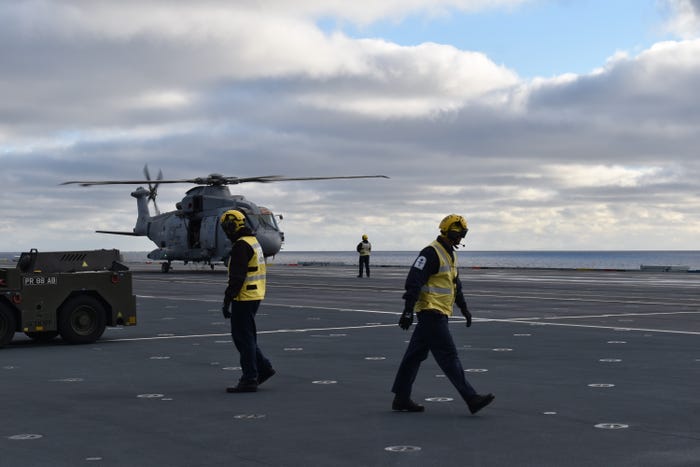
A Royal Navy helicopter navigates through thick fog over Norway’s rugged coastlines to the cold waters below. The drop in temperature brings harsher weather and limited daylight to the High North. The Merlink Mk4 helicopter lands on the flight deck of the HMS Prince of Wales, the UK’s flagship aircraft carrier. Here, bundled-up sailors maneuver F-35 stealth fighter jets as the autumn sun quickly dips towards the horizon, complicating operations in the fading light.
In November, Business Insider visited the Prince of Wales while it operated in the Norwegian Sea. This deployment marks the second phase of Operation Firecrest, aimed at deterring threats in the Arctic and the North Atlantic.
NATO’s focus has increased on strengthening its northern flank due to rising Russian military activity. Operating in the High North during these seasons poses unique challenges for allied forces. “The High North is a complex environment,” noted Capt. Ben Power, the Prince of Wales’ commanding officer, during an interview on the bridge.
Winter brings ice, low-pressure systems, and thick fog, necessitating readiness and ability to operate without radar signals or radio communications. These skills, crucial for enhancing warfighting proficiency, are significantly more complex in the High North.
NATO has expanded joint operations in the Arctic and North Atlantic to track Russian naval movements. Western officials emphasize monitoring Russian submarines, many stationed in Murmansk along the Barents Sea. These submarines typically navigate through strategic chokepoints like the GIUK gap to reach other seas. A firm NATO presence in this area is vital.
“We’ve observed increased Russian activity across all fronts — above, on, and particularly beneath the sea,” Power explained. “Russia continues to pose a credible threat,” he added.
Naval officers previously shared how harsh weather, particularly in winter, affects operations on a Dutch frigate in the Arctic, mentioning the influence of poor visibility and rough seas on flight operations. Training in challenging locations ensures crews are prepared for adverse conditions.
Commodore Richard Hewitt, commander of the UK’s carrier strike group, praised the Prince of Wales crew’s ability to manage such difficulties. The first phase of Operation Firecrest saw the carrier supporting Arctic Sentry, a NATO mission to boost High North security through exercises and patrols.
“This year has focused on the High North,” Hewitt stated. “I anticipate continued operations in the North Atlantic,” he affirmed.
Business Insider, with defense correspondent Jake Epstein, shares these strategic insights from the field. Jake, based in London, has reported from conflict zones and has extensively covered NATO operations in Europe, including numerous airborne military missions.
Leave a Reply