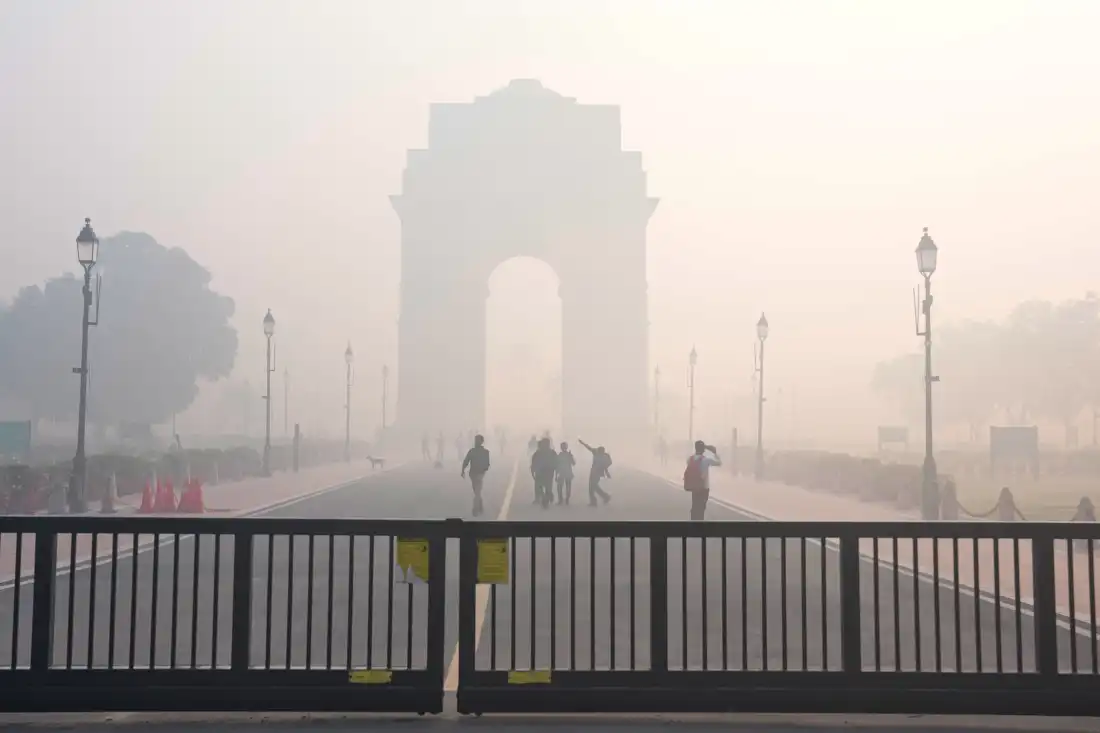
In New Delhi, a thick layer of smog enveloped the city on Monday, following Diwali celebrations. The use of firecrackers during these celebrations elevated the already high pollution levels, worsening the annual air quality crisis in the city.
Despite rules against fireworks, Diwali revelers in New Delhi continued to use them on Sunday night. This resulted in the release of smoke and fine particles into the air. The air quality index in several areas surpassed 350 by Monday morning. Such levels pose serious health risks. Monitoring stations reported similarly concerning metrics. The city experienced reduced visibility as a gray haze covered roads and buildings.
In an effort to control pollution, India’s Supreme Court had set limits on Diwali firecrackers in October. They allowed only certain ‘green firecrackers’ that emit less pollution and restricted their use to specific three-hour periods on Saturday and Sunday. Although these crackers generate fewer emissions, they still contribute to the city’s pollution.
Isyad, who resides in New Delhi, mentioned experiencing health issues due to the pollution. “The pollution causes throat irritation and eye itching,” he commented. New Delhi, with its metropolitan area housing over 30 million residents, often ranks as one of the world’s most polluted cities during winter.
Diwali fireworks make the pollution worse, coinciding with cooler weather and smoke from crop burns in nearby Punjab and Haryana states. After harvesting rice, farmers burn remaining stalks to ready fields for the next planting. The resulting smoke drifts towards New Delhi, exacerbating pollution from vehicles, industries, and construction dust.
The issue becomes critical in late October and November. During this time, cool weather, low wind speed, and stagnant atmospheric conditions trap pollutants, forming a persistent haze over the capital and nearby regions.
Measures to combat pollution in New Delhi include limiting construction and diesel generator use. Courts also attempt to restrict firecrackers. However, severe pollution recurs annually. Environmentalists advocate for long-term solutions, such as cleaner energy and stricter vehicle emissions controls, to avert the yearly crisis.
Shweta Narayan, a public health expert at the Global Climate and Health Alliance, criticized the government’s reactive measures, describing them as ‘temporary.’ She remarked that significant actions occur only under pressure to address the crisis.
Leave a Reply