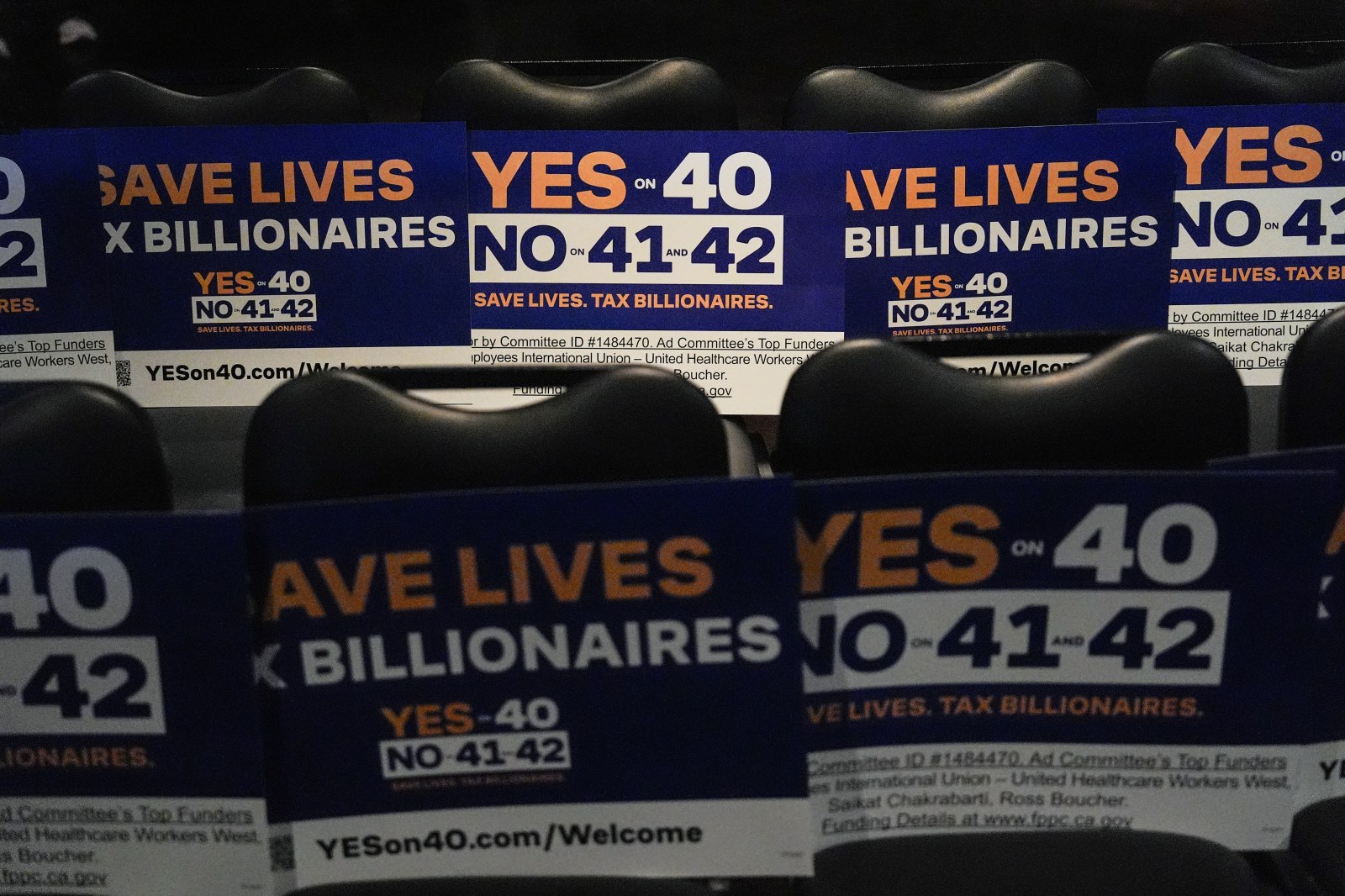
California voters have decided against Proposition 40, which aimed to introduce a state tax on billionaires’ net worth. According to the Associated Press, the decision was finalized six days after Election Day.
The vote resulted in a split among Democrats at senior levels. Governor Gavin Newsom opposed the proposal, citing concerns about the potential exodus of wealthy residents. On the other side, Senator Bernie Sanders and Representative Ro Khanna supported the measure, representing prominent progressive voices.
The semi-official tally by the Secretary of State, recorded at 5:14 p.m. on Monday, showed 5,789,026 voters (52.9%) rejecting the measure, and 5,159,356 (47.1%) supporting it.
Opposition and Financial Backing
Opponents of the measure raised significantly more funds than its supporters. The committee known as Building a Better California gathered over $333 million, with significant contributions like Google co-founder Sergey Brin’s $100 million donation.
Proposition 40’s Proposition
The proposal sought to levy a one-time tax of 5% on the net worth of billionaires residing in California as of January 1, 2026, payable in 2027. According to the nonpartisan Legislative Analyst’s Office analysis, most of the revenue would have supported healthcare, with the remainder allocated to education, food assistance, and administrative costs.
SEIU-United Healthcare Workers West, the union championing the measure, anticipated generating about $100 billion. However, the Legislative Analyst’s Office suggested revenues could reach ‘tens of billions’ over several years, acknowledging a potential decrease in billionaire-generated income tax of under $1 billion annually.
Divergent Views Among Economists
Economists presented opposing forecasts. A study by the Hoover Institution predicted that the tax would raise roughly $30 billion, far less than union projections. The report highlighted that nearly 30% of the relevant tax base had already moved out of California, estimating the net value to the state to be negative $38.9 billion.
Conversely, a paper from the National Bureau of Economic Research, co-authored by a drafter of the proposal, estimated possible tax receipts of up to $100 billion. It highlighted that California billionaires contribute about 0.2% of their wealth annually in state income tax, approximately equating to $3.2 billion.
Countermeasures and Future Implications
Building a Better California also endorsed Propositions 41 and 42, potentially conflicting with the wealth tax. If either received more affirmative votes than Proposition 40, courts might block the billionaire tax.
Though the supplementary measures were not needed to halt the tax, Proposition 42 might have lasting effects. It seeks to amend the state constitution to prevent new taxes on financial assets and most retroactive taxes. The semi-official tally placed Proposition 42 at 51.7% support, highlighting its possible endurance.
Significant figures in the tech world were already leaving the state before the tax’s proposed residency cutoff. While Sergey Brin and Larry Page began their departures beforehand, Meta CEO Mark Zuckerberg opted to remain. By committing to stay in California for eight years, he secured non-voting shares to address tax liabilities without losing corporate control.
Democratic Disagreement
Sanders endorsed the tax, commenting in December 2025 that national prosperity cannot rest on concentrated wealth. Khanna labeled Proposition 40 as “the most important ballot initiative in America.”
Governor Newsom, however, proposed a federal minimum tax on wealth starting at a net worth of $100 million, asserting a philosophical divergence with Sanders on state-level approaches.
A UC Berkeley poll conducted in October reported 45% of registered voters supporting the tax, 43% opposing, and 12% undecided, hinting at the electoral uncertainty prior to the final decision.
Potential Next Steps
If Proposition 42 passes, future wealth tax efforts in California would require another constitutional amendment by voters.
Observed as a foundational move, labor leaders saw this campaign as an indicator for other states. While the vote tally continues and official results await certification, this highlights a broader dialogue on wealth taxation.
Newsweek reached out to Building a Better California, SEIU-United Healthcare Workers West, and Newsom’s office for comments following the vote.
Leave a Reply