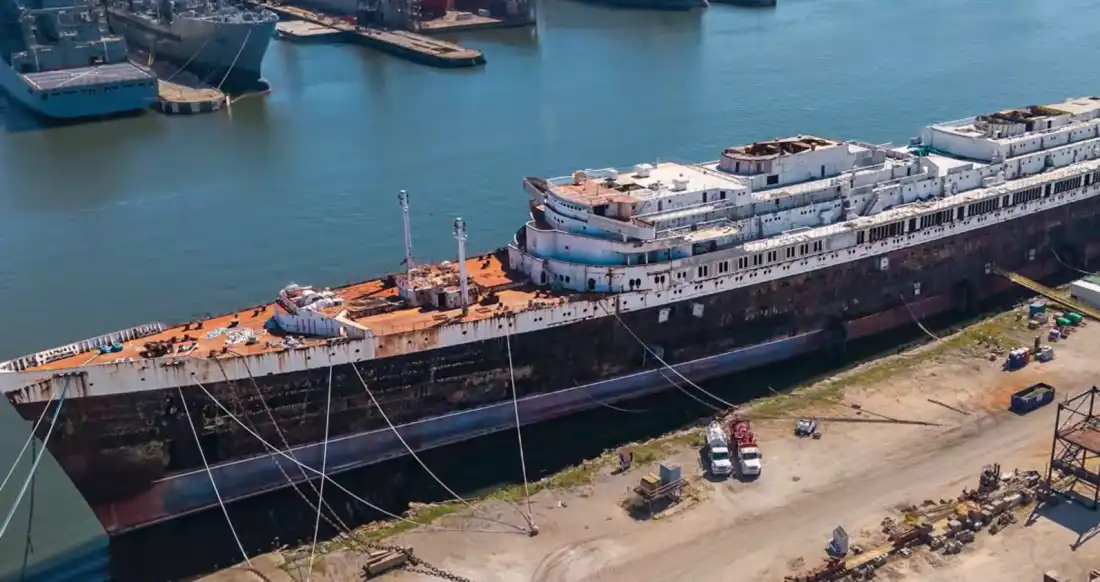
The SS United States, once the fastest passenger liner globally, crossed the Atlantic in under four days. On a recent Wednesday, it sank in five hours. The ship, launched in 1951 and longer than the RMS Titanic, carried four presidents, the Mona Lisa, and numerous 20th-century celebrities. After years of deterioration and facing demolition, a decision was made to transform it into what is anticipated to be the largest artificial reef.
The plan was executed off the coast of Okaloosa County, Florida. Crews removed plugs from the ship’s hull, allowing it to submerge without explosives. Delays occurred, but the process concluded swiftly. The ship tilted, then disappeared beneath the waves.
This transformation concludes the era of majestic ocean liners crossing seas in style.
Coastal communities aim to attract thrill-seeking tourists from global destinations, generating unexpected economic benefits. Karen Flynn, a wreck diver and maritime enthusiast, remarked that seeing it decay was far worse than the sinking. Her Maryland-based diving club planned a trip to explore the new artificial reef.
Visiting divers like Flynn are precisely the type of tourists Okaloosa County hopes to attract. Divers planning extended stays bolster the local economy with expenditures on gear, food, and accommodation. The Florida panhandle has already sunk hundreds of artificial reefs, largely ships or boats.
Economic Impact
According to Okaloosa County tourism director Jennifer Adams, the SS United States, nearly 1,000 feet long, is a significant addition. Reefs generate $10 to $12 million in yearly economic benefits for the county. Adams anticipates recouping their $10 million investment within a few years.
To make the site appealing to both tourists and marine life, and to meet federal regulations, the ship’s hull was stripped of toxins and bulky parts. Positioned just over 20 nautical miles from Destin’s beaches, it lies within recreational diving limits.
The SS United States now complements the USS Oriskany, an 888-foot post-war aircraft carrier, forming the world’s first and second largest artificial reefs. Florida has created over 4,000 artificial reefs since 1940. In 2017, the National Oceanic and Atmospheric Administration reported that visits to some reefs generated nearly a billion dollars in yearly benefits.
Economist Andrew Ropicki from the University of Florida noted the critical mass of planned shipwrecks potentially capturing more tourism revenue than other areas. However, he cautioned about possible diminishing returns if overinvestment occurs.
Plans are underway to sink five or six additional artificial reefs in Okaloosa County, said Adams. Her goal is for the unique sight of the SS United States to draw significant interest.
Reflecting on History
For Susan Gibbs, head of the SS United States Conservancy, the sinking evokes mixed emotions. She feels sorrow, coupled with gratitude, pride, and hope. Her grandfather, William Francis Gibbs, envisioned the ship nearly a century ago, and it symbolized American transportation might post-World War II.
“He would freely admit that he loved this ship a thousand times more than my grandmother,” Susan Gibbs recalled.
Although selling the ship to Okaloosa County for $1 million seemed like a modest sum compared to its original cost, Gibbs believes reefing offers a more dignified end than a scrapyard. Karen Flynn agrees, noting that the grandeur remains even underwater. She remarked that the sight of the ship’s bridge and bow stretching into the blue expanse will be stunning for divers.
Leave a Reply