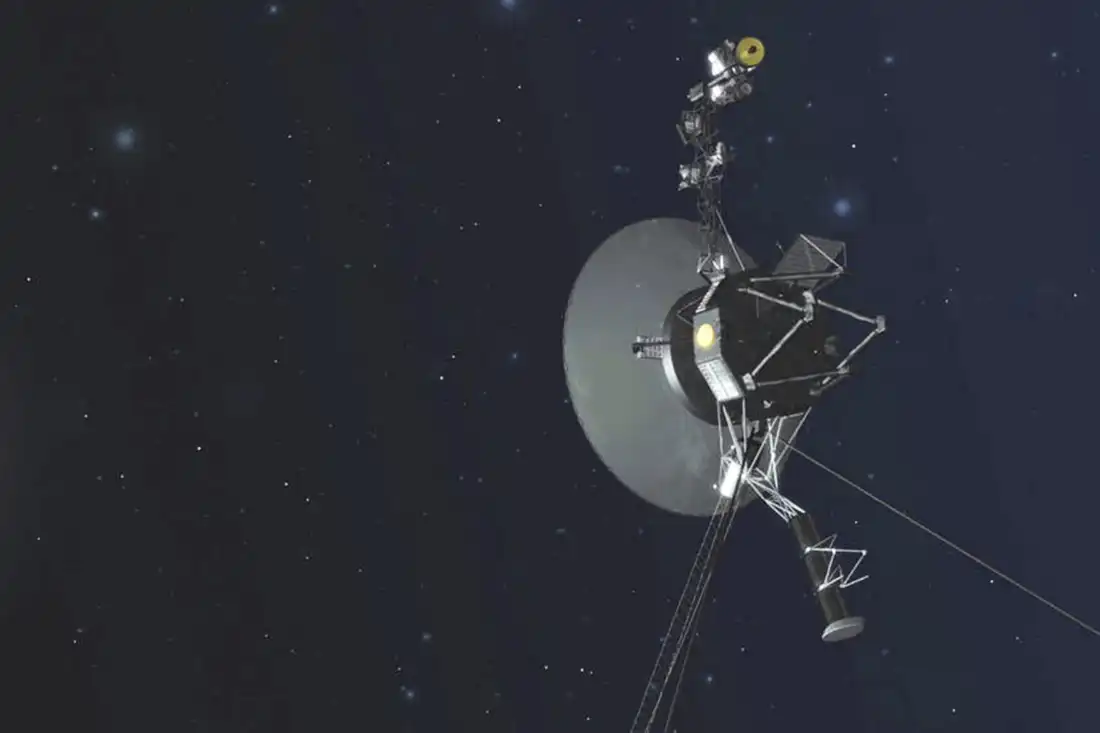
The NASA illustration shows Voyager 1, the spacecraft that has traveled farther than any other human-made object. On Wednesday, Voyager 1 is expected to reach a significant milestone by being one-light day away from Earth. This means that light, covering over 16 billion miles daily, takes a full day to travel from its position back to us.
In celebration, NASA has organized the “Shine Bright for Voyager’s Light-Day” event. This symbolic occasion asks the public to send Voyager’s call sign “V-G-R” into the sky in morse code on Tuesday night. Here’s how to participate:
- V: Three short flashes, one long flash
- G: Two long flashes, one short flash
- R: One short flash, one long flash, one short flash
Voyager 1, launched on September 5, 1977, continues its journey nearly 50 years later. It has conducted flybys of Jupiter and Saturn, uncovering a faint ring system on Jupiter in 1979 and capturing Saturn’s rings and moons in detail in 1980. Voyager 1 became the most distant human-made object on February 17, 1998, surpassing Pioneer 10. It is one of only two spacecraft, alongside Voyager 2, to leave the heliosphere—a bubble-like region that shields the solar system.
Since 2012, Voyager 1 has been on an interstellar mission, studying magnetic fields, particles, and plasma waves beyond the heliosphere and the atmospheres of other stars. NASA recently powered down the Low-energy Charged Particles experiment to conserve energy, potentially extending the spacecraft’s life. Despite this, Voyager 1 continues to operate with two functioning instruments.
Voyager 1 carries the Golden Record, an interstellar time capsule designed to convey Earth’s story to extraterrestrials. The gold-plated record holds 115 images, natural sounds including surf, wind, and animals, and greetings in 35 languages. Instructions on playback and details about the probe’s origin accompany these contents.
Voyager 1 will reach this “light-day status” at 5:16 a.m. ET on Wednesday, marking 49 years, two months, and 11 days of travel.
Leave a Reply