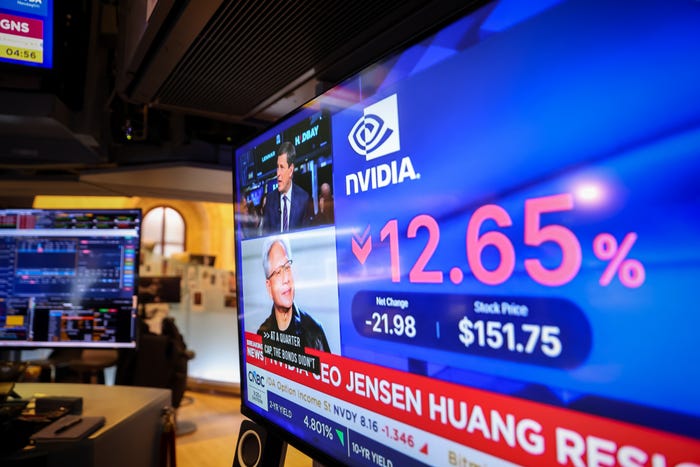
Nvidia is experiencing a significant slump in its stock price, affecting investor sentiment across global AI markets. This downturn is particularly impacting Asian markets as Nvidia’s stock issues spread to the region, causing steep declines in leading AI stocks.
As of Monday, the Kospi index in South Korea fell by 4%. This decline was driven by Samsung Electronics and SK Hynix, which saw their shares drop 4% and 8%, respectively. In Taiwan, the Taiex index plunged 6%, largely due to TSMC—Nvidia’s key chipmaking partner—also experiencing a 6% decline. Other Taiwanese chip firms, such as MediaTek and ASE Technology, also faced sharp drops. Japanese chip stocks were not immune, with Kioxia falling 8%, Tokyo Electron 7%, and Advantest 11%.
Meanwhile, in Hong Kong, tech stocks saw slight recovery despite last week’s downturn amid concerns over potential US restrictions on chip exports linked to Nvidia’s difficulties.
On Friday, Nvidia’s stock fell by 2% to settle at $162.85, culminating in a 13% loss for the week. Since peaking in October, the shares have declined by about a third due to the turmoil following cofounder Jensen Huang’s resignation as CEO. Nvidia’s challenges have had ripple effects throughout Asia, where it depends heavily on Taiwan’s TSMC and South Korea’s SK Hynix and Samsung Electronics for chip production and memory.
The brisk demand for AI chips, memory, and servers had previously driven stock-market rallies in both South Korea and Taiwan. Now, investors are contemplating whether Nvidia’s uncertainties could impact future orders and infrastructure spending. Wall Street expects Nvidia’s third-quarter fiscal revenue to reach $109 billion, with expected earnings growth of 90%, according to LSEG data. The earnings report is scheduled for release on Tuesday.
The future pricing of Nvidia’s stock is uncertain. According to Chris Weston, head of research at Pepperstone, even another strong quarter might not ease the pressure on Nvidia’s shares. He noted investors are now concentrating on Nvidia’s long-term prospects, given the uncertainties around its leadership and ability to maintain a competitive edge. Nvidia’s forward guidance, especially regarding chip orders or delivery schedules affecting Asian suppliers, is now more critical than recent results.
Charu Chanana, chief investment strategist at Saxo, emphasized that a positive earnings headline may have reduced impact if management expresses caution about future demand. Investors are also keeping an eye on the demand for Nvidia’s Blackwell chips and the next-generation Rubin processors to assess whether production and deliveries align with expectations.
Leave a Reply