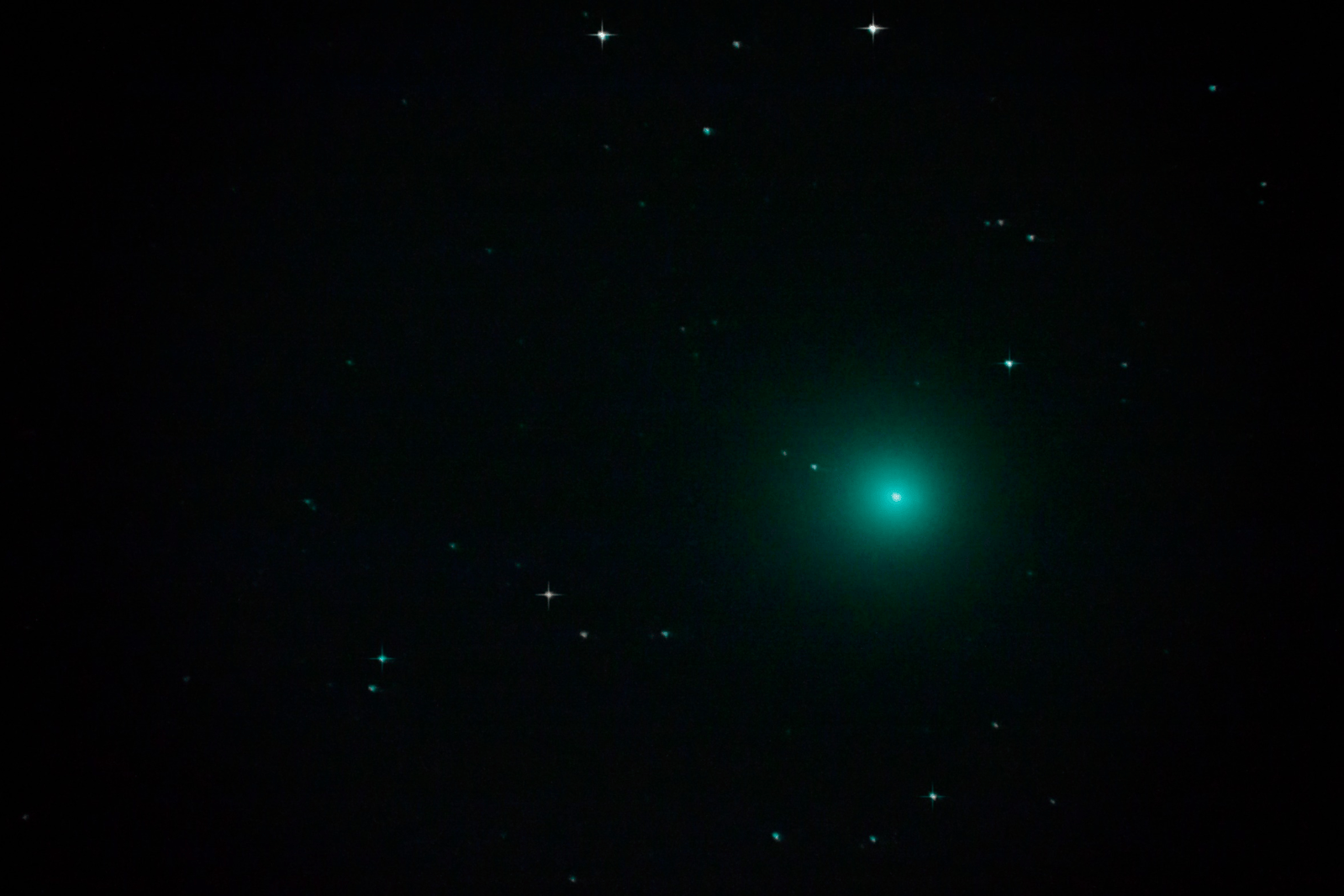
A small object orbiting the Sun, known as 1998 KY26, has become the center of a unique scientific debate. Scientists are exploring possibilities ranging from a rapidly spinning asteroid to a ‘dark comet,’ or even a lost Soviet spacecraft.
Discovery and Initial Observations
Astronomer Tom Gehrels discovered 1998 KY26 on May 28, 1998, during an observation session for the University of Arizona’s Spacewatch project at Kitt Peak. Early radar and telescope readings estimated it to be around 30 meters wide, spinning on its axis approximately every 10.7 minutes. However, more recent findings suggest it is only about 11 meters across, with a rotation period of around 5.35 minutes.
New Observations and Theories
New observations detected an unexpected push affecting 1998 KY26’s trajectory. Commonly, this effect in comets is due to gas and dust release, but 1998 KY26 lacks the expected cloud or tail.
Theory One: A Dark Comet
One explanation is that the object could be part of the ‘dark comet’ group, which receive extra movement without an obvious tail. A study led by Bryce T. Bolin using telescopes in Hawaii found no evidence of a dust cloud but noted that its rapid spinning might cause surface material to be flung away, slightly pushing the object.
Theory Two: The Lost Soviet Phobos 1 Probe
Abram Loeb from Harvard University and colleagues suggest 1998 KY26 might be the Soviet Phobos 1 probe, which lost contact in 1988. They highlight its orbit and unexplained movement as clues. While this theory is not confirmed, it poses thought-provoking questions.
Theory Three: A Tiny, Fast-Spinning Asteroid
1998 KY26 might simply represent an atypical asteroid. Using powerful telescopes and radar, Santana-Ros’s team concluded the object rotates every 5.35 minutes. Its rapid rotation implies it could be a cohesive rock instead of loosely bound debris.
Theory Four: A Dried-Out Object Without Ice
Research by Korbin Hansen and Masatoshi Hirabayashi examined if 1998 KY26 could retain enough water ice to act like a dark comet. Their model showed it’s too warm for this, implying any ice would have evaporated long ago, refuting this as the source of the extra push.
Renewed Interest and Future Exploration
The recent interest stems from several developments. New data show it is smaller, faster-spinning, and more reflective. Bolin’s research provides insight into its composition, while Hansen’s work challenges assumptions about ice. The Phobos 1 theory intrigues scientists with its fresh perspective.
Japan’s JAXA has sent Hayabusa2 on a mission to meet 1998 KY26 by 2031. It previously visited asteroid Ryugu and returned samples to Earth, now heading for its new objective, characterized as ‘rapidly rotating.’
Loeb anticipates this mission may clarify current theories, although his prediction remains speculative. Scientists expect that if Hayabusa2 reaches 1998 KY26, the object will reveal its true identity, solving this astronomical puzzle.
Newsweek leveraged Martyn, an AI assistant, to compile this story. For further details, connect with editors Tobias Meyjes and Emma Lee-Sang.
Leave a Reply