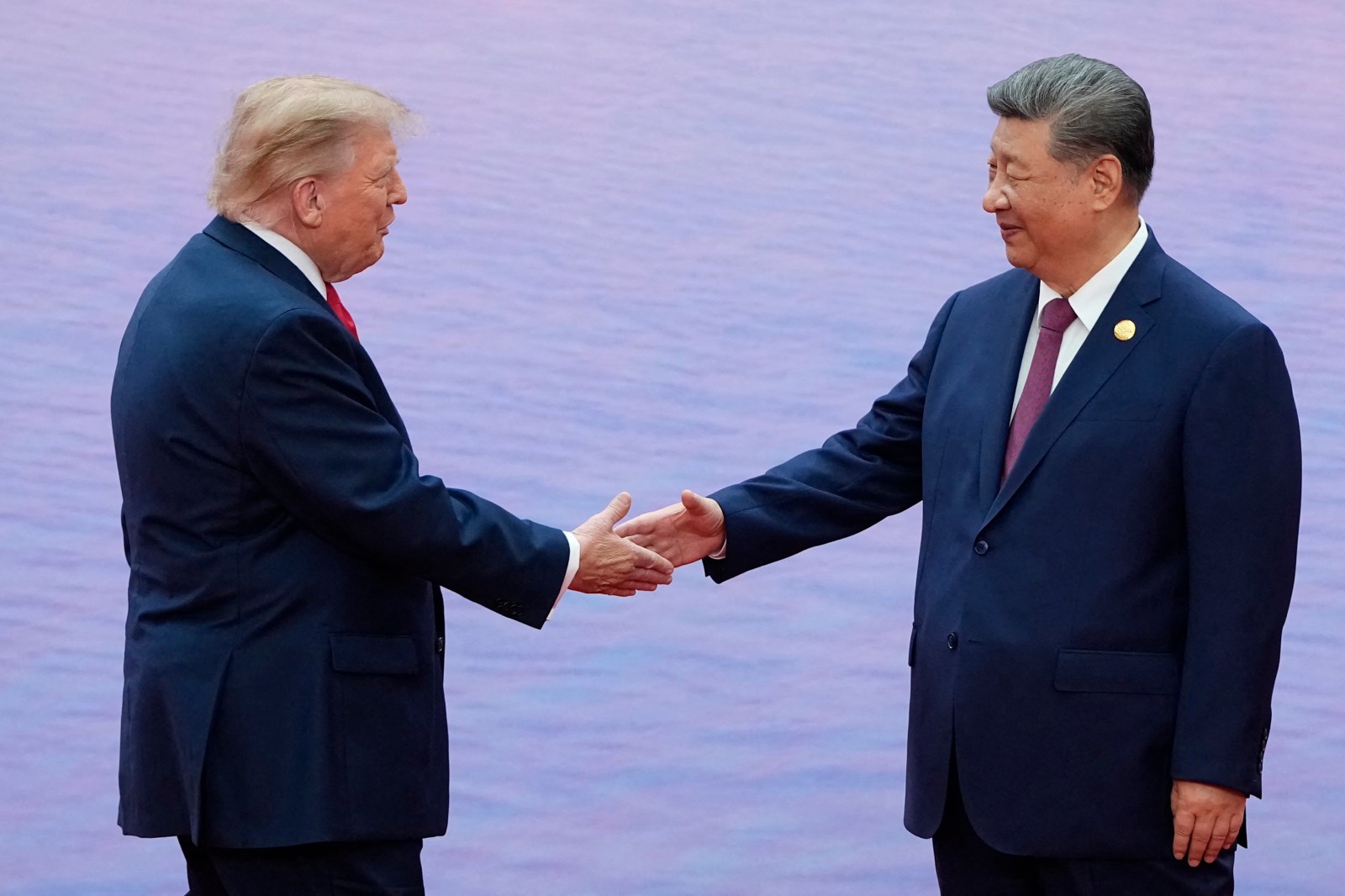
President Donald Trump arrived in China on Wednesday to engage in summit talks with Chinese President Xi Jinping. A key focus of these discussions is regional trade agreements in Asia. However, a significant issue for Trump’s administration is reducing reliance on Chinese mineral supplies and cultivating a domestic supply of essential minerals to counter China’s dominance.
A recent report by the U.S. Geological Survey (USGS) highlights China’s leading role in producing several critical minerals vital for national defense systems, semiconductor manufacturing, artificial intelligence infrastructure, and advanced batteries. The World Minerals Outlook (WMO) projects rising U.S. production capacity for eight critical minerals by 2030: antimony, copper, graphite, niobium, potash, silicon, silver, and tungsten. Despite this growth, China remains a leading supplier of these strategically important commodities.
The USGS report underscores the importance of these eight materials across industries crucial to both economic and national security. Currently, the U.S. imports over 50 percent of its annual consumption of each of these minerals. Seven are used in defense production and advanced technologies like semiconductors and electronics.
China accounts for 70 percent of global natural graphite production capacity, 70 percent of tungsten capacity, and 80 percent of silicon metal capacity. It is also a major exporter of antimony, graphite, and tungsten. Assistant Secretary of the Interior Andrea Travnicek emphasized, “In the 21st century, mineral security is national security.” China’s export restrictions last year disrupted U.S. manufacturers such as Ford Motor, demonstrating China’s leverage over these commodities.
When a single supplier controls most of a market, disruptions in that country can affect global supply.
said Braden Harker, director of the USGS National Minerals Information Center, warning about vulnerabilities in concentrated supply chains. The WMO points to the essential nature of strategic materials like copper, crucial for electronics and infrastructure, especially as data centers grow in demand.
Implications of Trump’s Meeting with Xi
The meeting between Trump and Xi is expected to address trade, technology, and supply chains amidst USGS findings. China has imposed export licensing requirements on antimony and graphite, adding controls on tungsten by 2025. USGS noted that tungsten prices outside China have more than doubled.
Inquiries to Newsweek about possible vulnerabilities in U.S. defense and technology supply chains highlighted the agency’s identification of risks associated with antimony, graphite, and tungsten in its 2025 critical minerals supply-chain analysis.
Can the U.S. Reduce Its Dependence on China?
The USGS report indicates potential growth in U.S. production capacity for antimony, graphite, and tungsten by 2030. This progress is crucial as the U.S. has had limited domestic production in recent decades. Harker suggested that economic factors would dictate any reduction in import dependence.
The expansion of supply must be driven by a mutually beneficial economic intersection of producers and consumers.
said Harker. Colin Williams from the USGS Mineral Resources Program noted ongoing mapping efforts to locate new mineral deposits for future domestic production.
Rich Nolan, CEO of the National Mining Association, pointed out the lengthy process to start mining operations in the U.S., currently averaging 29 years. Nolan stressed the necessity to recognize the challenge’s scale and intensify efforts to tackle it.
Future Prospects and Projections
According to the WMO, natural graphite production capacity is expected to grow by 20 percent globally through 2030, the largest among the studied minerals. Potash is projected to increase by 18 percent, with smaller gains for antimony, copper, niobium, silicon, silver, and tungsten.
Mines take time, and most capacity projected for 2030 was initiated before 2025.
said Harker, emphasizing the importance of time in mineral production. Andrew Stewart, lead author of the World Minerals Outlook, highlighted how the report can guide policymakers and industry in understanding supply risks and informing future investments.
For further details, contact Newsweek editors Ben Kelly and Cristina Diciu.
Leave a Reply