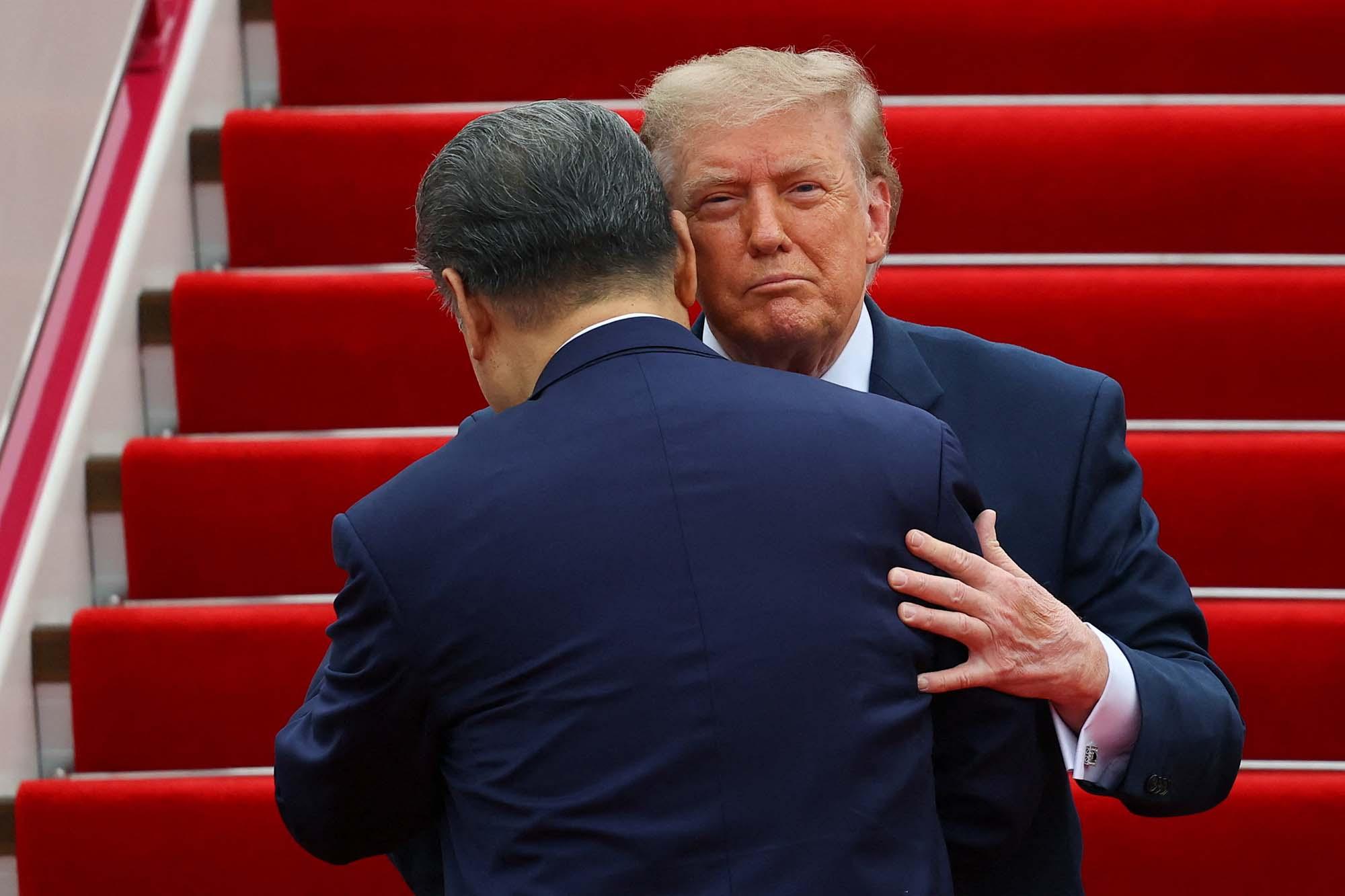
Chinese President Xi Jinping recently welcomed U.S. President Donald Trump at Shenzhen Airport, as he arrived to attend the Asia-Pacific Economic Cooperation (APEC) Leaders Summit in Shenzhen, China on November 18, 2026. The meeting between the two leaders drew significant attention, especially when Xi greeted Trump with a hug, an uncommon gesture for foreign leaders.
The press reacted strongly, with criticism centered around Trump’s perceived friendly approach to authoritarian leaders. Despite this display, Trump’s actions prior to the summit indicated a firm stance against China. He signed a trade agreement with Thailand, securing duty-free entry for American goods and addressing trade loopholes used by China through Thai ports to bypass tariffs.
Trump also reinforced the United States’ commitment to the 1951 Mutual Defense Treaty with The Philippines. Additionally, he announced joint anti-submarine patrols in the South China Sea involving the Quad nations—Australia, Japan, India, and the United States—aimed at monitoring Chinese submarine activities. These actions sent a clear message regarding China’s contested actions in the South China Sea.
The U.S. Department of Commerce, acting under Trump’s administration, restricted high-end chip sales not only to China but also to Southeast Asia, in response to security concerns. Future sales to countries like Singapore, Malaysia, and Indonesia will adhere to strict regulations to prevent unauthorized resales to China.
Trump’s administration remains cautious of President Xi’s reliability. China has allegedly breached trade agreements by failing to fulfill promises on rare earth shipments and agricultural purchases. Fentanyl precursors continue to flow to cartel labs, posing significant threats to American lives.
China engages in cyberattacks targeting infrastructure and personal financial accounts. It is also suspected of assisting North Korea in laundering funds.
Moreover, China’s support of Russia and Iran through covert shipments is seen as an attempt to extend America’s involvement in challenging military conflicts.
Within the Trump administration, figures like Secretary of Commerce Howard Lutnik may believe in the potential for cooperation with China. However, Trump’s approach indicates otherwise, suggesting a strategy aligned with the adage: Keep your friends close, and your enemies closer.
Steven W. Mosher, President of the Population Research Institute and author of “The Devil and Communist China: From Mao Down to Xi,” provides insights into the complexities of U.S.-China relations.
Leave a Reply