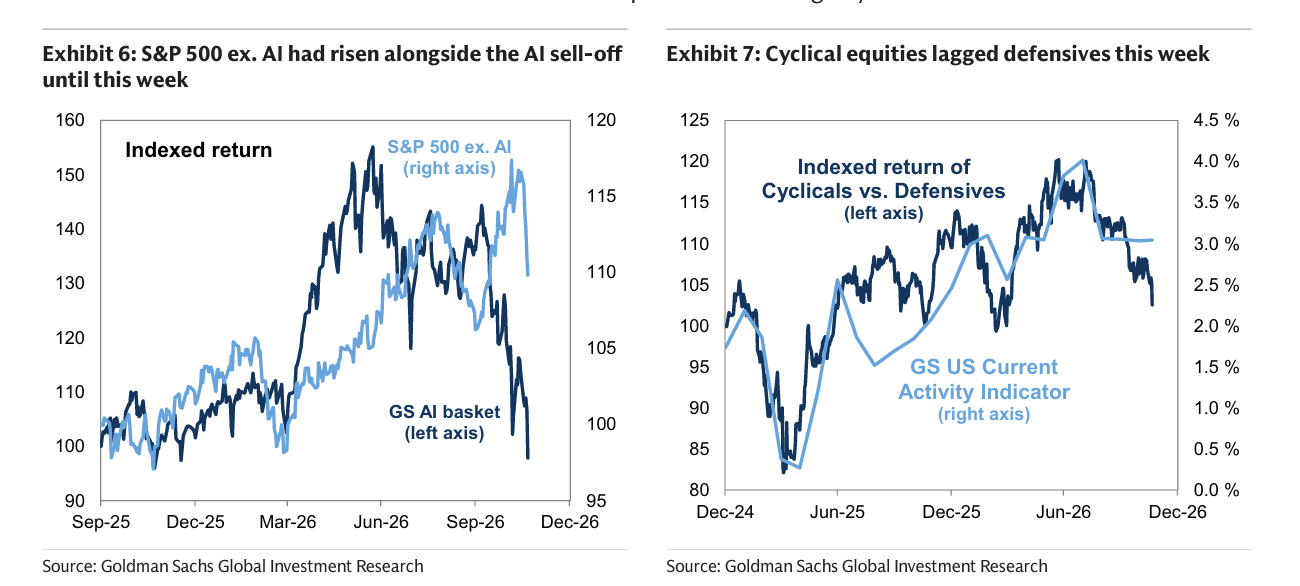
The S&P 500 ended on Friday in a correction phase, declining by 3.59% to 6,918.45. This marked its seventh consecutive loss, the longest since February 2020. Similarly, the Nasdaq Composite saw a drop of 5.28%, now over 2% down for the year. According to Goldman Sachs, the index resides 12% below its peak on October 6. Their strategists have pinpointed three conditions that need to be met to signal a market bottom.
Analyzing the Market Decline
Goldman Sachs observed that initially, the sell-off was concentrated on AI, but it has now broadened to a wider growth downgrade. The S&P 500, excluding AI, maintained its levels until recently and now stands 6% below its high. Goldman’s AI stock basket has fallen 32% since October 6. In the last 10 days, defensive stocks have outperformed cyclicals by 5 percentage points.
Three Conditions for Market Recovery
Goldman indicates any one of these conditions could support a market bottom and potential recovery:
Condition 1: AI Earnings
The market is currently testing this condition. Dan Niles mentioned that a pricing battle between Anthropic and OpenAI has impacted both companies. Their combined revenue growth decreased from 75% in Q2 to 48% in Q3, with losses increasing from $7.9 billion to $8.4 billion. Anthropic’s valuation remains at 40 times trailing sales. According to a US Bank Asset Management executive, this valuation expects years of rapid growth. Goldman views the outlook for AI in 2028 and beyond as uncertain.
Condition 2: Federal Reserve Signals
The likelihood of a Fed rate hike in December is about 95%, with expectations of additional increases in December and March. This could raise the federal funds rate peak to 4.25% – 4.5%. A dovish signal soon seems improbable. In contrast, Treasuries experienced a strong rally on Friday, indicating a search for safety rather than an imminent Fed pivot. Philadelphia Fed President Anna Paulson stressed further rate hikes due to persistent inflation.
Condition 3: Investor Positioning
A significant drop in investor positioning often signals the end of market downturns. Currently, this condition remains unsettled. Anthropic’s IPO was viewed as a critical test for AI investments, raising $93.5 billion, surpassing SpaceX’s record. Although its shares increased initially, they saw a decline by Friday. This shifted the debate about the future sustainability and revenue generation of AI investments. Major AI stocks like Nvidia saw dramatic declines in value, with Nvidia losing 47.5% since October 6.
The VIX, often called Wall Street’s ‘Fear Gauge,’ reached 35.89, the highest in 19 months. Despite uncertainties, David Kelly of JPMorgan Asset Management remains optimistic, describing the situation as manageable. Goldman points out hedge funds have reduced their net leverage to the lowest since April 2025. Although this implies caution, Goldman’s broader sentiment is still above average. Asset managers hold significant net equity futures positions.
Market Outlook and Projections
Goldman’s strategists attribute a 25% boost in S&P 500 earnings to the AI boom. However, the Street remains divided on future prospects, with expectations of further declines from Capital Economics. Goldman’s projections vary significantly, estimating a range between 5,800 and 8,100, depending on investor confidence. Historically, after 22 S&P 500 corrections since 1980, a 4% average return followed in the next three months.
Leave a Reply