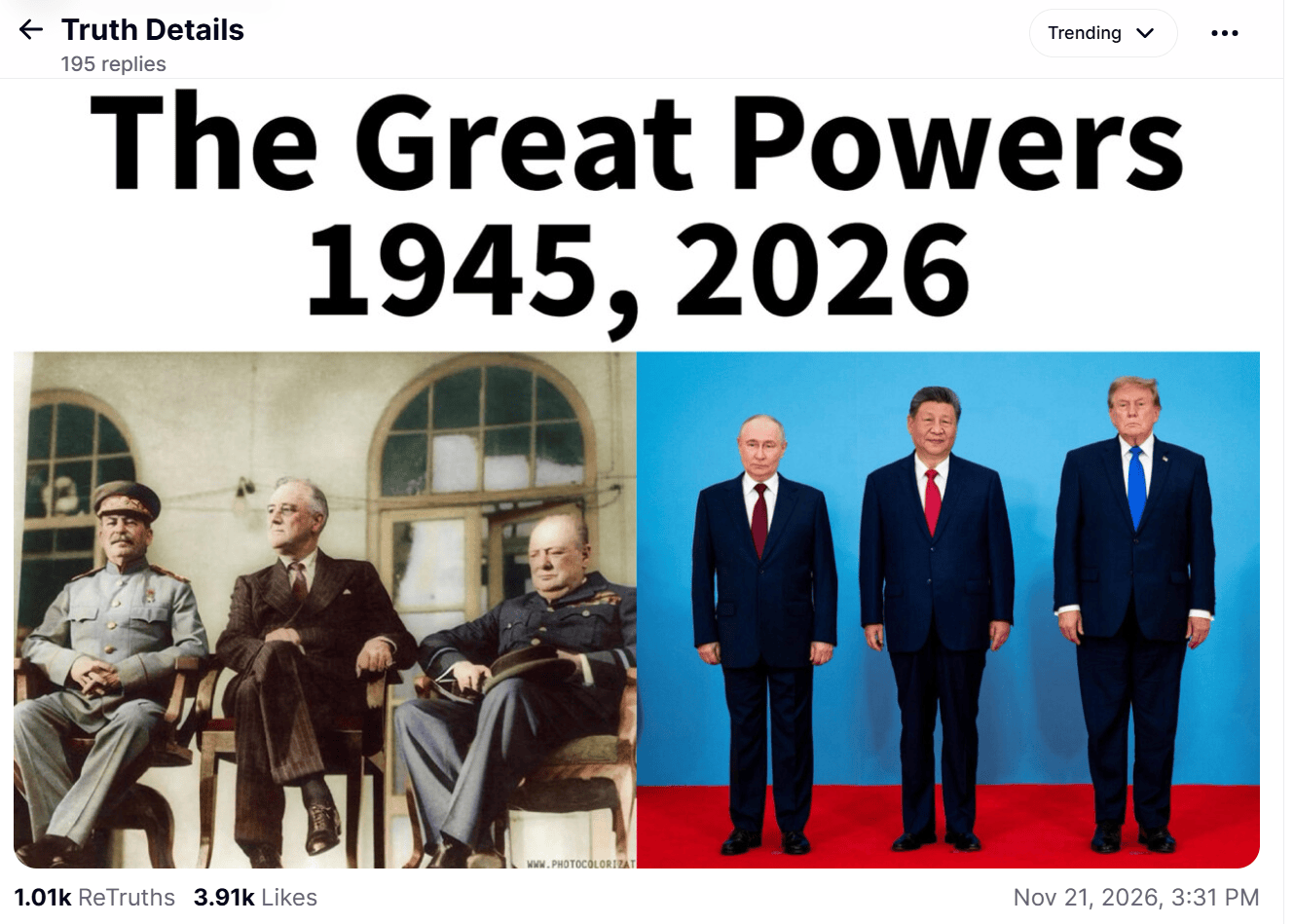
President Donald Trump recently shared an image depicting himself, Chinese President Xi Jinping, and Russian President Vladimir Putin alongside the leaders of the 1945 Yalta Conference. The photo was posted on Trump’s Truth Social account, comparing the recent meeting in China to the historic Yalta gathering.
The image juxtaposed the iconic World War II-era photograph of U.S. President Franklin D. Roosevelt, British Prime Minister Winston Churchill, and Soviet leader Joseph Stalin with a photo of Trump, Xi, and Putin. Trump described the meeting in Shenzhen as “bigger than Yalta.” Newsweek sought comments from the White House on the post.
This imagery resonates deeply in Ukraine and across Eastern Europe, where the Yalta Conference is viewed as a point where Western powers conceded influence to the Soviet Union. At Yalta, Roosevelt, Churchill, and Stalin determined Europe’s postwar boundaries, discussed the creation of the United Nations, and addressed Soviet participation in the war against Japan. The recent Shenzhen summit, while not producing sweeping agreements, revives concerns.
A New Yalta?
Apprehension about a “Yalta 2.0” emerged among Ukraine and some European allies before the leaders met at Shenzhen’s Kylin Villa. The meeting occurred on November 19, marking the first formal summit among the leaders of the U.S., China, and Russia. Although the session resulted in a joint “peace declaration,” it did not achieve the sweeping agreements seen at Yalta.
The declaration reinforced that a nuclear war must not occur, with the nations pledging dialogue to mitigate nuclear risks. Yet, no timetable or formal negotiations for a trilateral arms-reduction treaty were set. The leaders also aimed for U.N. reforms, improved oil supply, and upheld state officials’ immunity in international courts. However, solutions for Russia’s war in Ukraine or the U.S.-Iran conflict were absent.
Trump praised the summit, describing it as a great success in a conversation with NBC News. He rated the meeting highly, calling it a “12” on a zero-to-10 scale. He later joined talks in Berlin involving U.S. envoys Jared Kushner and Steve Witkoff, Ukrainian President Volodymyr Zelensky, and over 40 European leaders.
German Chancellor Friedrich Merz emphasized caution. “A Yalta format will not bring peace,” he warned, highlighting Europe’s historical division at Yalta.
Summit Conversations
As the summit began, Trump declared the event’s historical significance, asserting the responsibility of the three countries to address nuclear weapons and global security. Xi highlighted cooperation among the powers as crucial for international stability.
Putin clarified historical parallels. He stated, “There was no division of the world into ‘spheres of influence’ at Yalta.” Instead, he argued that Yalta acknowledged post-World War II realities. Putin’s reference to “realities on the ground” is relevant to Ukraine. Russian forces currently occupy a significant portion of Ukraine, using the phrase to demand peace terms considered unacceptable by Ukraine.
Meanwhile, Ukrainian Foreign Minister Andrii Sybiha dismissed the historical comparison after the summit. “Shenzhen is not the Yalta of Putin’s dreams,” he asserted.
Future Steps
With no breakthroughs achieved on the Ukraine conflict or other disputes involving the U.S., China, and Russia, the Shenzhen declaration leaves many diplomatic questions unresolved. Although Xi advocated for regular exchanges and crisis prevention measures, a schedule for follow-up talks has not been established.
For further details, please contact Newsweek editors Steve Mollman and Anthony Murray.
Leave a Reply