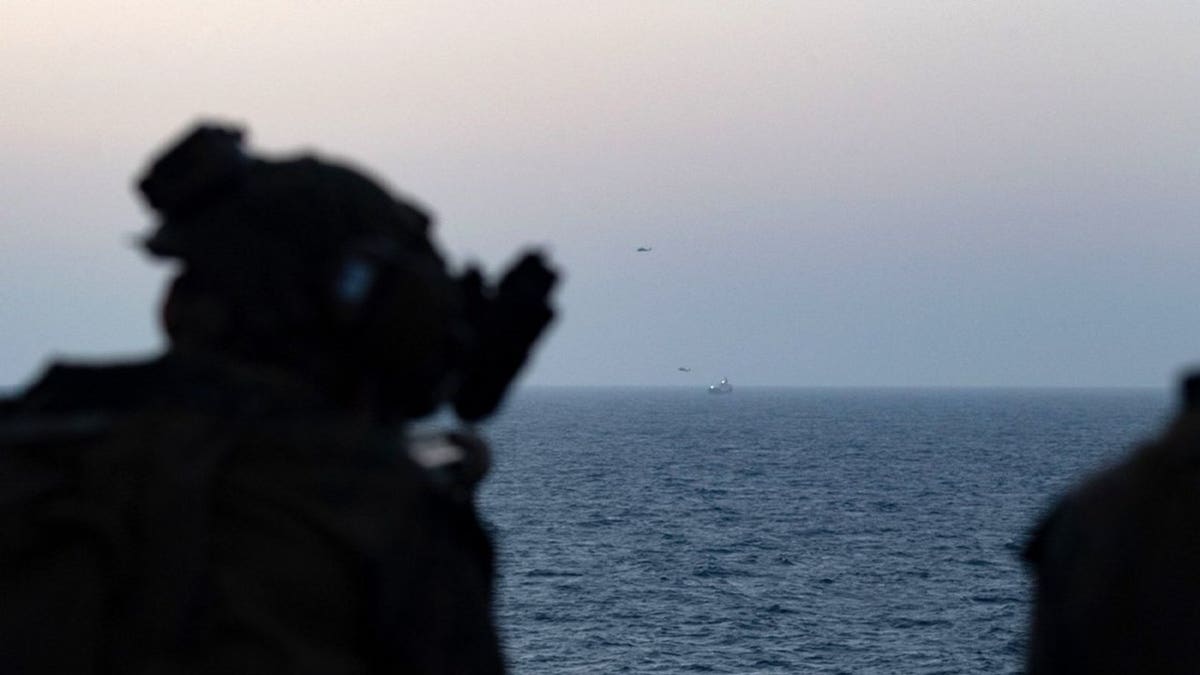
President Donald Trump emphasized the U.S. Navy’s blockade efforts against Iran in the Strait of Hormuz, declaring the area as under U.S. control. This military strategic action has severely impacted Iran’s economy, weakened its naval and air forces, and targeted terrorist leadership. The United States retains its military advantage, maintaining progress over competitors such as Russia, particularly in submarine advancements.
Reports have surfaced of Iran intending to send tankers through this blockade, sparking concerns of potential conflict. A maritime security expert warned of the risks, while Trump challenged Tehran, stating any breach attempt would result in failure. “I hope they do,” Trump said regarding Iran’s potential actions. “They’ll all be at the bottom of the sea like the rest of the navy.”
The potential breach involves tankers departing from Kharg Island, Iran’s critical oil export hub, aiming to pass through the Gulf of Oman. Charlie Brown, a senior adviser at United Against Nuclear Iran, dismissed the operation plans as unlikely and labeled them as propaganda. He emphasized the blockade’s enforcement across the Indian Ocean.
“The blockade is enforced not merely as a line that is crossed,” Brown stated, “The U.S. Navy’s capability extends over vast areas.”
Maritime tensions are rising as the UK Maritime Trade Operations reported an incident involving a tanker and military forces in the Gulf of Oman. The Institute for the Study of War suggested Iran could attempt a breach due to severe economic pressures. A recent report claimed Iran had prepared 14 tankers at Kharg Island.
Experts indicate that breaching the blockade carries significant risks, potentially leading to tanker destruction or a larger conflict. Despite this, Brown speculated that the reported Iranian convoy is propaganda, with no substantial evidence of tanker loading at Kharg Island.
Logistical hurdles, such as convoy coordination and communication, increase difficulties for Iran. Civilian crews could face serious danger if refusing to comply with military orders. According to U.S. Central Command, ships involved in ship-to-ship transfers with Iranian cargo risk interception, extending the blockade’s enforcement.
Procedures include the Navy contacting tankers via radio, with escalated responses if directives are ignored. The U.S. Navy’s ability to transfer responsibilities between commands complicates any evasion attempts into the Indian Ocean.
Brown emphasized the U.S. Navy’s preparedness across regions. In open waters, interception and maneuvering capabilities increase, adding enforcement strength beyond the Strait of Hormuz.
Emma Bussey, a breaking news writer for Fox News Digital, provided this coverage.
Leave a Reply