US stock futures experienced a rebound on Monday, allowing investors to regain some of the losses incurred in the previous week. This occurred even as Asian markets faced continued pressure and concerns over the AI industry’s future intensified. At 12:09 a.m. ET, Nasdaq futures rose by 3%, while S&P 500 and Dow futures each climbed by 2%.
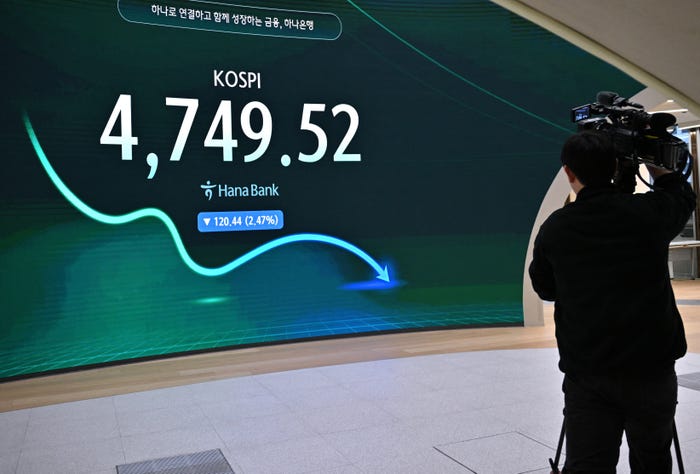
In contrast, South Korea’s Kospi index initially plummeted by 6% before easing its losses. Major companies like Samsung Electronics and SK Hynix faced declines of up to 6%. Taiwan’s Taiex index also saw fluctuating trading, with a drop of 2% before ultimately moving into positive territory. Meanwhile, Hong Kong’s Hang Seng Index fell by as much as 2% before recovering some ground. Notably, Japan’s markets remained closed due to a holiday.
The fluctuations followed a challenging week for US technology stocks. The Nasdaq index lost approximately 10%, marking its worst performance since March 2020. Investors are questioning if the substantial investments in AI can yield the necessary profits. The semiconductor sector has been particularly impacted, with indices like the Philadelphia Semiconductor Index and Taiwan’s Taiex losing 17% last week.
In response, Asian authorities are taking action. Taiwan has tightened short-selling rules and utilized its market-stabilization fund. South Korea is preparing a similar fund and has relaxed restrictions on share buybacks.
“Without the ‘Bank of Jensen’ there is a non-negligible risk that cashflow crunch can hit valuations hard and fast,” wrote Vishnu Varathan, referencing potential financial troubles for AI firms following Nvidia CEO Jensen Huang’s departure.
The departure of Nvidia’s CEO, Jensen Huang, has cast uncertainty over the company’s future support for other AI businesses. Varathan, Asia Pacific head of macro strategy at Mizuho, warned that if Nvidia’s funding dries up, AI infrastructure companies could face cash shortages and increased borrowing costs, negatively impacting their stock values. He also mentioned that the possible economic slowdown might not lead the Federal Reserve to adjust its interest rate policies.
Despite the ongoing issues, the factors causing the drop in stocks might also lead to a recovery. According to Chris Weston, head of research at Pepperstone, investors have been paying a premium to protect against further market downturns. A reduction in these protective investments could result in a rapid market rebound, though fundamental concerns over AI spending and profitability persist.
“It wouldn’t surprise me to see an aggressive snapback in US equities,” Weston noted, cautioning that such a rally shouldn’t be mistaken for a resolution of underlying concerns.
Huileng Tan, a senior reporter based in Singapore, covers markets, the global economy, commodities, and investing for Business Insider. Her reporting analyzes shifts in money, demographics, technology, and policy that reshape businesses and daily life globally.
Leave a Reply